
Design a Cohesive Marketing Strategy Without Wasting Your Budget
How to Design a Marketing Strategy Without Wasting Your Budget
Start designing a marketing strategy by setting a measurable business goal and learning what your buyers need. Decide why they should choose your brand, then focus on the channels they use. Set a budget, choose a few measures of success, and write down your decisions before planning campaigns. Review the results and adjust what is not working.
In 2026, buyers may find you through search, social media, reviews, or AI tools. A clear strategy helps your message stay consistent across those touchpoints without spreading your budget too thin.
I’m Megan McGuinness, owner and chief marketing officer of McGuinness Media & Marketing. My approach to designing a marketing strategy comes from more than 20 years of work with regional, national, and global brands across retail, finance, hospitality, and other fields.
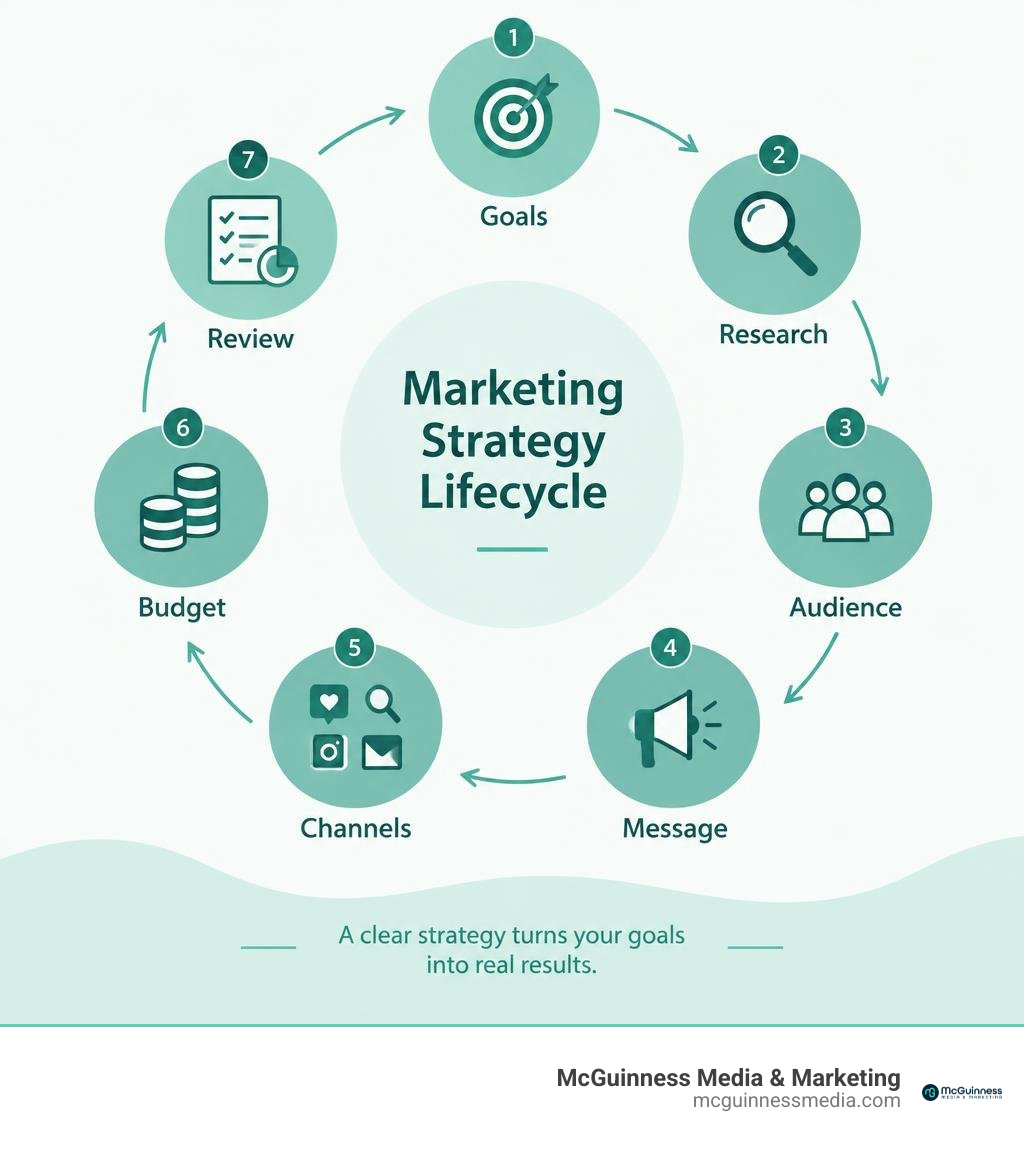
Simple designing a marketing strategy glossary:
- creating a strategic marketing plan
- corporate and marketing strategy
- digital marketing company strategy
Marketing Strategy vs. Marketing Plan: Understanding the Distinction
A major reason businesses burn capital without seeing measurable returns is confusing a strategy with a tactical plan. When teams launch isolated ad campaigns or publish weekly blogs without strategic direction, marketing becomes purely reactive.
Research shows that 74% of small and medium-sized businesses lack confidence in their marketing strategies, while companies operating without a documented strategy waste an average of $847,000 every year on disconnected tactics. Conversely, marketers who document their strategy are 313% to 414% more likely to report success, and the most organized teams are 674% more likely to achieve their goals.
Before allocating media dollars, we always begin by analyzing your current marketing situation to establish clear boundaries between high-level positioning and day-to-day execution.
| Attribute | Marketing Strategy | Marketing Plan |
|---|---|---|
| Core Focus | The “What” and “Why” (Vision, positioning, value) | The “How” and “When” (Tactics, schedules, execution) |
| Lifespan | Long-term (Multi-year, evolves with market shifts) | Short-term (Quarterly or annual campaign cycles) |
| Primary Scope | Target audience, competitive advantage, brand positioning | Content calendars, ad spends, asset creation, channel logistics |
| Key Output | Value propositions, buyer personas, growth vectors | Detailed action roadmaps, deliverables, assigned tasks |
Strategic Foundation: Defining the What and Why
Your marketing strategy serves as an enduring north star. It defines your core value proposition, sustainable competitive advantage, target market segments, and commercial goals. A solid strategic framework remains steady over time because your fundamental reason for existing in the marketplace does not shift every quarter. It establishes why consumers should care about your offerings and sets the benchmark against which every future project is evaluated.
Tactical Marketing Plans: Mapping the How and When
A marketing plan is the logistical engine that brings your strategy to life over a set timeframe. It outlines specific promotional initiatives, campaign dates, creative deliverables, channel distributions, and operational budgets. If your strategy determines that you will win the market through premium service and educational authority, your tactical plan outlines the specific steps for creating a strategic marketing plan from scratch, including exact webinar dates, white paper production schedules, and paid search budgets.
Step-by-Step Framework for Designing a Marketing Strategy
Building an effective strategic framework does not require endless binders of theory. Instead, it demands structured thinking across five core stages.
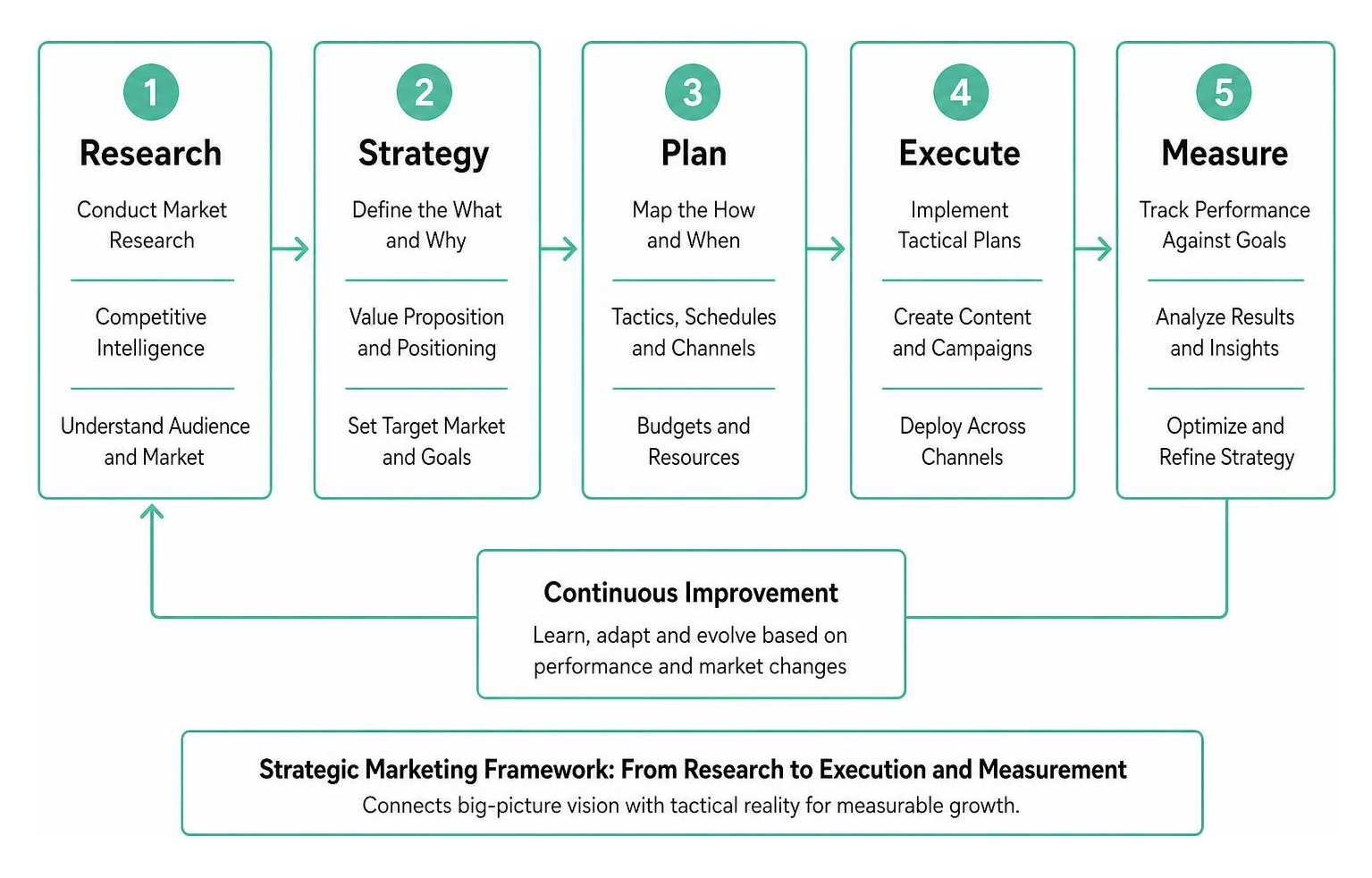
Understanding the overarching strategic marketing planning process gives your internal team the clarity needed to connect big-picture vision with tactical reality.
Step 1: Conduct Market Research and Competitive Intelligence
Every resilient strategy begins with primary and secondary research. Rather than relying on assumptions, gather direct qualitative feedback through customer interviews and community listening across discussion forums and review platforms. Supplement this with quantitative surveys to measure demand patterns and market readiness.
Next, conduct a rigorous competitive audit. Evaluate your competitors’ positioning, pricing structures, organic keyword footprints, and customer sentiment gaps. Aligning your internal capabilities with external market shifts follows established AMA strategic marketing research standards, enabling you to pinpoint genuine market voids rather than competing head-on in saturated categories.
Step 2: Segment the Market and Develop Buyer Personas
Attempting to appeal to every potential buyer dilutes your messaging and drains your media spend. We utilize the classic STP framework (Segmentation, Targeting, and Positioning) to identify the most lucrative buyer profiles:
- Demographic & Firmographic Attributes: Industry vertical, company scale, geographic location, job title, and decision-making power.
- Psychographic Drivers: Core values, operational ambitions, risk tolerance, and professional motivations.
- Behavioral Buying Triggers: The specific pain points, friction events, or operational bottlenecks that force a buyer to seek a solution immediately.
Build out three to four primary buyer personas detailing these traits. Understanding what keeps your target customers awake at night ensures that every dollar spent directly addresses their priorities.
Step 3: Establish Unique Value Propositions and Core Messaging
Your Unique Value Proposition (UVP) must clearly articulate how your offering solves customer pain points better than any alternative. Using the 3 Cs model (Company, Customers, Competitors), craft messaging that is authentic to your strengths, relevant to buyer needs, and distinctly differentiated from competitor claims.
Avoid vague buzzwords like “innovative,” “seamless,” or “best-in-class” unless you back them up with verifiable proof points. Developing a cohesive brand communications strategy ensures that your core value proposition, tone of voice, and brand codes remain unified across every medium.
Step 4: Formulate the Marketing Mix (4 Ps and 7 Ps)
The marketing mix translates your positioning into concrete commercial parameters across the traditional 4 Ps, expanded to 7 Ps for service environments:
- Product: The specific design, features, quality, and problem-solving utility of your good or service.
- Price: Your monetization model (premium, value-based, subscription, tiered) reflecting your positioning.
- Place: The physical and digital distribution channels where buyers discover and purchase your offering.
- Promotion: The integrated communications, advertising, and storytelling vehicles used to generate demand.
- People: The team members, customer service staff, and cultural ambassadors who represent your brand.
- Process: The frictionless workflows, customer onboarding experiences, and service delivery systems you provide.
- Physical Evidence: The tangible proofs of quality, such as modern office facilities, case studies, verified reviews, and cohesive digital branding assets.
Step 5: Establish SMART Marketing Objectives and Core KPIs
High-level visions must be grounded in quantifiable business results. Frame your marketing objectives using the SMART framework: Specific, Measurable, Achievable, Relevant, and Time-bound.
Instead of setting a vague goal like “grow brand awareness,” establish concrete metrics: “Increase qualified inbound leads by 25% over the next two quarters while maintaining a Customer Acquisition Cost (CAC) under $450.” Tie these objectives directly to marketing qualified leads (MQLs), pipeline velocity, conversion rates, and Customer Lifetime Value (CLV).
Strategic Growth Models and Market Opportunity Alignment
Selecting which commercial path to pursue requires balancing upside potential against resource investment and operational risk.
When crafting your winning marketing strategy, using established models helps leadership allocate capital to the initiatives with the highest probability of sustainable ROI.
Applying the Ansoff Matrix When Designing a Marketing Strategy
Ansoff’s Matrix provides four clear vectors for business expansion:
- Market Penetration (Existing Products, Existing Markets): The lowest-risk growth vector, focused on capturing greater market share through competitive pricing, loyalty programs, and aggressive promotional campaigns.
- Product Development (New Products, Existing Markets): Introducing novel offerings or enhanced features to an already loyal customer base that trusts your brand.
- Market Development (Existing Products, New Markets): Expanding proven products into new geographic regions, international territories, or adjacent demographic verticals.
- Diversification (New Products, New Markets): The highest-risk, highest-reward vector, involving the launch of entirely new offerings into unfamiliar territories.
De-risking Strategic Growth Pathways
To prevent catastrophic budget waste when entering new quadrants of the Ansoff Matrix, always pilot initiatives on a smaller scale first. Run regional beta campaigns, test messaging with small customer focus groups, and analyze early conversion indicators before committing major media spend. Phased rollouts protect working capital while validating product-market fit in real time.
Marketing Budget Allocation and Omnichannel Distribution
A brilliant strategy is ineffective without appropriate funding and balanced channel distribution. Spreading a modest budget across ten different advertising networks guarantees dilution. Instead, master two or three core channels that directly align with your audience’s media habits.

State and regional educational resources, such as the URI small business marketing and PR guidance, emphasize that building disciplined distribution systems is essential for local and regional commercial growth.
Media Mix and Resource Allocation When Designing a Marketing Strategy
To balance rapid short-term customer acquisition with durable long-term brand equity, we recommend the proven 40:60 resource allocation model:
- 40% Direct Sales Activation: Focused on capturing active, in-market demand through search engine marketing, direct retargeting ads, localized promotional campaigns, and direct-response email funnels.
- 60% Long-Term Brand Building: Dedicated to cultivating mental availability, reputation, and authority through PR, thought leadership, organic video storytelling, and building a strategic digital content plan.
Group your promotional channels across three integrated environments:
- Paid Media: Search ads, paid social campaigns, sponsored newsletters, and targeted out-of-home displays that provide instant visibility.
- Owned Media: Your website, proprietary email lists, podcast series, case study repositories, and white papers that you control entirely.
- Earned Media: Organic social shares, user-generated content, press coverage, third-party reviews, and industry citations that build undeniable credibility.
Modern Omnichannel Integration and AI Search Optimization
Consumer touchpoints are no longer strictly linear. In 2026, buyers consult social video platforms, peer communities, local directories, and generative AI search engines like ChatGPT, Gemini, and Perplexity before ever visiting a brand website. Research reveals that 55% of consumers use AI tools to research products weekly, and 43% have discovered new brands directly inside AI search environments.
Creating a future-proof digital marketing strategy integration requires optimizing for Answer Engine Optimization (AEO) alongside traditional SEO. This means earning third-party digital mentions, maintaining structured website schema, and publishing clear, answer-focused content that AI discovery engines index as authoritative source material.
Performance Tracking, Governance, and Iterative Optimization
A marketing strategy is not a static document to be filed away on a shelf. It is an evolving operational framework that requires ongoing governance and rigorous analytical oversight.

Implementing clear marketing plan control and analysis mechanisms ensures that your marketing investments remain profitable and aligned with quarterly business benchmarks.
Financial Attribution and Pipeline Metrics
Avoid vanity metrics like impressions or surface-level page views. Evaluate your marketing health through financial and operational pipeline indicators:
- Customer Acquisition Cost (CAC): Total sales and marketing spend divided by total new customers acquired over a specific period.
- Customer Lifetime Value to CAC Ratio (CLV:CAC): The long-term revenue generated by a customer compared to the cost of acquiring them (a healthy benchmark is 3:1 or higher).
- Marketing-Sourced Pipeline Velocity: The speed at which marketing-generated leads move from initial qualification to closed-won revenue.
- Channel-Specific ROAS & ROI: The net commercial return generated from distinct paid advertising investments.
Iterative Strategy Reviews and Agile Adaptation
Establish a formal governance rhythm:
- Monthly Performance Audits: Review campaign-level cost-per-click, conversion rates, and email engagement to make tactical, day-to-day optimizations.
- Quarterly Strategic Reviews: Evaluate broader channel ROI, pipeline generation, and competitive positioning adjustments with key executive stakeholders.
- Annual Strategy Overhauls: Re-examine overarching buyer personas, pricing structures, and macroeconomic shifts to set the strategic direction for the upcoming year.
When tactical results lag behind forecasts, isolate the underlying cause before abandoning your overarching strategy. Test alternative ad copy, refine landing page layouts, or adjust audience parameters to solve the issue.
Frequently Asked Questions About Marketing Strategy Design
What is the most common reason marketing strategies fail?
Marketing strategies most often fail due to a tactical disconnect: jumping straight into ad campaigns, social media posts, or graphic design without first defining the overarching value proposition, customer personas, or commercial goals. Failing to document the strategy in writing also leads to misaligned teams, wasted budgets, and uncoordinated marketing efforts.
How often should a company update its marketing strategy?
A company should conduct a comprehensive review of its core marketing strategy once a year using fresh market research, customer data, and competitive audits. However, tactical marketing plans and media spend allocations should be evaluated monthly and adjusted quarterly to respond to emerging market shifts and platform performance.
What percentage of revenue should be allocated to a marketing budget?
According to standard CMO Survey benchmarks, companies allocate an average of 8% to 10% of their total annual revenue to marketing budgets. Established businesses seeking steady retention often allocate 6% to 8%, while high-growth businesses entering competitive markets frequently invest 12% to 15% (or more) of projected gross revenue to capture market share.
Conclusion
Designing an effective marketing strategy provides the operational clarity needed to eliminate wasted ad spend, align internal teams, and drive sustainable long-term revenue. By establishing clear target personas, articulating an authentic value proposition, balancing brand building with performance activation, and maintaining rigorous performance governance, your organization transforms marketing from a speculative cost center into a predictable growth engine.
For Rhode Island organizations seeking to elevate their market presence, partner with our team at McGuinness Media & Marketing for expert branding and strategic marketing planning services that deliver lasting commercial impact.