How to Create a Solid Digital Marketing Strategy for Your Business
Build a Digital Marketing Company Strategy That Drives Growth
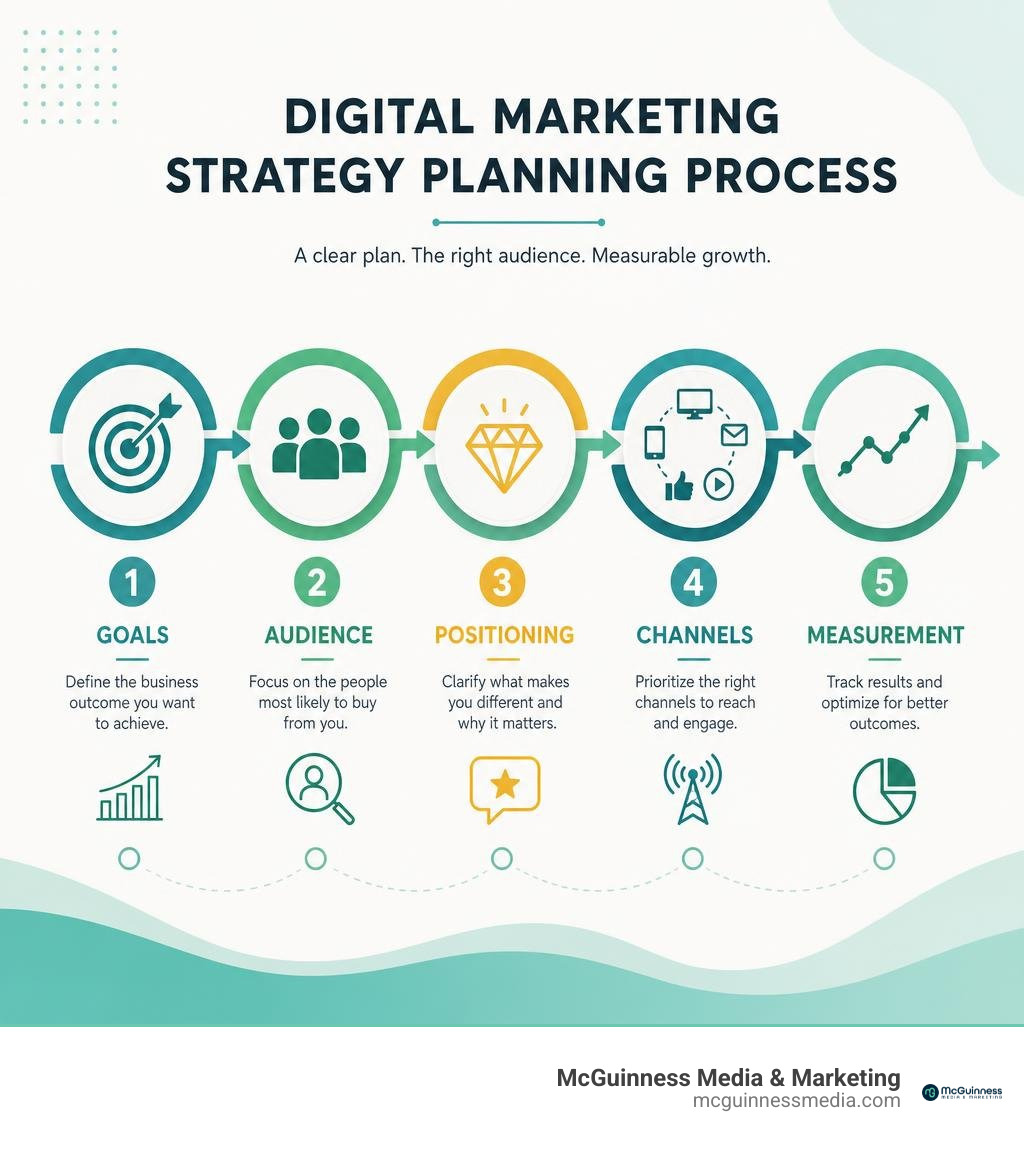
A digital marketing company strategy is a clear plan for reaching the right audience, explaining why your brand matters, and turning attention into measurable business growth. It connects your goals, positioning, budget, channels, content, and metrics so every marketing decision has a purpose.
A quick way to build one:
- Set the business goal – Define the outcome you need, such as qualified leads, online sales, stronger brand awareness, or customer retention.
- Choose the audience – Focus on the customers most likely to buy, not everyone who could possibly see your message.
- Clarify your position – State the problem you solve, what makes you different, and why customers should believe you.
- Prioritize the right channels – Use search, email, social media, content, paid media, and offline touchpoints based on where your audience makes decisions.
- Measure results – Track revenue, leads, conversion rates, customer acquisition cost, and other outcomes tied to the goal.
This matters because many businesses still market without a documented direction. Research suggests that only 17% of companies clearly define their digital marketing strategies, while nearly half have no planned strategy at all. A focused plan helps prevent a common failure: spreading time and budget across every new platform without building momentum anywhere.
Digital marketing is changing quickly, especially as AI search summaries reduce clicks to traditional search results. But the core need has not changed: create a distinct brand, earn trust, show up where buyers are looking, and give them a clear next step.
I’m Megan McGuinness, owner and CMO of McGuinness Media & Marketing, with more than 20 years of experience building marketing strategies for regional, national, and global brands across retail, finance, hospitality, banking, and more. My approach to a digital marketing company strategy connects strong positioning, creative work, media placement, and measurable performance.
Understanding Digital Marketing Company Strategy vs. Tactics
To create a strategy that delivers real business growth, you must understand how strategy differs from campaigns and everyday tactics. Far too often, teams mistake a list of marketing activities for a strategic plan. They launch a TikTok account, run a batch of Google Ads, or send out a monthly newsletter without asking how these pieces fit together to solve a high-level business problem.
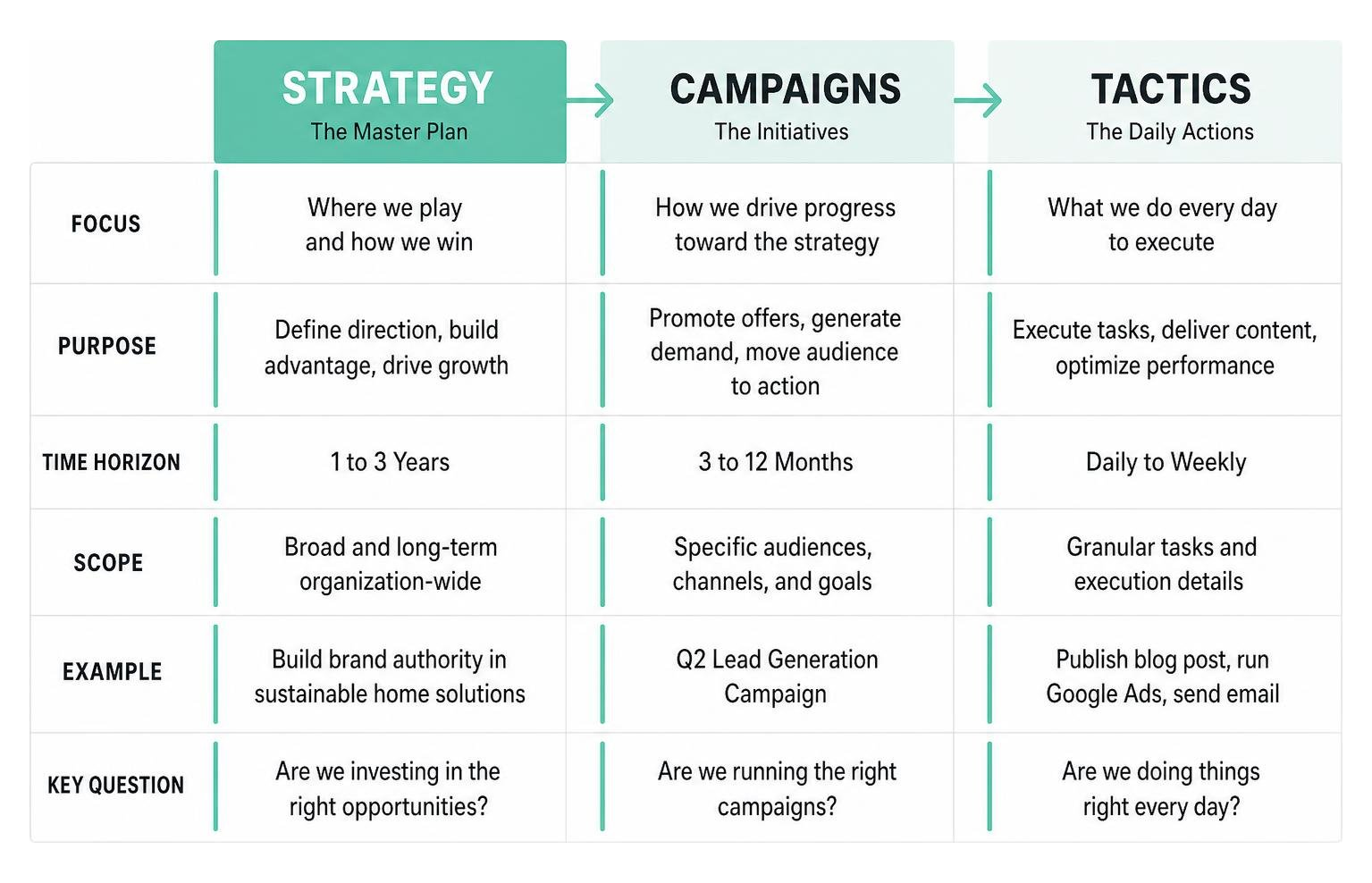
A digital marketing company strategy represents your overarching vision. It sets the direction for how your organization uses digital tools, creative content, and online media to achieve fundamental growth goals over a 12-to-36-month horizon. While tactics shift rapidly based on algorithm updates or seasonal trends, your foundational strategy remains steady.
| Strategic Level | Scope | Primary Objective | Time Horizon | Example Focus |
|---|---|---|---|---|
| Strategy | High-level master plan | Market positioning, audience alignment, growth | 1 to 3 Years | Establishing market dominance in regional B2B logistics |
| Campaigns | Medium-term initiative | Specific milestone or seasonal objective | 1 to 3 Months | Q3 product launch targeting mid-market operations managers |
| Tactics | Granular task execution | Direct engagement, daily optimization | Weekly / Daily | Writing meta descriptions, publishing weekly reels, A/B testing ad copy |
Defining a Core Digital Marketing Company Strategy
At its core, your digital strategy is defined by strategic positioning and target market understanding. Before writing copy or designing display ads, you need a precise definition of your buyer personas, brand value proposition, and unique competitive advantage.
When we partner with clients through our Services/Branding And Strategy offerings, we start with the “3 C’s” framework:
- Consumer Analysis: What specific pain points, motivators, and buying habits define your target audience?
- Competitor Analysis: What claims are competitors making, where are their messaging gaps, and how can you stand out?
- Company Analysis: What unique strengths, internal capabilities, and values give your business a legitimate right to win?
Your value proposition should synthesize these elements into a single compelling statement. For example: “For mid-sized manufacturers, Brand X is the only logistics partner providing real-time local fleet tracking within two hours because our direct regional network eliminates intermediary delay.”
When your strategic positioning is crystal clear, every marketing asset you create—from landing pages to social video clips—reinforces the exact same message across the buyer journey.
Distinguishing Strategy from Campaigns and Tactics
If strategy is your destination and road map, campaigns are the individual legs of the journey, and tactics are the fuel and driving mechanics.
- Strategy: Capturing 25% market share among commercial property managers by establishing our brand as the top authority on energy-efficient building upgrades.
- Campaign: A 90-day integrated initiative offering a downloadable white paper on cost-saving building retrofits paired with an invitation to an exclusive executive webinar.
- Tactics: Running targeted LinkedIn sponsored posts, setting up an automated email sequence for downloaders, building a landing page with a custom contact form, and optimizing blog posts for long-tail search keywords.
Confusing tactics for strategy leads to high costs and inconsistent results. Jumping straight to tactical execution without defining your strategic core creates fragmented messaging, uncoordinated spending, and difficulty measuring ROI.
Core Frameworks to Structure Your Strategic Plan
Building a comprehensive digital marketing company strategy does not require a 100-page document that gathers digital dust. In fact, executive teams execute better when a strategy is structured clearly around proven framework models.

Developing a Digital Marketing Company Strategy Framework
Two frameworks stand out for structuring modern marketing plans: the RACE model (Reach, Act, Convert, Engage) and the SES framework (Search, Email, Social). You can review additional detailed breakdowns in ClickMinded’s digital marketing strategy guide to see how frameworks apply across different models.
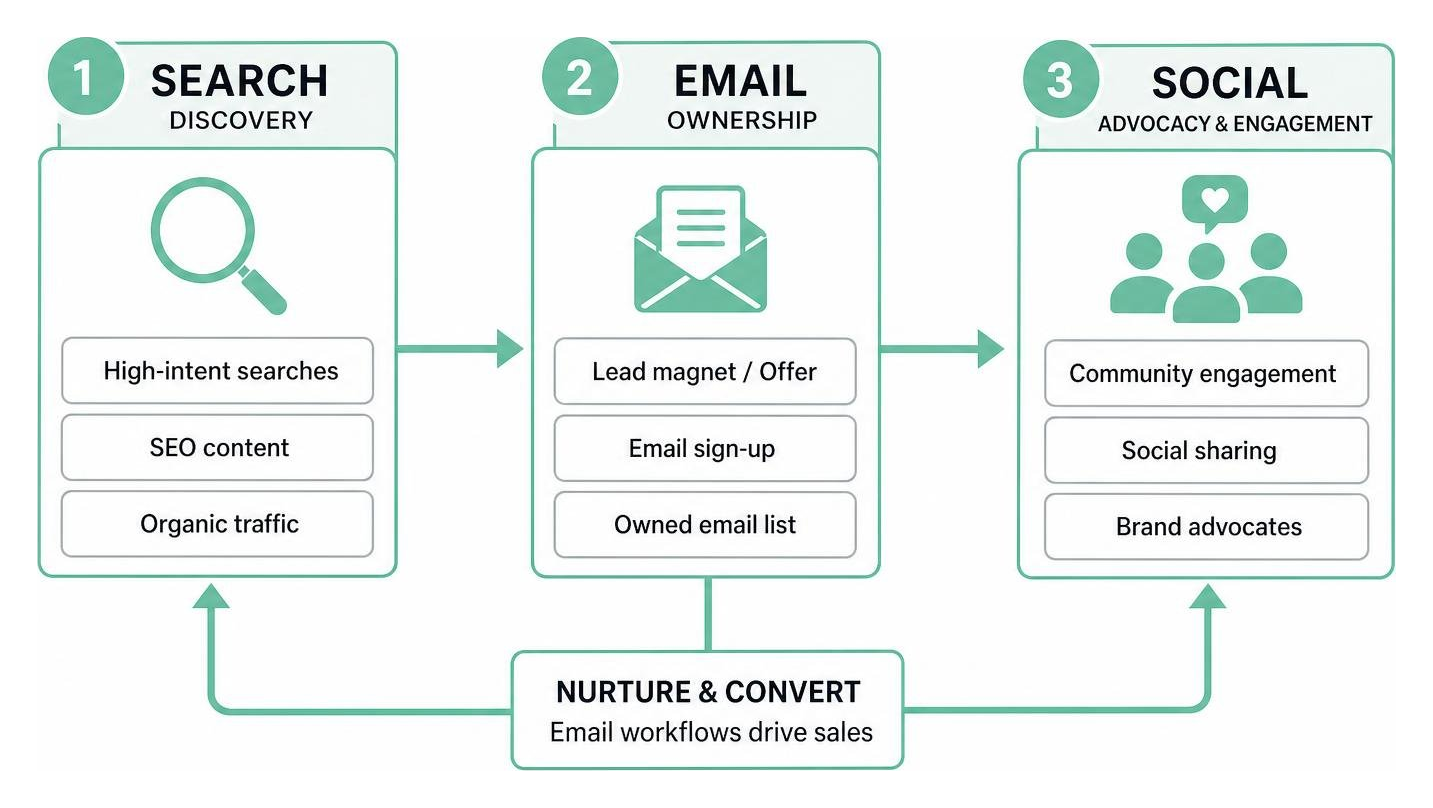
The SES Framework focuses on three core pillars that structure how strangers become loyal advocates, as outlined in Neal Schaffer’s guide on The Simple SES Framework:
- Search (Discovery): High-intent search engine traffic brings buyers who are actively seeking solutions. This represents top-of-funnel discovery.
- Email (Ownership): Social networks and search engines are rented channels governed by third-party algorithms. Your email subscriber list is an owned asset where direct relationship building and sales conversions happen.
- Social (Advocacy & Engagement): Social media platforms build human connections, showcase brand personality, foster community interaction, and turn satisfied customers into vocal brand advocates.
By focusing on one clear “play” across Search, Email, and Social, small and mid-sized businesses avoid getting overwhelmed. Each channel directly feeds the next: Search and Social drive traffic to high-converting lead magnets, building your Email list, while automated Email workflows generate sales and encourage Social sharing.
To execute this integrated workflow, explore our dedicated Services/Digital Marketing solutions to streamline cross-channel performance.
Establishing SMART Goals and Key Performance Indicators
A strategy without measurable targets is just a wish list. Every level of your marketing plan must align with specific business targets using the SMART framework (Specific, Measurable, Attainable, Relevant, Timely).
When establishing key performance indicators (KPIs), categorize them across four distinct areas:
- Business Outcomes: Net new revenue, Customer Acquisition Cost (CAC), monthly recurring revenue (MRR) growth, CAC payback period, and Customer Lifetime Value (LTV).
- Conversion & Lead Performance: Marketing Qualified Leads (MQLs), Sales Qualified Leads (SQLs), landing page conversion rate, and cost-per-lead (CPL).
- Brand Visibility: Organic search impressions, brand search volume, non-brand keyword rankings, and share of voice.
- Implementation & Health: Content output velocity, campaign launch schedules, and platform engagement rate.
Tracking revenue-connected metrics like CAC payback and LTV prevents teams from focusing on vanity metrics like surface-level impressions or raw follower counts.
Key Channels and Levers for Digital Growth
Executing a digital marketing company strategy requires picking the right combination of growth levers for your target market and business model.

Search Engine Optimization and AI Overviews in 2026
Organic search remains a crucial source of trackable online traffic, driving 53% of all web visits. However, search behavior has evolved significantly.
With AI search summaries appearing in roughly 18% to 35% of Google queries, zero-click searches now make up nearly 65% of all web searches. When an AI summary appears, users click traditional website links only about 8% of the time, compared to 15% when no summary is shown.
To maintain high search visibility today, your content strategy must adapt:
- Build Topical Authority: Organize your content into hub-and-spoke topic clusters. A comprehensive central pillar page links to tightly related sub-topic articles, showing search engines and AI models that your brand offers deep domain expertise.
- Optimize for AI Citations: Structure content with clear question-and-answer formatting, structured schema markup, original research, and named author bylines so generative AI engines directly cite your business as a primary source.
- Target High-Intent Keywords: Focus on bottom-of-funnel commercial keywords where searchers want to purchase, request a quote, or schedule a demo rather than basic informational queries easily answered in a summary box.
For businesses looking to capture organic traffic, partnering with an experienced Inbound Marketing Agency Ri guarantees your search strategy accounts for these modern algorithm updates. Additionally, managing direct media placements through our specialized Services/Media Planning team helps protect your brand visibility across all channels.
Owned Assets: Email Marketing and Web Infrastructure
While search engines and social algorithms change constantly, your website and email list remain fully owned assets. Email marketing continues to deliver an average return of $36 for every $1 spent—making it one of the highest-performing channels available.
A strong email infrastructure relies on three core elements:
- Compelling Lead Magnets: Replace generic “Sign up for our newsletter” forms with actionable resources, such as industry benchmark studies, interactive calculators, or exclusive video tutorials.
- Automated Lifecycle Sequences: Set up automated lead nurturing workflows that send personalized onboarding, educational content, and product offer sequences based on user behavior.
- Optimized Web Infrastructure: Your website serves as the ultimate hub for all digital campaigns. It must load quickly, offer seamless mobile navigation, feature clear calls to action, and deliver custom user experiences.
Investing in high-performance web development ensures your site turns traffic into qualified sales opportunities. Browse our full suite of web design capabilities on our Services/Web Development page.
Social Media Engagement and Video Production
With over 5.7 billion active social media users worldwide, social platforms are essential for audience discovery, brand affinity, and direct selling. In fact, nearly 7 in 10 shoppers rely on social media for product recommendations or buy directly through social channels.
To build meaningful connections, modern social media strategy requires shifting from push-style promotion to active community building and short-form video storytelling:
- Select the Right Platforms: Avoid spreading your team too thin. B2B service firms usually see higher returns on LinkedIn and YouTube, whereas B2C lifestyle brands tend to perform best on Instagram, TikTok, and Pinterest.
- Focus on Video Content: Short-form video (such as Instagram Reels, YouTube Shorts, and TikTok clips) delivers high organic reach and engagement. Authentic, behind-the-scenes video content builds immediate trust with target buyers.
- Engage in Continuous Community Management: Respond to comments, participate in relevant industry discussions, and actively nurture relationships across platform direct messages.
To elevate your brand presence on social media, see how our team produces compelling content by exploring our Services/Social Media solutions and professional video assets via Services/Video And Photography.
Resource Allocation, Budgeting, and Offline Integration
Even the best digital marketing company strategy will stall without proper resource planning, budget allocation, and operational alignment.
Integrating Digital and Traditional Touchpoints
While digital marketing offers precise data and targeting, traditional offline channels remain valuable touchpoints. Research shows that high-growth professional services firms achieve better profitability and faster growth by combining digital tactics with offline marketing.
A strong omnichannel strategy connects digital and physical brand interactions:
- Live Events and Trade Shows: Drive event foot traffic through geo-targeted mobile ads, follow up via automated email sequences, and publish short video clips from live speaking presentations across social media.
- Print and Direct Mail: Include custom QR codes on physical flyers, mailers, or print advertisements to direct prospective customers to personalized landing pages with exclusive digital offers.
- Promotions and Local Sponsorships: Amplify community events through local social media campaigns and press coverage.
Combining offline brand presence with digital retargeting ensures high touchpoint visibility across the entire buying cycle. Learn more about how we bring physical brand experiences to life on our Services/Events And Promotions page.
Budget Allocation for B2B and B2C Models
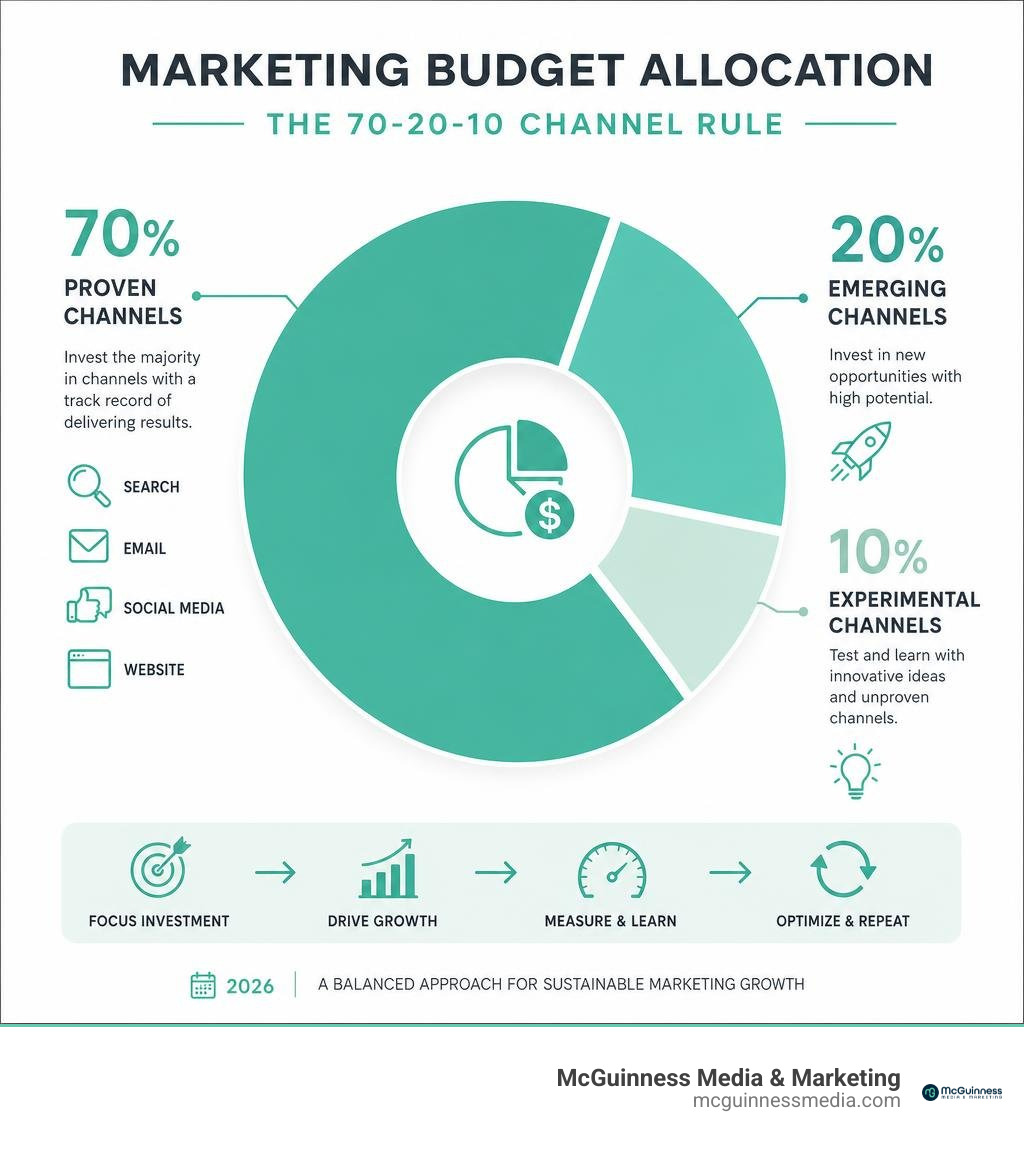
Allocating your marketing budget effectively requires balancing predictable revenue drivers with continuous testing. A proven framework is the 70-20-10 Rule:
- 70% on Proven Core Channels: Invest the majority of your budget into established channels with proven customer acquisition metrics (such as SEO, Google Search Ads, and Email Nurturing).
- 20% on Scaling Adjacent Channels: Allocate one-fifth of your budget to promising strategies that are showing strong initial performance (such as LinkedIn thought-leadership ads or short-form video campaigns).
- 10% on Experimental Bets: Reserve one-tenth for emerging platforms, creative formats, or untried marketing channels.
Budget priorities also vary based on your specific business model:
- B2B Professional Services: Focus budgets on original industry research, long-form content, account-based LinkedIn advertising, and automated lead nurturing email flows.
- B2C E-Commerce: Prioritize eye-catching social media advertising, short-form video creative, dynamic retargeting campaigns, and SMS mobile promotions.
- Local Service Businesses: Concentrate spend on local map pack SEO optimization, hyper-local pay-per-click advertising, and customer review generation strategies.
When facing budget constraints, focus your spend on doing two or three channels exceptionally well rather than diluting your resources across every platform.
Frequently Asked Questions About Digital Strategy
What is the difference between a digital marketing strategy and a marketing plan?
A digital marketing strategy outlines your overall direction, positioning, strategic decisions, and channel choices based on business goals and deep audience research. It answers why and what you are building.
In contrast, a digital marketing plan details the operational roadmap for executing that strategy. It outlines exact timelines, content calendars, team task assignments, budget line items, and campaign execution steps. Strategy sets the high-level roadmap, while the plan manages day-to-day execution.
How has AI search changed digital marketing strategies?
Generative AI search overviews directly address user questions within search results pages, reducing traditional link click-through rates. As a result, digital strategies must adapt beyond basic keyword optimization.
Modern strategies prioritize building deep topical authority, creating unique proprietary content, structuring data for AI citations, and diversifying distribution across direct owned email lists, video content, and active social media channels.
How often should a business review its digital marketing strategy?
We recommend holding comprehensive quarterly strategy reviews to assess channel performance, track progress against business KPIs, evaluate conversion funnels, and adapt to major platform algorithm updates.
While core strategic positioning stays consistent for 12 to 36 months, your tactical campaign execution and budget allocations should be reviewed and optimized continuously.
Conclusion
Creating a solid digital marketing company strategy transforms disconnected tactics into a focused, revenue-generating engine. By establishing clear SMART goals, conducting deep target audience research, deploying structured frameworks like RACE and SES, and balancing your channel mix across search, email, and social media, you give your business a strong strategic advantage.
Sustained business growth requires aligning creative storytelling, smart channel selection, dynamic web design, and media strategy toward measurable financial metrics.
At McGuinness Media & Marketing, our team partners with ambitious organizations in Rhode Island and nationwide to design data-driven integrated marketing strategies that stand out in crowded markets. Explore our full range of creative services on our main services hub, learn more about our strategic growth approach, or connect directly with a team that delivers real results by visiting our page for a premier Marketing Agency Rhode Island.
Ready to take your brand growth to the next level? Request a consultation with our strategy experts today at McGuinness Media Branding and Strategy Services.