
The Executive Playbook for Corporate Marketing Planning
Align Corporate and Marketing Strategy for Measurable Growth
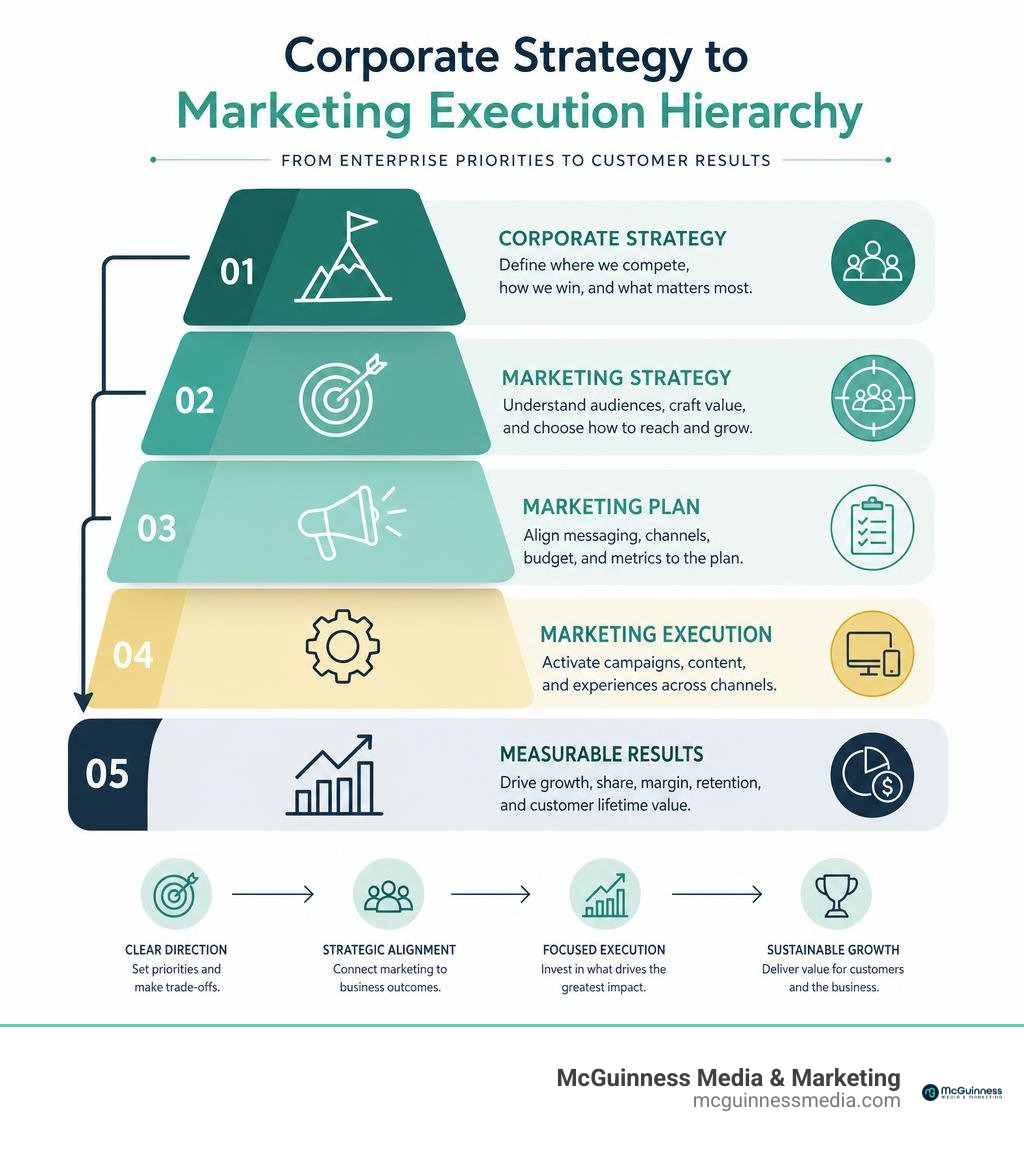
A strong corporate and marketing strategy connects leadership decisions to customer action. Start by setting the company goal, choosing where to invest, and defining the trade-offs you will make. Then build marketing around the audiences, value proposition, channels, budget, and metrics that support that goal.
In simple terms:
- Corporate strategy decides where the business will compete and how it will allocate people, capital, and attention.
- Marketing strategy decides how the business will earn customer attention, preference, and revenue in those chosen markets.
- Alignment happens when marketing KPIs, spending, and campaigns can be traced back to business outcomes such as growth, market share, margin, retention, or expansion.
This matters because a great campaign cannot fix an unclear business direction. Likewise, a sound corporate plan will fall short if customers do not understand why they should choose your brand. The best plans create a clear line from enterprise priorities to brand positioning, media choices, customer experience, and measurable results.
I am Megan McGuinness, owner and chief marketing officer of McGuinness Media & Marketing, with more than 20 years of experience building corporate and marketing strategy for regional, national, and global brands. My work spans retail, finance, hospitality, banking, wholesale, and other competitive markets where clear positioning and accountable marketing make growth possible.
Important corporate and marketing strategy terms:
- branding development strategies
- developing marketing strategies and plans ppt
- digital marketing company strategy
Corporate and Marketing Strategy: Core Differences and Synergy
Think of corporate strategy as the engine of an organization and marketing strategy as the gearbox. Without a powerful engine, the vehicle goes nowhere; without a responsive gearbox, all that internal power fails to reach the road.
Corporate strategy is governed at the executive level. It determines the overarching scope of the firm, portfolio balance, capital structure, and overarching financial benchmarks. In contrast, marketing strategy sits at the business-unit level, translating high-level ambitions into compelling market positioning, channel distribution, and customer acquisition campaigns.
When establishing sustainable growth, teams must navigate a comprehensive guide to the strategic marketing planning process to bridge high-level vision with frontline engagement.
| Strategic Dimension | Corporate Strategy | Marketing Strategy |
|---|---|---|
| Primary Scope | Entire organization across all business units | Specific target markets, segments, and offerings |
| Key Objectives | Enterprise valuation, ROIC, capital allocation, diversification | Customer acquisition, retention, brand equity, pipeline growth |
| Time Horizon | Long-term (3 to 10+ years) | Medium to short-term (1 to 3 years, reviewed quarterly) |
| Core Frameworks | Portfolio matrices, financial risk models, M&A roadmaps | The 4 Ps (Product, Price, Place, Promotion), STP, Ansoff Matrix |
| Ownership | Board of Directors, CEO, CFO, Chief Strategy Officer | CMO, VP of Marketing, Brand Directors, Product Marketing |
| Output | Capital expenditure plans, business models, annual reports | Campaign roadmaps, content calendars, media plans, messaging matrices |
The Four Pillars of Corporate Strategy
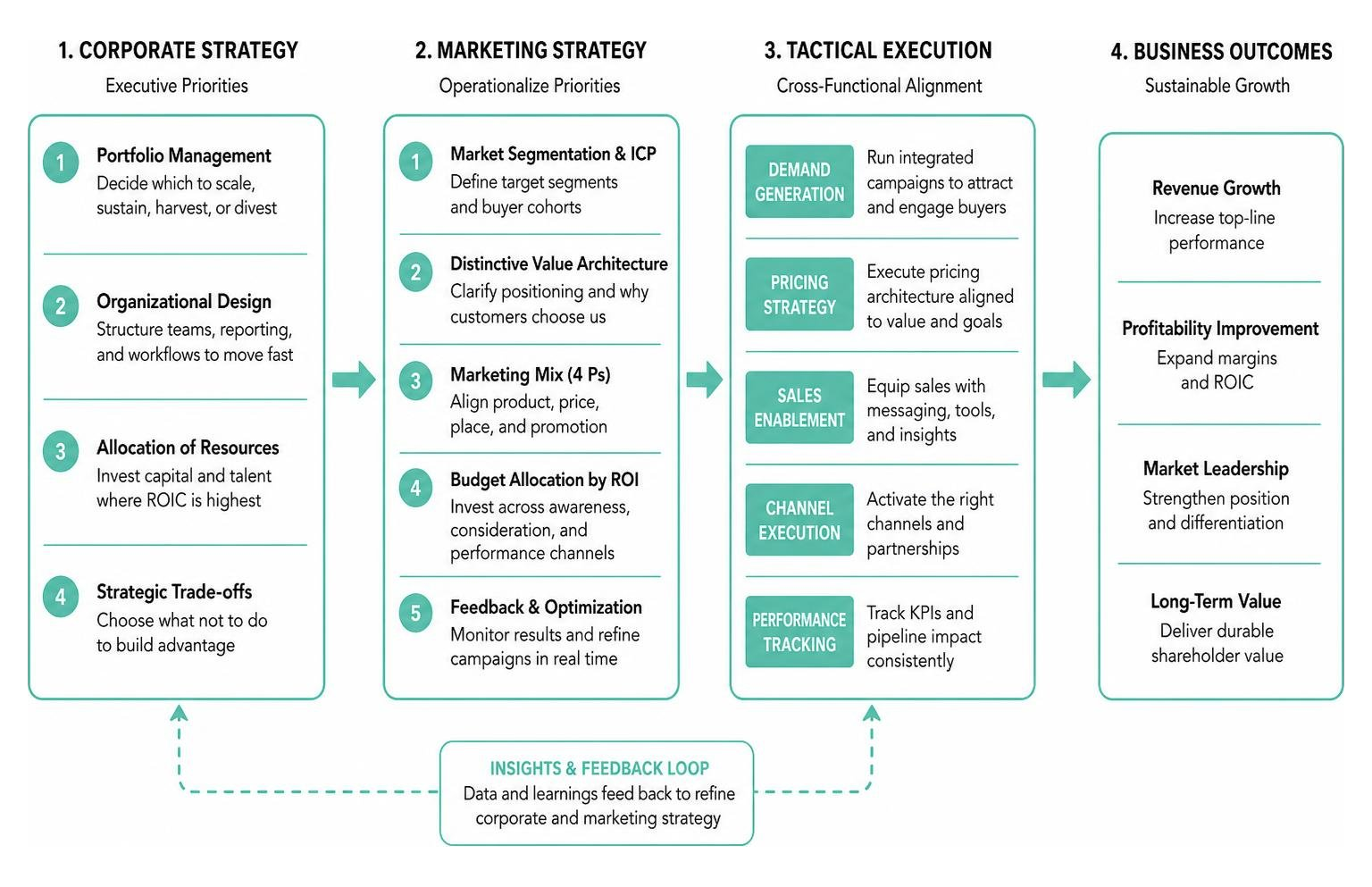
A comprehensive corporate strategy rests on four distinct pillars that define how an enterprise creates, delivers, and captures value:
- Portfolio Management: Evaluating which business units, product categories, or regional markets to scale, sustain, harvest, or divest. For example, global brands periodically simplify their SKU portfolios to eliminate margin-diluting drag and focus resources on core profit drivers.
- Organizational Design: Structuring communication, executive reporting lines, talent acquisition, and operational workflows. A sound corporate strategy ensures that internal teams are structured to move fast without getting bogged down in cross-departmental friction.
- Allocation of Resources: Deciding where human capital and financial budgets generate the highest return on invested capital (ROIC). Capital allocation dictates whether surplus cash funds research and development, geographical expansion, or marketing technology infrastructure.
- Strategic Trade-offs: Choosing what not to do. Sustainable competitive advantage requires disciplined choices—such as opting for premium brand positioning rather than entering a race-to-the-bottom price war.
The Essential Components of Modern Marketing Strategy
Once enterprise priorities are set, the marketing strategy operationalizes those mandates. Marketers can rely on strategic planning for marketers: a practical guide to brand growth to anchor these operational steps:
- Market Segmentation & Ideal Customer Profile (ICP): Dividing broader market segments into actionable buyer cohorts based on firmographics, behaviors, pain points, and purchase intent.
- Distinctive Value Architecture: Defining clear positioning that articulates exactly why a customer should choose your solution over competitors.
- The Marketing Mix (4 Ps): Developing synchronized policies across product design, pricing elasticity, channel placement, and multi-touch promotional outreach.
- Budget Allocation by Expected ROI: Distributing media investments across brand awareness, mid-funnel consideration, and direct-response performance channels.
- Feedback and Optimization Loops: Establishing structured mechanisms to review lead velocity, conversion data, and customer feedback to refine campaigns in real time.
Operationalizing Strategy: From Corporate Objectives to Tactical Execution

Bridging executive ambitions and day-to-day execution requires clear operational alignment. When corporate leadership establishes a financial growth target, marketing cannot operate in an isolated silo. Enterprise leaders demonstrate that long-term value creation depends directly on integrated strategies that connect broad capabilities to consumer touchpoints, as detailed in P&G’s integrated strategy.
Corporate objectives become operational when broken down into manageable commercial components:
Core Pillars of Corporate and Marketing Strategy Alignment
To build an accountable revenue engine, marketing teams must translate executive mandates into clear commercial agreements:
- Unified Growth Flywheels: High-level revenue targets must link directly to demand-generation initiatives, pricing architectures, and sales pipelines.
- The Marketing-Sales Service Level Agreement (SLA): Documenting shared definitions for Marketing Qualified Leads (MQLs), Sales Qualified Leads (SQLs), follow-up timelines, and pipeline acceptance criteria.
- Customer Lifetime Value (LTV) Optimization: Aligning marketing acquisition budgets against corporate payback benchmarks, targeting an LTV-to-CAC ratio of 3:1 or better.
- Executive Communication Cadence: Presenting marketing impact through clear executive briefings. Marketing leaders can refine their reporting approach by reviewing mastering marketing strategy presentations with winning slide decks to keep executive teams fully aligned.
Defining a Defensible Unique Value Proposition (UVP)
A compelling Unique Value Proposition (UVP) is the cornerstone of effective marketing strategy. It bridges internal corporate capabilities with real customer problems.
- Identify Critical Customer Pain Points: Uncover the primary operational, financial, or emotional bottlenecks experienced by your target audience.
- Map Defensible Capabilities: Identify the proprietary technology, unique delivery frameworks, or deep domain expertise that your company provides.
- Draft a Clear Positioning Statement: State who you serve, what problem you solve, how you solve it, and the clear benefit you provide.
- Validate Through Customer Feedback: Continuously test positioning across live marketing channels and customer discovery interviews to confirm message resonance.
Navigating the AI Era: Modern Growth Playbooks and Market Realities
The digital landscape is changing rapidly. As of 2026, zero-click searches account for 66.4% of total search engine queries, meaning the vast majority of consumers find answers without ever clicking through to a destination website. Generative AI tools and autonomous shopping assistants are fundamentally shifting how buyers evaluate and purchase solutions.
To capture market share today, leadership teams must consult modern execution frameworks, such as the GTM strategy playbook from Salesforce, which highlight the importance of integrating artificial intelligence with customer relationship workflows.

Building a Data-Driven Corporate and Marketing Strategy in the AI Era
Navigating this new media environment requires organizations to adapt their commercial planning to modern media realities. Leaders can review strategies for adapting to the new media landscape to refine their channel mix.
Key operational adjustments include:
- Aggregated First-Party Data Foundations: Unifying disconnected CRM databases, web analytics, and point-of-sale systems into a single source of truth.
- AI-Enabled Audience Avatars: Building dynamic persona models that run predictive purchase simulations before deploying major media budgets.
- Optimization for AI Search & Agentic Commerce: Structuring brand information, clear product data, and transparent pricing so that AI engines accurately surface your business.
- Predictive Lead Scoring: Using machine learning algorithms to evaluate behavioral intent signals and prioritize high-value pipeline opportunities.
High-Impact Marketing Approaches for 2025 and Beyond
Modern marketing plans blend precise digital tactics with established offline reach:
- Short-Form Video and Visual Storytelling: Producing agile, authentic video content that answers direct customer questions across digital feeds.
- Micro-Influencer & Creator Collaborations: Partnering with niche industry creators whose focused audiences deliver higher engagement and trust than broad celebrity endorsements.
- Conversational AI & On-Demand Support: Using intelligent conversational assistants to qualify incoming website traffic and route qualified leads instantly.
- Optimized Local Media Strategies: Balancing digital acquisition with established offline channels. Small to mid-market businesses can explore practical tactics in maximizing ROI with media planning tips.
Measuring Strategy Effectiveness and Avoiding Critical Pitfalls
A sound strategy requires continuous measurement. Without clear metrics, corporate leadership risks over-investing in underperforming tactics while starving high-growth initiatives.
To keep digital execution focused and avoid common pitfalls, teams can consult guides like from chaos to clarity: building a strategic content plan.
KPIs That Bridge Corporate and Departmental Success
To evaluate strategy health, leadership teams track metrics across three interconnected operational tiers:
Strategic Mistakes That Derail Execution
Even well-funded initiatives stumble when execution is disconnected from strategic reality. Common pitfalls include:
- Siloed Planning: Building marketing plans without direct input from finance, product development, and sales leadership.
- Static Annual Documents: Treating a strategic document as a fixed annual plan rather than reviewing performance and adjusting quarterly.
- Broad, Undifferentiated Positioning: Trying to be everything to everyone, which dilutes messaging and weakens brand recall.
- Vanity Metric Overload: Over-indexing on impressions, social clicks, or page views that never translate into qualified pipeline or verified revenue.
- Misaligned Incentive Structures: Compensating sales teams solely on closed volume while rewarding marketing for raw lead quantity, resulting in friction and wasted spend.
Frequently Asked Questions About Corporate and Marketing Planning
How does corporate strategy directly influence marketing budget allocation?
Corporate strategy dictates which business units, product categories, or geographic regions receive growth investment versus those that maintain existing margin. The executive team identifies high-potential revenue pools and allocates resources accordingly. Marketing leadership then distributes that capital across performance media, brand awareness campaigns, operational talent, and infrastructure to hit enterprise targets.
Why do companies fail when executing marketing strategies?
Most failures stem from departmental silos, poorly defined value propositions, and static execution. When marketing teams operate without an active feedback loop from frontline sales, campaigns attract low-intent prospects. Similarly, strategies built on guesswork rather than clear market data fail to adapt when consumer behaviors or competitive environments shift.
How is generative AI transforming go-to-market planning?
Generative AI shortens research and planning cycles from months to days. Modern revenue teams use AI to analyze customer data, build dynamic persona models, draft messaging variations, and automate lead scoring. In an environment where zero-click searches dominate, AI enables brands to monitor search landscape changes and maintain visibility across conversational assistants.
Conclusion
A successful business requires strong synergy between high-level vision and frontline execution. When corporate objectives set a clear destination and marketing plans provide the dynamic execution to get there, organizations capture market share and drive long-term profitability.
At McGuinness Media & Marketing, we help brands build structured, accountable strategies that deliver measurable business growth. Whether you are modernizing your customer acquisition model or refining your brand architecture, our experienced team provides the strategic insight and creative execution you need to stand out.
Explore how our expert team can elevate your brand by visiting our branding and strategy services to schedule your strategic consultation today.