
Mastering Marketing Strategy Presentations with Winning Slide Decks
Core Foundations for Developing Marketing Strategies and Plans PPT Decks
Behind every successful slide deck is a firm understanding of fundamental marketing concepts. Before opening PowerPoint or Google Slides, strategic planners must establish the business core: company mission, organizational strengths, strategic business unit (SBU) alignments, and holistic value creation.
A comprehensive strategic plan doesn’t start with tactical social media posts or ad spend allocations. It starts with identifying core competencies—the unique capabilities and technological skills that give a firm a distinct competitive advantage. When building a deck based on resources like a Comprehensive Guide to Developing Marketing Strategies and Strategic Planning | PPTX, we always ensure that the core competencies directly inform the firm’s overall value chain.
The value chain model divides organizational operations into primary activities (inbound logistics, operations, outbound logistics, marketing, and customer service) and support activities (procurement, technology development, human resources, and infrastructure). In a developing marketing strategies and plans ppt, presenting this alignment proves to executive leadership that marketing is directly tied to profit generation and operational effectiveness.
Furthermore, framing corporate strategy around holistic marketing ensures that every department works in harmony. Holistic marketing emphasizes four main pillars:
- Integrated Marketing: Ensuring products, pricing, channels, and communications work seamlessly together.
- Internal Marketing: Educating and empowering employees so they genuinely embody the brand values.
- Relationship Marketing: Building deep, lasting connections with customers, suppliers, and distributors.
- Performance Marketing: Measuring financial and non-financial returns, including brand equity, social responsibility, and customer lifetime value.
Value Delivery Processes and Corporate Planning
At the corporate headquarters level, executive leadership establishes overarching mission statements, defines strategic business units, assigns capital resources, and assesses prospective growth opportunities. A well-crafted mission statement provides a clear, long-term vision, focusing on a limited set of strategic goals rather than vague statements.
In classic frameworks, such as those found in the Developing Marketing Strategies and Plans kotler | PPT guide, value creation is understood as a three-phase sequence:
- Choosing the Value: Segmenting the market, selecting the appropriate target demographic, and defining the value proposition (STP marketing).
- Providing the Value: Determining specific product features, setting competitive pricing structures, and establishing distribution channels through effective supply chain management.
- Communicating the Value: Utilizing promotional media, sales force execution, advertising, and digital outreach to inform the market.
This process rests on key internal business capabilities: the market-sensing process (continually gathering market intelligence), the new-offering realization process (researching and launching new products), the customer acquisition process (defining target segments and acquiring new buyers), and the customer relationship management process (nurturing customer loyalty).
Strategic Frameworks: Ansoff Matrix and Porter’s Strategies
To map out clear expansion avenues within a developing marketing strategies and plans ppt, strategic frameworks provide clarity for executive audiences. Two fundamental models belong in nearly every strategic planning slide deck: Porter’s Generic Strategies and the Ansoff Matrix.
Porter’s Generic Strategies categorize competitive strategic positioning into three distinct paths:
- Cost Leadership: Striving to achieve the lowest operational, production, and distribution costs across the industry to underprice competitors.
- Differentiation: Concentrating on superior customer value, unique product design, or premium service performance that justifies a higher price point.
- Focus: Narrowing strategic attention onto a specific market niche or customer group, tailoring marketing efforts exclusively to their specialized demands.
To pair positioning with concrete expansion opportunities, planners turn to the Ansoff Matrix:
- Market Penetration: Selling more existing products to existing customer segments through enhanced promotion or competitive pricing.
- Market Development: Introducing existing products into entirely new geographical or demographic markets.
- Product Development: Creating fresh features, upgrades, or new products for existing loyal customer bases.
- Diversification: Developing completely new products aimed at brand-new customer markets—a higher-risk growth strategy requiring thorough market analysis.
Step-by-Step Strategic Marketing Planning Process
Translating strategic framework theories into an actionable presentation requires a structured planning sequence. The marketing planning sequence acts as an operational roadmap moving from situation evaluation to tactical execution.
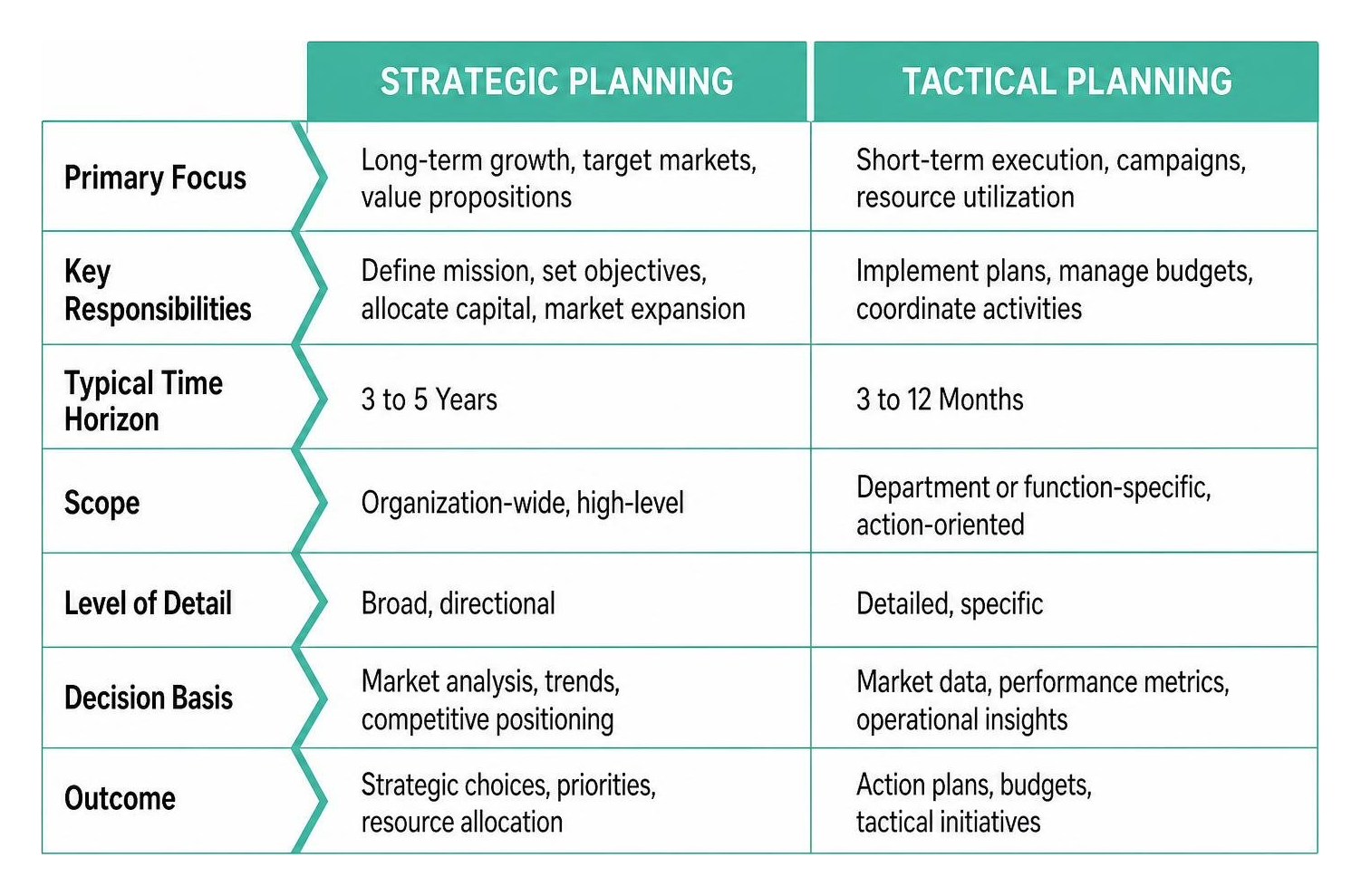
To illustrate how high-level vision translates into daily execution, compare the strategic and tactical levels of planning:
| Planning Level | Primary Focus | Key Responsibilities | Typical Time Horizon |
|---|---|---|---|
| Strategic Planning | Long-term growth, target markets, value propositions | Defining mission, setting SBU goals, allocating capital, market expansion | 3 to 5 Years |
| Tactical Planning | Execution details, campaign deployment, channel tactics | Content creation, media planning, pricing adjustments, promotional schedules | 1 Year or Quarterly |
When businesses partner with experts in Strategic Branding and Strategy Services, they establish a bridge between broad high-level strategies and daily execution tasks.
Developing Marketing Strategies and Plans PPT Slide Structures
Structuring a strategy slide deck requires narrative discipline. Rather than burying stakeholders under mountain ranges of raw text, structure your slide deck following a standardized executive layout:
- Executive Summary: A one-slide high-level summary detailing the core strategic direction, major financial investments, and expected ROI.
- Situation Analysis: Clear visual breakdowns covering internal strengths and weaknesses alongside external market opportunities and threats (SWOT Analysis).
- Target Audience Segmentation: Personas detailing demographic, firmographic, and psychographic characteristics of core target customers.
- Go-To-Market (GTM) Strategy & Roadmap: Clear visual timelines showing phase-by-phase launch activities.
- Marketing Mix Execution (7Ps): Detailing Product, Price, Place, Promotion, People, Process, and Physical Evidence.
- Financial Forecasts & Implementation Controls: Budget breakdown charts, revenue forecasting models, and key performance indicators (KPIs).
If you are looking for ready-to-use slide deck formats, downloading structured presentation templates like Download Now! Marketing Business Plan PPT And Google Slides gives you editable node layouts designed specifically for strategic reporting.
Integrating Digital Channels into Strategic Slide Decks
Modern marketing strategies cannot afford to treat digital tactics as an afterthought. Modern slide decks must show how traditional brand communications integrate seamlessly with digital customer acquisition funnels.
When presenting digital channels, break down your tactical slides into measurable modern pillars:
- Search Engine Optimization (SEO): Detail high-intent organic search targets, technical site architecture upgrades, and content authority strategies.
- Content Marketing: Outline strategic content hubs that move leads through awareness, consideration, and decision phases. You can explore our complete framework for From Chaos to Clarity: Building a Strategic Content Plan for Digital Success to align content directly with customer journeys.
- Social Media & Paid Media Acquisition: Present target audience retargeting funnels, creative campaign formats, and media planning metrics across digital platforms.
Brands seeking cohesive multi-channel execution frequently leverage targeted Digital Marketing Services to back up strategic slide decks with real-world execution power.
Best Practices for Presenting Strategies in PowerPoint
Creating an impactful developing marketing strategies and plans ppt requires as much attention to design clarity as to strategic rigor. Even the most brilliant strategy fails to gain traction if board members and stakeholders tune out mid-presentation.

To maximize engagement and comprehension:
- Adopt Widescreen (16:9) Formatting: Standardize your slide decks in standard 16:9 widescreen formats suitable for modern displays and virtual boardrooms.
- Utilize Visual Node Structures: Group related ideas into distinct visual containers, such as 3-node or 5-node hexagonal or gear layouts, rather than traditional bulleted lists.
- Leverage High-Contrast Color Palettes: Use executive background shades (navy, deep slate) paired with vibrant accent highlights (warm orange, bold gold) to draw attention to crucial takeaways.
- Maintain Visual Hierarchy: Use variable font weights and clean typography to guide stakeholder eyes naturally across data points.
If you are building custom presentations across platforms, tools like the Go To Market Strategy Plan Presentation And Canva Template provide versatile baseline graphics compatible across PowerPoint, Google Slides, and Canva.
Avoiding Common Pitfalls in Slide Deck Design
In our decades of managing corporate growth strategies at McGuinness Media & Marketing, we frequently spot recurring slide deck design mistakes that compromise strategic buy-in:
- Text Overload and Data Density: Slides filled with paragraph-long blocks of text force the audience to choose between reading the slide or listening to the speaker. Keep slides clean and move detailed supporting statistics into appendix notes.
- Failing to Treat the Deck as an Internal Sales Tool: Strategic planning decks aren’t mere historical records—they are internal sales documents designed to persuade decision-makers to invest capital and internal effort.
- Misaligned Compensation and Incentives: A plan will fail during execution if managerial compensation isn’t tied directly to the plan’s milestones and KPIs. Ensure your implementation slides clearly assign ownership and outline accountability frameworks.
- Rushing Data Collection: Skipping comprehensive background market analysis to jump straight to flashy promotional ideas usually results in strategic missteps. Allocate sufficient research time before finalizing slide deck assumptions.
Tailoring a Developing Marketing Strategies and Plans PPT for Stakeholders
Different stakeholders care about different outcomes. A fatal flaw in strategy presentation is presenting the exact same 60-slide deck to everyone in the enterprise.
Customizing slide emphasis ensures executive buy-in:
- For C-Suite Leadership and Boards: Focus heavily on high-level executive summaries, macroeconomic opportunities, overall budget spend, risk mitigation, and long-term ROI metrics.
- For Sales and Departmental Execution Teams: Emphasize customer personas, campaign launch calendars, competitive differentiation points, collateral delivery schedules, and lead generation expectations.
- For Financial Officers: Highlight unit economics, customer acquisition costs (CAC), lifetime value (LTV) ratios, and detailed quarterly channel spend allocations. Small-to-midsize enterprises can gain deeper financial insights by reviewing our guide on Maximizing ROI: Media Planning Tips for Small Businesses.
Frequently Asked Questions About Marketing Strategy Presentations
What are the essential slides required in a marketing strategy PPT?
A complete strategic marketing slide deck should contain an Executive Summary, Situation Analysis (covering market research and SWOT analysis), Target Audience Personas, Strategy Frameworks (Ansoff Matrix or Porter’s positioning), Marketing Mix Tactics (7Ps), Financial Projections, and Implementation Controls featuring clear KPIs and audit timelines.
How does corporate strategy differ from tactical marketing planning?
Corporate strategy operates at the business unit and corporate headquarters level, focusing on defining company missions, assigning strategic business unit (SBU) capital, selecting long-term growth paths, and identifying core competencies. Tactical marketing planning translates those high-level goals into short-term campaign executions, specific media planning buys, channel management, promotional pricing schedules, and creative messaging.
What makes a strategic marketing planning system successful?
A successful strategic marketing planning system relies on multi-level stakeholder involvement (gathering insights from frontline sales and customer service teams up through upper management), thorough internal and external market data analysis, alignment of managerial compensation incentives with planning milestones, flexible adaptability based on continuous market-sensing feedback, and regularly scheduled performance auditing routines.
Conclusion
Mastering the art of building a developing marketing strategies and plans ppt bridges high-level strategic vision and real-world commercial success. By combining core concepts—such as value chain alignment, strategic business unit planning, and modern multi-channel media tactics—with clean, visual slide deck design, you create a compelling strategic narrative that aligns stakeholders and inspires confidence.

At McGuinness Media & Marketing, we help businesses across Rhode Island and nationwide eliminate chaos, clarify their brand strategy, and build data-driven marketing programs that yield measurable revenue growth. Whether you are re-evaluating your target positioning, refreshing your corporate messaging, or building an omni-channel media strategy, our team brings over two decades of industry leadership to your table.
Ready to transform your strategic plans into market leadership? Transform Your Business Strategy with McGuinness Media & Marketing today and let our strategy experts craft your roadmap to success.