
From Chaos to Clarity: Building a Strategic Content Plan for Digital Success
Why Your Business Needs an Effective Content Strategy
An effective content strategy is the roadmap that guides all your content marketing efforts—from the individual pieces you create to how you deliver them across different stages of the customer journey. Without one, even the most creative content may fail to generate results.
Here’s what an effective content strategy includes:
- Clear business goals – Define what you want to achieve (brand awareness, lead generation, customer retention)
- Target audience understanding – Know who you’re creating content for and what they need
- Content planning – Decide what types of content to create and when to publish them
- Distribution channels – Choose where to share your content (website, social media, email)
- Measurement system – Track performance and optimize based on data
Why it matters: Content marketing generates three times as many leads as traditional outbound marketing but costs 62% less. Yet most organizations still treat content as an afterthought instead of a strategic asset.
In today’s crowded marketplace, businesses waste money and resources creating content that’s pointless for users and profitless for organizations. The problem? They lack a content strategy. Without a well-defined plan, you’re essentially working blind—publishing content and hoping something sticks.
The good news is that documented content strategies work. Organizations with a documented approach are far more likely to consider themselves effective at content marketing, feel less challenged with every aspect of it, and can justify spending a higher percentage of their marketing budget on content efforts.
As Megan McGuinness, owner and chief marketing officer of McGuinness Media & Marketing, I’ve spent over 20 years helping regional, national, and global brands develop effective content strategies that drive measurable results. Working with clients across retail, finance, hospitality, and more, I’ve seen how a strategic approach transforms scattered content efforts into powerful marketing engines that improve brand awareness and customer engagement.
Laying the Foundation: Defining Your Purpose and Audience
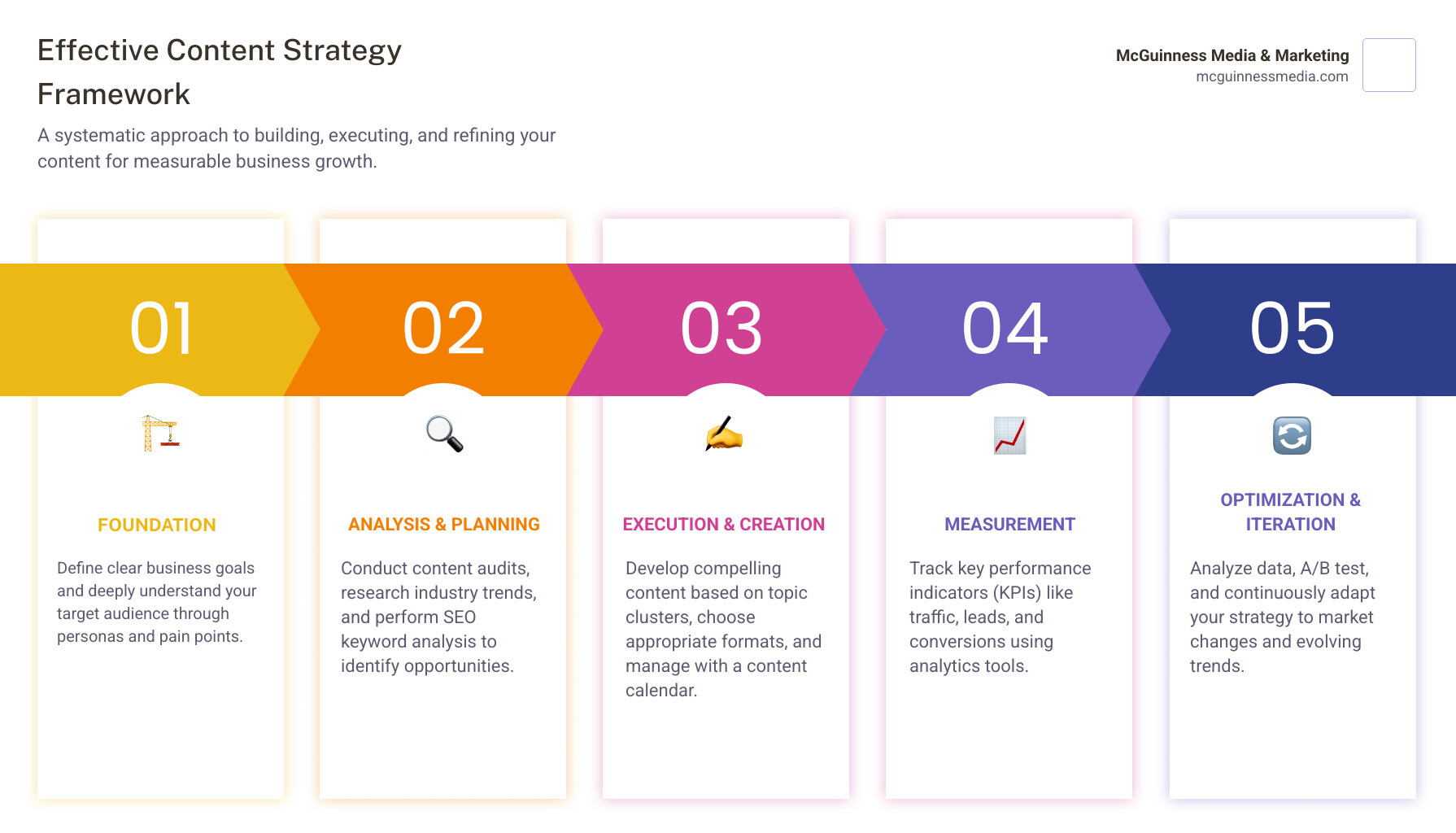
Before we dive into creating content, we need to establish a solid foundation. Think of it like building a house: you wouldn’t start hammering nails before drawing up blueprints, right? An effective content strategy begins with understanding why we’re creating content and for whom. This involves defining our business objectives, crafting our brand story, and deeply understanding our target audience.

Setting Clear Business Goals
Every piece of content we create should serve a specific purpose, aligning with our overarching business objectives. Without clear goals, our content efforts can become aimless. Are we aiming to increase brand awareness, generate more leads, or improve customer retention? Perhaps we want to establish ourselves as a thought leader in our industry.
We recommend using the SMART framework to define our goals: Specific, Measurable, Achievable, Relevant, and Time-bound. For example, instead of “get more website traffic,” a SMART goal might be “increase organic website traffic by 20% within the next six months.”
Once our goals are set, we need to establish Key Performance Indicators (KPIs) to track our progress. These are the metrics that will tell us if our content is actually working. KPIs could include website visitors, lead conversion rates, social media engagement, or customer testimonials. By aligning our content with our company mission and values, we ensure every effort contributes to our larger vision.
To help you get started, we’ve put together a goal-planning template that can guide you through this crucial initial step. You can download our free goal-planning template to determine your content goals.
Understanding Your Target Audience
Knowing our audience is paramount to an effective content strategy. We’re not just creating content for “everyone”; we’re speaking to specific individuals with unique needs, motivations, and pain points. Who are they? What problems are they trying to solve? What information do they seek, and where do they look for it?
We dig into both demographics (age, gender, location, occupation) and psychographics (interests, values, lifestyle, attitudes) to build detailed buyer personas. These semi-fictional representations of our ideal customers help us personalize our content and ensure it resonates deeply. For instance, in Rhode Island, understanding local business owners’ challenges might lead to very specific content about local market trends or regulations.
To gather these insights, we can conduct surveys, interviews, and analyze existing customer data. A CRM tool is invaluable here, helping us store these details and even set up personalized email nurturing campaigns. These campaigns can then guide leads further down the funnel, turning them into loyal customers.
We believe in making our customers the hero of our brand story. By focusing on their journey, challenges, and how our solutions help them succeed, we build trust and foster deeper connections. Our detailed guide on how to create buyer personas for your business can walk you through this process.
Analysis and Planning: Auditing Your Landscape
With our foundation in place, it’s time to look around. This phase involves taking stock of our existing content, understanding the competitive landscape, and identifying opportunities to create truly impactful content. This analytical approach ensures our effective content strategy is data-informed and competitive.
Conducting a Content Audit
A content audit is like a spring cleaning for our digital assets. It involves inventorying all our existing content—blogs, web pages, videos, social media posts, etc.—and assessing its performance. This isn’t just about what we have, but how well it’s working for us and our audience.
We look at metrics like traffic, engagement, conversions, and even backlinks to identify our high-performing assets. These are the gems we can repurpose, update, or expand upon. Conversely, the audit helps us pinpoint underperforming content or identify content gaps where we’re not adequately addressing our audience’s needs. Did you know that 75% of companies conduct a content audit annually? For those who are most successful, 65% conduct these audits at least twice a year. This regular review is crucial for continuous improvement.
An audit also helps us understand what content is evergreen (always relevant) versus topical (time-sensitive). It’s a critical step to ensure our content library is lean, relevant, and effective. Sometimes, we might even find that we have too much content, leading to “content overload.” Our article How to Deal with Content Overload While Designing offers some great insights into managing this.
Leveraging Industry Insights
Beyond our own content, we need to understand the broader industry landscape. What are our competitors doing well? Where are they falling short? What trends are emerging that we can capitalize on? This competitive analysis helps us identify opportunities to differentiate ourselves and carve out our unique niche.
We analyze the content formats and channels our industry peers are using, looking for inspiration but also for underserved topics or audiences. This process isn’t about copying; it’s about identifying gaps and developing fresh approaches. For instance, if everyone in our sector is focusing on text-based blogs, perhaps there’s an opportunity for us to lead with video content or interactive tools.
By examining top-ranking articles and successful campaigns, we gain insights into searcher intent and what truly resonates with our shared audience. This allows us to design content that not only satisfies user queries but also establishes us as an authority. Our guide How to Analyze Your Industry to Step Up Your Content Strategy provides a deeper dive into this process.
Developing an Effective Content Strategy: A Step-by-Step Framework
Now that we have a solid foundation and a clear understanding of our landscape, it’s time to build the framework for our effective content strategy. This involves generating compelling topics, choosing the right formats, organizing our efforts, and establishing clear guidelines for consistency.
Generating Topics and Choosing Formats
Content idea generation is where creativity meets strategy. We brainstorm topics that directly address our audience’s pain points and align with our business goals. Keyword research tools are indispensable here, helping us find what our target audience is actively searching for. We also look for topic pillars—broad themes central to our business—and then create topic clusters around them, covering specific sub-topics in detail. This approach not only provides comprehensive information to our audience but also signals to search engines that we are an authority on these subjects.
When it comes to content formats, we meet our audience where they are. Do they prefer reading, watching, or listening? A diverse content mix often yields the best results. Here are some formats we frequently use:
- Blog posts: Excellent for SEO, thought leadership, and in-depth explanations. In fact, 16% of marketers say their blog posts generated the biggest ROI for their businesses in 2024.
- Ebooks: Ideal for lead generation and offering comprehensive guides.
- Case studies: Powerful for demonstrating real-world success and building credibility.
- Infographics: Great for visualizing data and complex information in an easily digestible way.
- Videos: Highly engaging and shareable, especially short-form videos which 17% of marketers report have generated strong results for their businesses.
- Podcasts: Allow us to reach audiences on the go and build a more intimate connection. There was a 6% year-over-year increase in U.S. podcast listeners in 2022, highlighting their growing popularity.
- Social Media posts: Essential for amplifying reach, engaging communities (90% of social media marketers say building an active online community is crucial), and driving traffic to our other content.
The goal is to choose formats that best tell our story and suit our target customer. Our article on Responsive Web Design: Creating for Multiple Devices can also offer insights into how content adapts across different platforms.
Establishing a Content Governance Model
A content governance model ensures consistency, quality, and efficiency across all our content efforts. It’s the “who, what, when, and how” of our content operations. This model outlines:
- Brand guidelines: Our voice, tone, style, and visual identity. This ensures every piece of content reflects our brand consistently. Our article Color Trends and Typography: What Brands Should Be Using and Avoiding digs into visual consistency.
- Editorial workflow: The step-by-step process for content creation, from ideation to publication.
- Roles and responsibilities: Clearly defining who is responsible for writing, editing, approving, publishing, and maintaining content.
- Content calendar: This central tool organizes and schedules our content, ensuring timely delivery and consistency. It’s not just about dates; it includes content titles, topics, formats, target keywords, responsible parties, and publication channels. A staggering 80% of the most successful companies in content marketing are using a content calendar.
Sharing our content strategy with other teams within the company is also crucial. This ensures everyone, from sales to customer service, is aligned with our messaging and understands the value of our content. It minimizes duplicated efforts and ensures we’re all working towards the same goals.
Measurement, Optimization, and Future-Proofing
An effective content strategy isn’t a “set it and forget it” endeavor. It requires continuous measurement, analysis, and optimization. This iterative process ensures our content remains relevant, performs optimally, and adapts to the ever-changing digital landscape.
Measuring Success: How to Track and Optimize Your Effective Content Strategy
Remember those KPIs we set? Now it’s time to track them! We use tools like Google Analytics to monitor website performance, traffic sources, user behavior, and conversion paths. For social media, email marketing, and other channels, we leverage their native analytics to gather insights.
Key metrics we track include:
- Website traffic: How many people are visiting our content? Where are they coming from?
- Engagement: How long are they staying? Are they interacting with our content (comments, shares)?
- Lead generation: Is our content converting visitors into leads?
- Conversions: Is our content contributing to sales or other desired actions?
- SEO rankings: How well is our content performing in search engine results?
By regularly analyzing this data, we identify what’s working and what isn’t. This informs our optimization cycle: we refine our content, test new approaches (A/B testing headlines, calls-to-action, or formats), and make data-driven adjustments to our strategy. How often should we review? While core elements like our mission and audience personas might be reviewed annually, tactical elements like our channel strategy or specific topics should be revisited quarterly or semi-annually to respond to performance data and market shifts. This ensures we’re always improving our return on investment, a topic we explore further in Maximizing ROI: Media Planning Tips for Small Businesses.
Staying Ahead: Trends and Ethical Considerations
The digital world evolves rapidly, and so must our effective content strategy. We keep a keen eye on emerging trends to ensure our content remains fresh and competitive.
- Video content’s role: Video continues to dominate, with 17% of marketers reporting strong results from short-form videos. Platforms like TikTok, Instagram Reels, and YouTube Shorts are powerful channels for engaging audiences. Our YouTube channel is a great example of how we leverage video to provide valuable content.
- The Rise of AI in Marketing: Artificial intelligence is changing content creation and optimization. From generating content ideas to personalizing user experiences, AI offers powerful tools. However, it’s crucial to use AI ethically and ensure human oversight. Learn more in The Rise of AI in Marketing: What It Means for Small Businesses.
- Empathetic marketing and combating misinformation: In an era of information overload, building trust is paramount. Our content must be empathetic, addressing real human needs and concerns. We must also actively combat misinformation by providing accurate, well-researched, and credible information. A study in Singapore, for instance, showed how misinformation led to harmful health practices during the pandemic. This highlights the critical importance of accuracy, especially in sensitive topics.
- Building online communities: Beyond simply publishing, fostering active online communities around our content is key. 90% of social media marketers emphasize its importance for a successful social media strategy. This involves engaging with our audience, responding to comments, and facilitating discussions.
By staying abreast of these trends and maintaining a strong ethical compass, we future-proof our content strategy and continue to connect with our audience authentically.
Frequently Asked Questions about Content Strategy
We often encounter common questions about the nuances of content strategy. Let’s clarify some of the most frequent ones.
What is the difference between a content strategy and content tactics?
This is a crucial distinction that many people confuse.
- Content Strategy is the “why” and the overarching plan. It defines our goals, our audience, our unique value proposition, and how content will help us achieve our business objectives. It answers questions like, “Why are we creating this content?” and “Who are we trying to help?” Kristina Halvorson, a pioneer in the field, defines it as “the ongoing practice of planning for the creation, delivery, and governance of useful, usable, and effective content about a particular topic or set of topics.”
- Content Tactics are the “how”—the specific actions and deliverables we execute to fulfill the strategy. These are things like writing a blog post, creating a video, designing an infographic, or posting on social media.
Essentially, content strategy comes before tactics. The strategy provides the blueprint, and the tactics are the construction tools. Without a strategy, tactics are just busywork without clear direction.
How does a content strategy differ from a content marketing strategy or a content plan?
These terms are often used interchangeably, but they represent different levels of scope and detail:
- Content Strategy (broadest): This is the most comprehensive term. It encompasses the entire lifecycle and governance of all content an organization produces, digital or otherwise. It addresses the creation, publication, and maintenance of useful, usable, and effective content, ensuring it aligns with overall business goals and user needs. It’s concerned with the content itself as an asset, regardless of its immediate marketing purpose.
- Content Marketing Strategy (more specific): This is a subset of content strategy. It focuses specifically on using content to achieve marketing goals—attracting, engaging, and retaining an audience to drive profitable customer action. It’s about how content supports lead generation, brand awareness, customer loyalty, and sales. While closely related, content marketing strategy is typically outward-facing and tied to marketing objectives.
- Content Plan (most tactical): This is the day-to-day, week-to-week, or month-to-month schedule of what content we will create, when it will be published, where it will be distributed, and who is responsible for each step. It’s the tactical execution document derived from the broader content marketing strategy. It includes specifics like topics, keywords, calls-to-action, and deadlines.
Think of it this way: Content Strategy is the entire library’s management system. Content Marketing Strategy is the plan for promoting specific book genres to attract readers. A Content Plan is the list of new books to acquire and display each month.
How often should I update my content strategy?
An effective content strategy is a living document, not a static one. Its review frequency depends on its components:
- Core elements (mission, business goals, target personas, brand story): These fundamental aspects should be relatively stable but still reviewed at least annually. Significant shifts in the market, our business model, or our audience might necessitate a more frequent review.
- Tactical elements (content topics, channel strategy, content formats, editorial processes): These elements are more dynamic and should be reviewed more frequently, perhaps quarterly or semi-annually. This allows us to adapt to performance data, emerging trends, and changes in audience behavior. For example, if we notice a new social media platform gaining traction with our audience, we might adjust our channel strategy. Similarly, if a particular topic isn’t performing well, we’d reconsider our approach.
Regular review cycles, informed by analytics and market intelligence, are essential for keeping our content strategy relevant and effective.
Conclusion
Navigating the digital landscape can feel like a tangled mess of wires, but with an effective content strategy, we can bring clarity to the chaos. We’ve explored how defining our purpose, understanding our audience, auditing our existing content, and embracing continuous optimization are all critical steps in building a strategic content plan for digital success.
An effective content strategy is an ongoing process, not a one-time task. It requires dedication, data analysis, and a willingness to adapt. But the rewards are immense: stronger brand authority, deeper customer connections, and ultimately, measurable business growth.
At McGuinness Media & Marketing, our Rhode Island-based team specializes in changing complex marketing challenges into clear, actionable strategies. We pride ourselves on being the #1 creative services leader in RI, helping brands like yours stand out and achieve their growth objectives. To build a robust plan that drives real results, we invite you to explore our digital marketing services. Let’s turn your content chaos into clarity together.