
A Comprehensive Guide to the Strategic Marketing Planning Process
What Is Strategic Marketing Planning (And Why It Matters for Growth)
Strategic marketing planning is the process of defining where your business wants to go, identifying who you’re trying to reach, and building a clear roadmap to get there — then measuring whether it’s working.
Here’s a quick breakdown:
| Question | What It Means |
|---|---|
| Where are we now? | Assess your current market position, strengths, and gaps |
| Where do we want to be? | Set long-term growth goals tied to business objectives |
| How will we get there? | Choose strategies, channels, and resources to close the gap |
| How will we know we’re succeeding? | Define KPIs and track performance continuously |
In short, it’s the difference between reacting to the market and leading in it.
Most businesses are busy with marketing. Fewer are strategic about it. Running campaigns, posting on social media, and running seasonal promotions are all useful — but without a long-term plan connecting those activities to measurable business outcomes, you’re leaving real growth on the table.
As one expert put it: “A strategic marketing plan without data is just a wish list.”
Strategic marketing moves beyond short-term wins. It aligns every marketing decision with your brand’s long-term vision — building the kind of sustainable competitive edge that compounds over time.
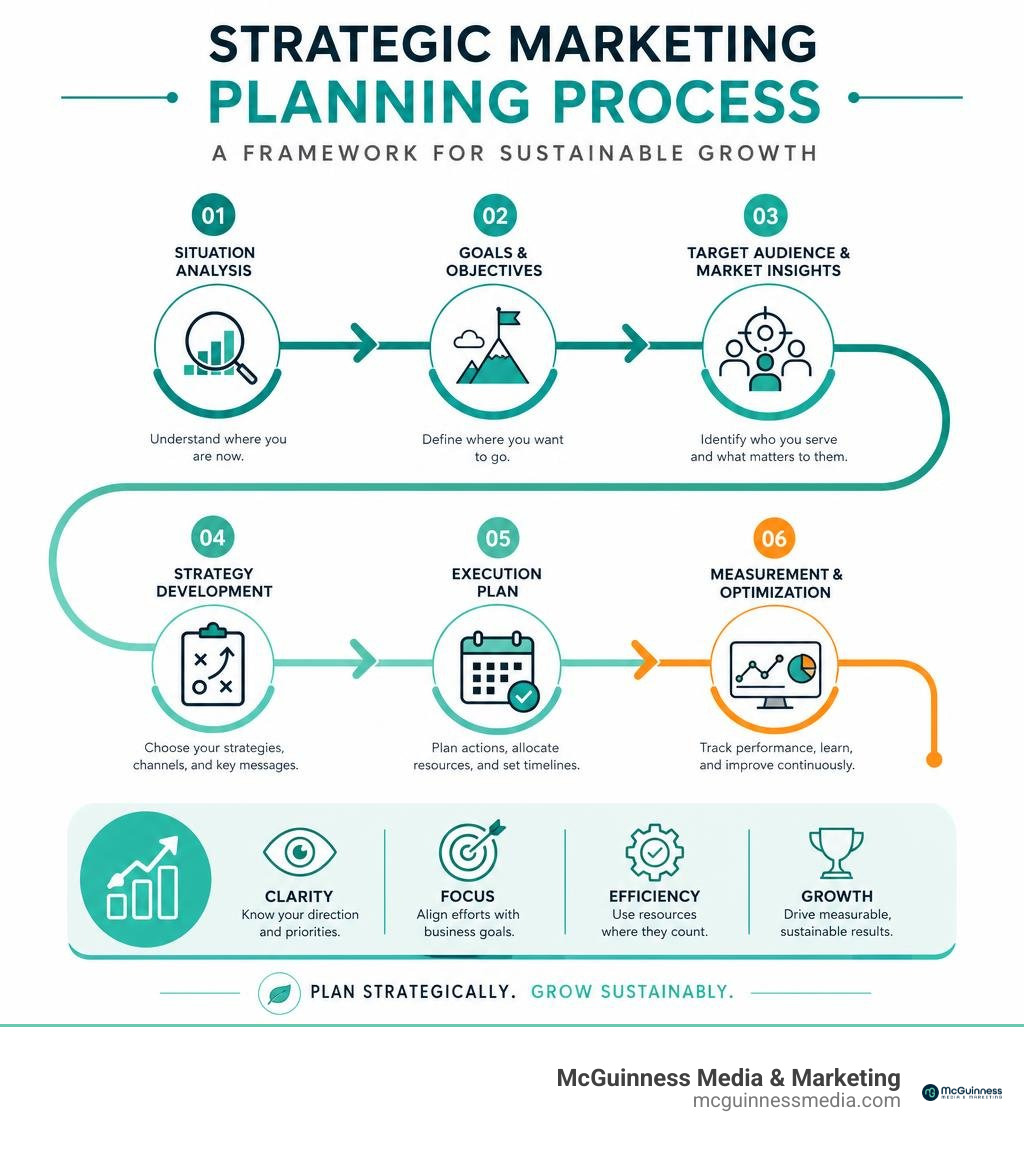
I’m Megan McGuinness, owner and CMO of McGuinness Media & Marketing, and over my 20+ years developing strategies for regional, national, and global brands, strategic marketing planning has been the single most consistent driver of measurable, lasting results for my clients. In this guide, I’ll walk you through every stage of the process — from situation analysis to execution and optimization.
Foundations of Strategic Marketing Planning vs. Tactical Marketing
To build an engine for sustainable corporate expansion, you must first understand the structural difference between strategy and tactics. Think of strategic marketing planning as building the blueprints for a skyscraper, while tactical marketing is the actual work of laying bricks, running wire, and painting walls. If you start laying bricks without a structural blueprint, you might end up with a very pretty wall that collapses the moment a stiff wind blows through Rhode Island.
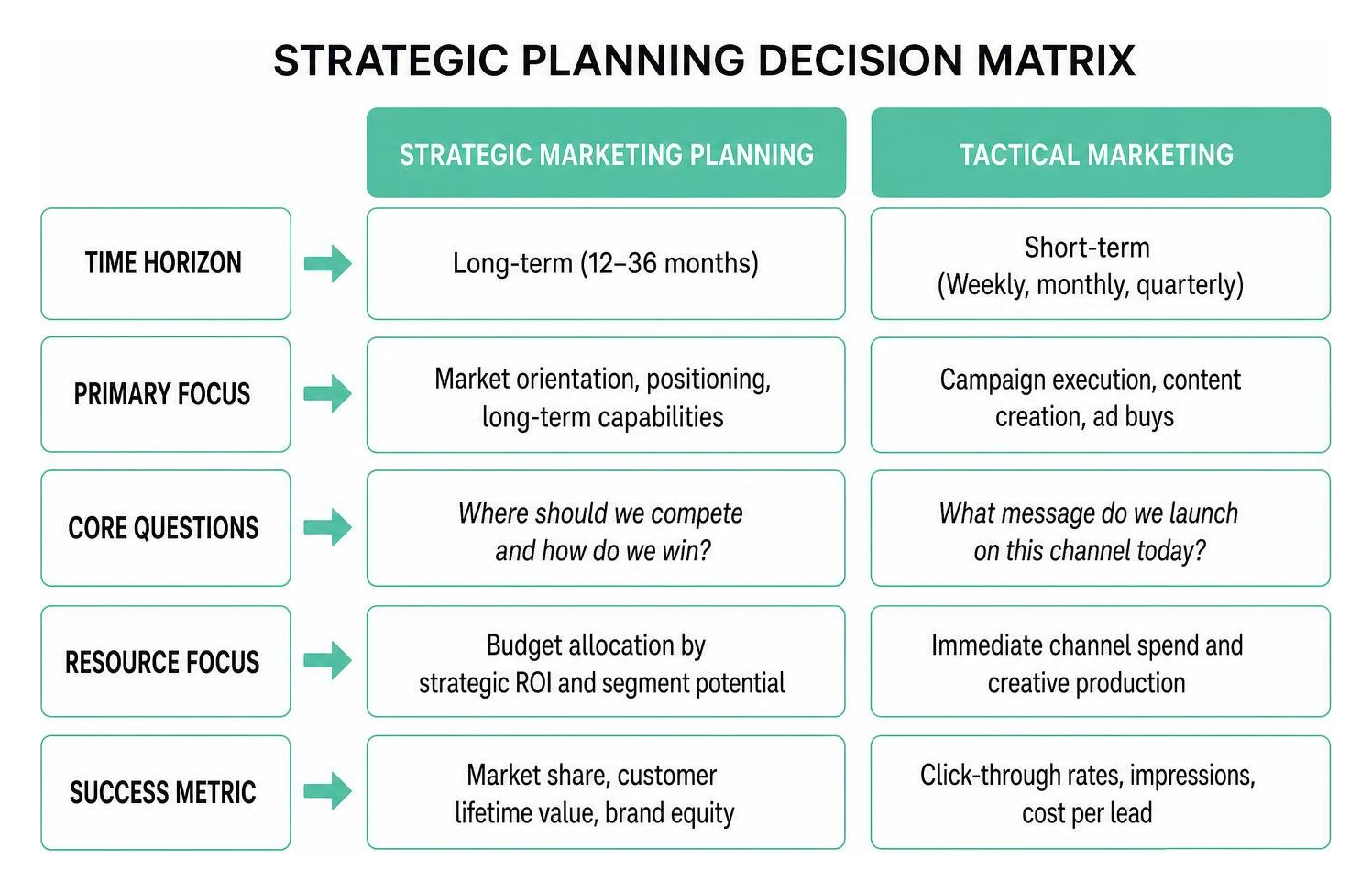
Strategic planning operates on a long horizon — typically 12 to 36 months out. It focuses on big-picture choices: defining target customer segments, positioning your brand identity, carving out market share, and developing capabilities. Tactical planning, on the other hand, operates on a weekly, monthly, or quarterly timeframe. It concentrates on executing specific campaigns, optimizing ad creative, drafting social content, or launching a promotional email blast.
When organizations skip strategic planning to jump straight into tactics, they fall into the “activity trap.” Teams run around frantically producing content and launching ad spend, but without a unified direction, those efforts rarely produce compound revenue growth.
| Planning Dimension | Strategic Marketing Planning | Tactical Marketing |
|---|---|---|
| Time Horizon | Long-term (12–36 months) | Short-term (Weekly, monthly, quarterly) |
| Primary Focus | Market orientation, positioning, long-term capabilities | Campaign execution, content creation, ad buys |
| Core Questions | Where should we compete and how do we win? | What message do we launch on this channel today? |
| Resource Focus | Budget allocation by strategic ROI and segment potential | Immediate channel spend and creative production |
| Success Metric | Market share, customer lifetime value, brand equity | Click-through rates, impressions, cost per lead |
Core Purpose and Organizational Benefits
The core purpose of strategic marketing planning is to establish total alignment between marketing efforts and overall business goals. Studies continuously confirm that market orientation — actively gathering customer intelligence and distributing it across all departments — directly correlates with superior financial performance and business longevity. Strategic marketing decisions carry major consequences for an organization’s long-term trajectory.
When your marketing efforts map directly to overarching revenue objectives, every dollar spent works toward a single unified purpose. Key organizational benefits include:
- Sustainable Growth: Focuses efforts on high-value buyer segments rather than chasing quick, low-margin transactional wins.
- Optimal Resource Allocation: Eliminates waste by concentrating financial and human capital on channels with verified return on investment.
- Enhanced Customer Retention: Deepens brand loyalty by consistently serving customer pain points, which can boost retention rates by up to 20% annually.
- Proactive Resilience: Gives organizations the agility to pivot smoothly when market conditions shift, rather than scrambling reactively.
To explore foundational concepts around business strategy integration, read 2.1 Developing a Strategic Plan – Principles of Marketing | OpenStax.
Strategic Frameworks Driving Market Success
Sharpening your strategy requires proven frameworks that translate raw market data into actionable insights. Rather than relying on guesswork, top marketing strategists use formal analytical models to evaluate opportunities and risks:
- SWOT Analysis: Examines internal Strengths and Weaknesses alongside external Opportunities and Threats to establish an honest baseline of where your brand stands today.
- PESTEL Analysis: Evaluates external macro-environmental drivers, including Political, Economic, Social, Technological, Environmental, and Legal forces shaping your operational landscape.
- Porter’s Five Forces: Analyzes industry competitiveness by examining competitive rivalry, supplier power, buyer leverage, threat of substitution, and barriers to entry.
- Ansoff Matrix: Evaluates growth paths through four strategic lenses: Market Penetration, Market Development, Product Development, or Diversification.
- Gap Analysis: Measures the exact operational distance between where your performance currently sits and where you want to go, identifying the specific capabilities required to bridge that gap.
For a deeper dive into professional planning methodologies, review the CIM Qualifications Specification.
Conducting Situation Analysis and Market Research
Before deciding where your business is going, you must gain total clarity on where you stand right now. A thorough situation analysis forms the foundation of any effective strategic plan. Trying to map a growth route without baseline research is like turning on your GPS without letting it locate your current position.
Market research transforms assumptions into reliable intelligence. It blends internal analytics — such as sales figures, customer acquisition costs, and churn rates — with external insights on industry shifts, buyer expectations, and competitor moves.
Auditing the Internal and External Environment
A complete marketing audit investigates both internal capabilities and macro-environmental shifts. Internally, you need to audit your brand’s MarTech stack, content assets, media efficiency, sales funnel conversion points, and staff bandwidth. Externally, you must track shifting economic conditions, demographic trends, and emerging customer expectations.
In today’s environment, consumer habits evolve rapidly across fragmented digital and offline spaces. To dive into how modern brands can stay ahead amidst shifting consumer habits, check out our guide on Adapting to the New Media Landscape Challenges for Brands.
Key elements of a comprehensive strategic audit include:
- Baseline Data Gathering: Document historical metrics across sales revenue, customer acquisition cost (CAC), pipeline velocity, and media channel performance.
- Competitor Benchmarking: Analyze competitors’ market positioning, pricing models, creative messaging, and media presence to discover unaddressed market niches.
- Customer Voice Analytics: Gather direct feedback through surveys, focus groups, customer reviews, and sales call recordings to identify real friction points.
Market Segmentation, Targeting, and Positioning
With deep research in hand, the next phase relies on the foundational STP framework: Segmentation, Targeting, and Positioning. Strategy is fundamentally about choice — choosing who you serve and, just as importantly, choosing who you do not serve.
First, divide the broader market into granular customer segments based on demographic traits (age, income, job role), geographic parameters, psychographic profiles (lifestyle, core values), and behavioral patterns (usage habits, brand interactions).
Next, select your target segments based on total profit potential, segment growth rates, customer acquisition efficiency, and alignment with your business capabilities.
Finally, establish a distinct positioning strategy backed by a compelling Unique Value Proposition (UVP). Your value proposition explains precisely why your brand is uniquely qualified to solve your customer’s core challenge better than any alternative on the market. To learn how we build distinct identity systems for growing organizations, explore our Services – Branding and Strategy.
Formulating Goals and Aligning the Marketing Mix

Once your market research points the direction and your target audience is clearly defined, the next stage of strategic marketing planning focuses on turning broad vision into measurable growth targets — and shaping the operational levers to hit them.
A broad statement like “we want to build our brand awareness” is not a strategic plan; it’s a general wish. True strategic planning translates overarching business objectives into crisp, quantifiable marketing goals that drive accountability across your entire company.
Defining Goals within Strategic Marketing Planning
Effective marketing objectives link directly to long-term corporate vision while giving your execution teams crystal-clear operational benchmarks. We build marketing objectives around the proven SMART framework:
- Specific: Target a distinct, unequivocal outcome (e.g., “increase organic inbound qualified leads”).
- Measurable: Tie goals to concrete numerical metrics (e.g., “by 45% over baseline”).
- Achievable: Ensure targets are realistic based on resources and market capacity.
- Relevant: Directly map objectives to revenue, customer lifetime value, or market expansion goals.
- Time-bound: Assign an unambiguous deadline (e.g., “by Q4 2026”).
For instance, rather than setting a vague objective to grow pipeline, a well-defined strategic goal would be: “Generate $2.5 million in marketing-sourced pipeline from mid-market healthcare organizations across Rhode Island within 12 months.”
Structuring the Marketing Mix for Maximum Impact
With target metrics established, you shape the strategic execution levers known as the Marketing Mix (the 4 Ps). Tactical decisions across these four foundational levers must directly reinforce your core positioning strategy:
- Product: Ensure your product features, quality standards, packaging, customer support, and brand experience deliver on your value proposition.
- Price: Set pricing models — whether premium value-based, competitive penetration, or subscription tiers — that reflect your market positioning and margins.
- Place: Select optimal distribution channels and touchpoints where your target audience naturally shops and makes purchasing decisions.
- Promotion: Craft integrated promotional strategies across digital advertising, PR, content marketing, direct mail, and event activation to guide prospective buyers smoothly down the funnel.
When marketing strategy operates in tandem with sales teams — a concept known as marketing convergence — sales win rates jump significantly, and customer retention metrics improve dramatically.
Data-Driven Execution, Budget Alignment, and Optimization

A brilliant plan sitting inside a slide deck creates zero business value. The true magic of strategic marketing planning happens when you bridge the gap between high-level vision and tactical execution on the ground.
Executing a marketing strategy requires structured governance, clear accountability, agile budget management, and continuous performance review cadences.
Executing and Monitoring Strategic Marketing Planning
Execution begins with a structured roadmap. Assign every initiative a clear owner, operational timeline, resource budget, and target key performance indicators (KPIs). To keep execution on schedule without blind spots, establish continuous monitoring systems using balanced dashboards:
- Leading Indicators: Track early predictive engagement behaviors, such as digital channel traffic, email open rates, content downloads, and ad engagement. These metrics signal future pipeline health before sales close.
- Lagging Indicators: Measure bottom-line business outcomes, such as quarterly revenue growth, customer acquisition cost (CAC), sales conversion velocity, and net customer retention.
Review these metrics across structured cadences: perform weekly reviews on tactical performance, monthly reviews on strategic KPIs, quarterly reviews on baseline strategic assumptions, and a full annual plan refresh.
To discover practical ways to make every media dollar work harder for your business, read our insights on Maximizing ROI Media Planning Tips for Small Businesses and explore our hands-on Services – Digital Marketing.
Overcoming Implementation Challenges and Disruption
Even well-crafted plans hit implementation friction. Understanding common failure points allows leadership to address roadblocks proactively:
- Functional Silos (Interdependence): Silos between sales and marketing slow momentum down. Overcome this by involving sales reps during early planning stages and sharing CRM pipeline data across departments.
- Strategic Drift & Separation: Plans break down when leadership creates unrealistic targets disconnected from frontline capacities. Maintain open feedback loops and build clear RACI project ownership matrices.
- Adapting to Industry Disruption: Emerging technologies like artificial intelligence are reshaping search behaviors, media buying, and content scaling overnight. To understand how automated systems can amplify your reach, read about The Rise of AI in Marketing What It Means for Small Businesses.
Finally, maintain budget agility. A powerful rule of thumb in modern strategic planning is reserving 10% to 20% of your total marketing budget for experimentation. Testing emerging digital channels, ad creative formats, and untapped audiences allows you to discover high-ROI revenue engines before your competitors spot them.
To master long-term planning frameworks adapted for digital spaces, review Marketing Plans: Profitable Strategies in the Digital Age, 9th Edition | Wiley.
Frequently Asked Questions About Strategic Marketing Planning
How does strategic marketing planning differ from tactical marketing?
Strategic marketing planning defines your long-term vision, target customer selection, brand positioning, and budget allocation across a 12-to-36-month horizon. Tactical marketing focuses on executing specific, short-term campaigns and creative tasks — such as managing social posts, ad campaigns, or email newsletter blasts — over weekly, monthly, or quarterly timeframes to support that strategy.
What are the core stages of the strategic marketing planning process?
The process follows five sequential stages:
- Situation Analysis: Conducting thorough internal audits and external market research using SWOT, PESTEL, and competitive benchmarking.
- Objective Setting: Establishing quantifiable, SMART marketing goals tied directly to corporate revenue growth.
- Strategy Development: Identifying clear target audience segments, selecting high-value customer groups, and shaping a distinct value proposition (STP).
- Tactical Execution: Structuring the 4 Ps (Product, Price, Place, Promotion) and launching channel campaigns backed by dedicated resource budgets.
- Measurement & Iteration: Tracking leading and lagging KPIs across structured dashboard cadences to continuously optimize performance.
How much budget should be reserved for experimental marketing initiatives?
We recommend reserving 10% to 20% of your total marketing budget specifically for testing experimental channels, emerging ad formats, and new audience segments. This built-in innovation fund helps your company identify high-converting acquisition channels before competitors do, while keeping your core 80% to 90% budget focused on proven revenue engines.
Conclusion
At its core, strategic marketing planning turns marketing from an unpredictable expense into a reliable driver of revenue growth. By rooting your decisions in rigorous market research, mapping tactics directly to measurable SMART targets, and constantly measuring results against bottom-line KPIs, you build a resilient, scalable market presence that compounds over time.
Strategic clarity gives your company the agility to navigate changing media landscapes, align internal teams, and maximize every dollar spent. Growth doesn’t happen by accident — it’s built intentionally.
At McGuinness Media & Marketing, we help businesses cut through digital noise, sharpen their brand positioning, and build data-driven strategic roadmap plans that deliver real ROI. Whether you need full-funnel strategy development or high-impact execution, our Rhode Island team is ready to help you win.
Ready to take your business growth to the next level? Explore our integrated Services – Media Planning and start building your strategic roadmap with us today.