
A Practitioner’s Guide to Cohesive Brand Communications Strategy
Build a Brand Communications Strategy That Holds Together
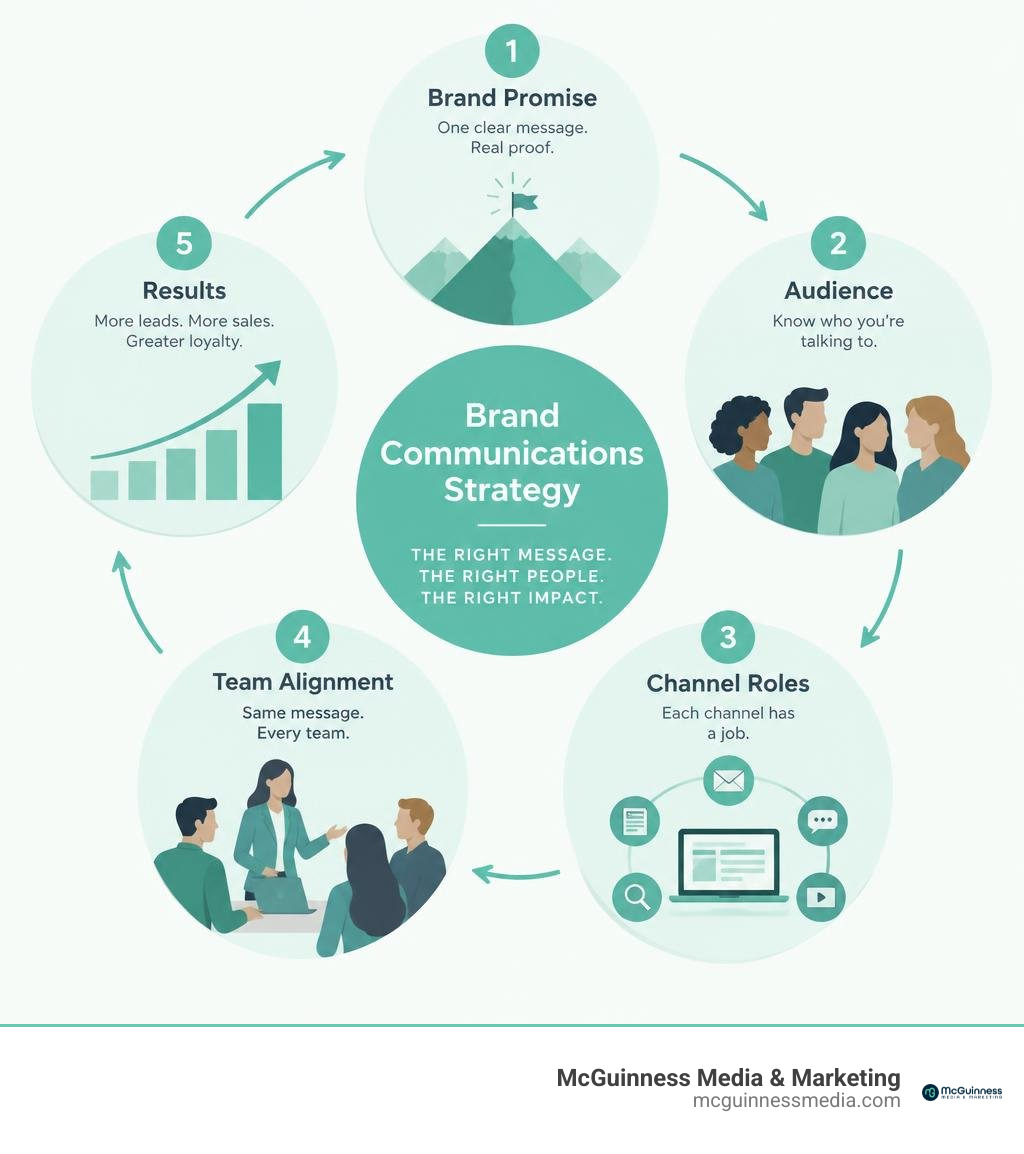
To build a brand communications strategy, start with the people you need to reach and what you want them to understand. Then:
- Choose one clear brand promise and the proof that supports it.
- Give each channel a job, from building trust through PR to explaining your offer on your website.
- Share the same message guide with marketing, sales, leaders, and customer-facing teams.
- Check what people remember and whether the work improves leads, sales, or retention.
The goal is not to say the same thing everywhere. It is to make every interaction feel like it comes from the same brand.
I’m Megan McGuinness, owner and chief marketing officer of McGuinness Media & Marketing. For more than 20 years, I’ve helped regional, national, and global brands develop marketing plans; this guide applies that experience to building a brand communications strategy.
Brand communications strategy glossary:
Strategic Foundations: Differentiating Narrative, Marketing, and Content
Most businesses do not suffer from a lack of communication. They suffer from a lack of coherence.
Walk into almost any mid-market or enterprise organization and you will find an avalanche of active touchpoints: blogs publishing weekly, LinkedIn feeds updating daily, PR pitches going out monthly, and sales teams delivering pitches on Zoom. Yet when you ask three different department heads to explain what the company stands for, you will often get three completely different answers.
Most companies have communications activity. Very few have a communications strategy.
At McGuinness Media & Marketing, we see this breakdown constantly. Organizations invest heavily in campaigns, but their foundational story remains murky. A sustainable narrative must be anchored in genuine market tension—the friction between what your audience currently struggles with and what the market fails to deliver. Without this tension, communications default to generic self-praise.
Connecting this narrative to commercial outcomes requires clarity on how strategic disciplines interact. When organizations understand why growing businesses need dedicated brand positioning experts, they stop treating communications as mere copywriting and start treating it as a commercial delivery system.
| Strategic Dimension | Marketing Strategy | Content Strategy | Brand Communications Strategy |
|---|---|---|---|
| Core Focus | Commercial objectives, pricing, distribution, customer acquisition, and market share. | Creation, lifecycle, format, governance, and distribution of assets. | The narrative delivery system: messaging, voice, channel roles, and perception alignment. |
| Primary Question | Where will we play and how will we win commercially? | What specific formats and assets do we need to produce? | What do we want audiences to believe, feel, and remember across all touchpoints? |
| Key Output | Go-to-market plans, revenue targets, pricing models, and budget allocations. | Editorial calendars, asset libraries, SEO keyword clusters, and production workflows. | Message hierarchy, audience perception maps, voice/tone guides, and consistency governance. |
| Scope | Business-wide commercial engine. | Operational media production. | Holistic reputation, alignment, and relationship architecture. |
What Is a Communications Strategy vs. Marketing and Content?
To build an effective system, we must clarify terminology that industry discourse frequently blurs:
- Marketing Strategy sets the commercial foundation. It identifies market segments, sets pricing, defines the product offering, and establishes revenue targets.
- Content Strategy manages tactical production. It determines whether a message should become a long-form article, a short-form video, or an infographic, governing editorial workflows and digital asset management.
- Brand Communications Strategy is the overarching delivery system that ensures your narrative promise, corporate values, and strategic positioning are expressed consistently across every internal and external touchpoint.
A brand communications strategy functions as an organizational operating system. It translates high-level positioning into a clear message hierarchy that marketing, sales, executive leadership, and customer support can execute daily without narrative drift.
Why Most Brand Communications Strategy Initiatives Fail
When communication strategies collapse, it is rarely due to a lack of creative talent. They fail because of structural flaws:
- Channel Proliferation Without Purpose: Companies rush to maintain an active presence across TikTok, LinkedIn, YouTube, X, email, and industry events simply because those channels exist. Consistency on fewer channels outperforms inconsistency across many, almost every time.
- Operational and Departmental Silos: Public relations operates independently of the performance marketing team; the internal communications group rarely talks to customer service; sales representatives build their own pitch decks. The result is a fragmented customer experience that confuses the market.
- Premature Abandonment: Brand equity takes time to compound. Research shows that most companies abandon their strategic position before it has had time to work, confusing the internal fatigue of seeing the same message every day with market saturation.
- Vanity Metric Addiction: Teams obsess over social media impressions and top-of-funnel reach while ignoring message recall, brand sentiment, and commercial pipeline velocity.
- A Lack of Living Governance: Fewer than one in five organisations has a message hierarchy document that is current and actually used. Strategy documents are drafted in executive retreats, saved to shared drives, and promptly forgotten.
Core Framework: How to Build an Integrated Brand Communications Strategy
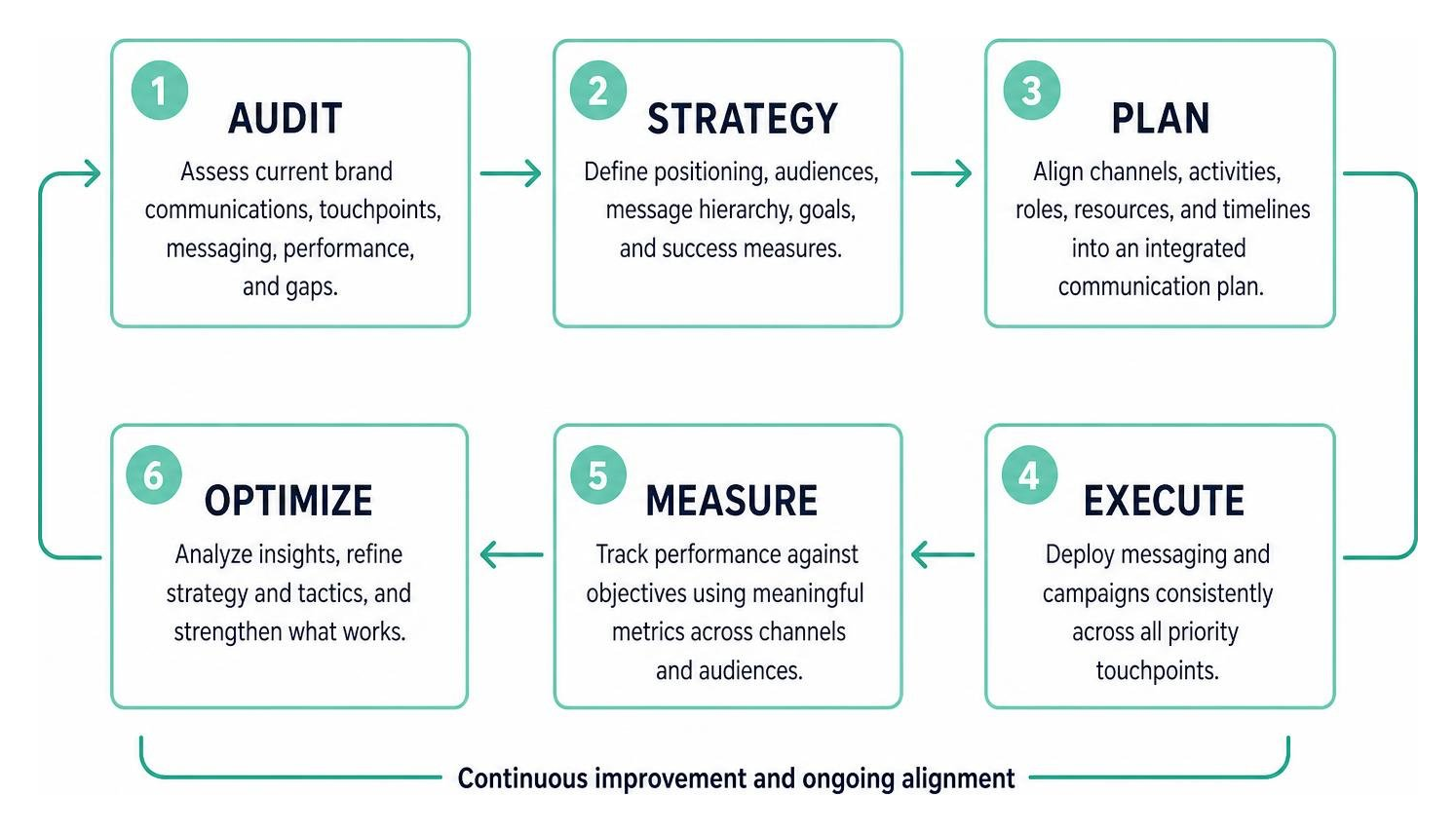
A meaningful communications strategy typically takes six to twelve weeks to develop properly. A strategy built in a week is usually a document that reflects internal assumptions rather than external reality. Building a framework that holds together requires a structured process that links your market position to audience reality, following the practical guide to the strategic marketing planning process.
Conducting a Comprehensive Brand and Touchpoint Audit
You cannot chart a path forward without an unvarnished view of your current communications footprint. Start by assembling an exhaustive inventory across five key areas:
- Owned Digital Touchpoints: Website pages, landing pages, mobile apps, email newsletters, and automated transactional messages.
- Earned and Media Touchpoints: Press releases, media coverage, executive podcast appearances, and analyst mentions.
- Shared and Community Touchpoints: Organic social media profiles, community forums, and customer review platforms.
- Sales and Commercial Collateral: Pitch decks, one-pagers, proposals, contract templates, and trade show booths.
- Internal Communications: Employee onboarding materials, all-hands presentations, intranet updates, and internal policy guides.
Once compiled, perform a consistency audit. Pull five distinct touchpoints—a sales deck, a support email, the homepage, an executive LinkedIn post, and a recruitment listing. Read them side by side. If they sound like they were written by five completely unrelated companies, you have identified your strategic baseline gap.
Establishing the Core Narrative, Pillars, and Message Hierarchy
Your narrative hierarchy creates structural order out of complex corporate value propositions:
- The Core Brand Promise: A singular, defensible statement that captures the primary value you deliver and the tension you resolve for the market.
- Strategic Message Pillars: Three to four thematic categories that support the core promise. These pillars organize your messaging into clear territories (e.g., Operational Simplicity, Enterprise Security, Customer Partnership).
- Supporting Proof Points: Every claim must be substantiated by hard evidence—proprietary technology, audited case studies, customer metrics, industry certifications, or operational benchmarks.
- Audience-Specific Messaging: Customized translations of the core message tailored to the distinct priorities of technical buyers, executive decision-makers, frontline users, and internal talent.
Designing the Channel Ecosystem and Role Matrix
Every communication channel must have a clear job description. Avoid publishing identical content across all platforms. Instead, build a channel matrix that defines how each touchpoint advances the core narrative based on audience context.
| Channel | Strategic Role | Primary Objective | Content Expression | Core KPI |
|---|---|---|---|---|
| Website | Single Source of Truth | Deep education, conversion, validation | Comprehensive solution architecture, case studies, interactive tools | Conversion rate, dwell time, qualified inbound volume |
| Public Relations (PR) | Credibility & External Validation | Authority building, third-party validation | Executive commentary, proprietary research releases, corporate milestones | Share of voice, high-tier placements, narrative pull-through |
| Social Media | Frequency & Community | Ongoing engagement, brand personality | Snackable thought leadership, culture spotlights, conversational Q&A | Message engagement rate, qualified follower growth |
| Events & Experiential | Direct Brand Experience | Relationship building, immersion | Keynote presentations, curated executive dinners, product demonstrations | Pipeline generated, attendee sentiment, post-event acceleration |
| Internal Comms | Operational Alignment | Cultural coherence, message adoption | Executive video town halls, internal playbooks, success stories | Employee message alignment, internal survey sentiment |
Channel Execution: Unifying PR, Web, Social, and Experiential Touchpoints
Executing an integrated brand communication strategy requires an orchestrator’s mindset. When a major story or campaign goes live, every channel should activate its specific assignment within the narrative architecture rather than simply copy-pasting the same copy.

Global enterprises demonstrate the power of this discipline. Consider how Yum! Brands operationalized an integrated communications strategy across global markets, aligning thousands of franchisees, corporate employees, and diverse regional audiences across 160 countries through unified narrative pillars. Whether managing thousands of locations or growing a regional business in Rhode Island, the principle remains identical: establish a shared narrative core, then adapt the delivery to fit the local and channel context.
Aligning Internal and External Communications
Your internal team is your first and most critical audience. When companies launch an external campaign that internal teams do not understand or believe, cynicism sets in, customer service falters, and the brand promise breaks down at the point of delivery.
Companies that delight customers at every touchpoint, including human interactions, grow more efficiently than those relying on marketing to compensate for operational shortfalls. To ensure total alignment:
- Brief Employees First: Never let your staff learn about a major strategic pivot, brand campaign, or product announcement from a public press release or social media post.
- Translate Strategy for Roles: Help customer support representatives, account managers, and field technicians understand what the brand promise means for their daily interactions with clients.
- Enable Executive and Employee Advocacy: Provide leadership and frontline staff with modular, easily shareable talking points that allow them to speak naturally on professional channels like LinkedIn without sounding scripted.
Adapting Messaging Across Channels Without Diluting Brand Voice
Maintaining consistency does not mean sounding monotonous. Think of your brand voice as a distinct human personality:
- Voice is Fixed: Your character, core values, baseline vocabulary, and foundational principles remain constant everywhere.
- Tone is Flexible: Your emotional register shifts based on context, platform, and audience emotional state.
When responding to an upset customer on a support channel, your tone should be empathetic, concise, and resolution-oriented. When sharing an industry milestone on LinkedIn, your tone should be confident, analytical, and forward-looking. The underlying voice remains unmistakably yours, but the expression respects the audience’s immediate mindset.
Governance, Cross-Functional Alignment, and Performance Measurement
A communications strategy without clear governance will inevitably succumb to message drift. As new team members join and external agencies are onboarded, unmanaged narratives fracture. Creating operational stability requires treating communications as an organizational discipline, supported by the frameworks outlined in our executive playbook for corporate marketing planning.
Maintaining Communications Governance Across Distributed Teams
To protect narrative integrity across teams, establish lightweight, operational governance mechanisms:
- The Message Hierarchy Document: Maintain a single, living document that contains your core positioning, audience personas, strategic pillars, approved proof points, and boilerplate language. Store it in an easily accessible location.
- Defined Sign-Off Workflows: Clarify who owns narrative approval for external statements, executive communications, major campaigns, and PR outreach. Keep approvals streamlined to prevent bottlenecks.
- Regular Onboarding and Enablement: Train new hires—across marketing, sales, product, and customer success—on the company’s messaging framework during their first 30 days.
Measuring the Real ROI of Your Brand Communications Strategy
Move past vanity metrics. The true commercial test of a communications strategy is whether it shifts market perception and accelerates business growth.

A comprehensive measurement scorecard tracks performance across three critical tiers:
- Perception and Awareness:
- Message Pull-Through: The percentage of press coverage, analyst reports, and organic discussions that accurately mirror your core strategic pillars.
- Brand Sentiment: Net sentiment trends across earned media, customer reviews, and social listening.
- Unaided Brand Recall: Audience recognition within targeted market categories.
- Commercial Velocity:
- Sales Cycle Length: A clearer market narrative reduces buyer hesitation, shortening the duration from initial discovery to closed deal.
- Pipeline Quality and Win Rates: Higher-fit inbound prospects who already understand your core differentiation convert at higher rates.
- Customer Lifetime Value (LTV) and Retention: Unified messaging across pre-sale and post-sale touchpoints minimizes onboarding friction and reduces customer churn.
- Internal Cohesion:
- Employee Message Fluency: Periodic surveys measuring how accurately and confidently team members can articulate the company’s core value proposition.
Adapting Strategy Across Scenarios: Launches, Repositioning, and Crisis
Strategic frameworks must remain resilient when market conditions shift. An effective communication model flexes across high-stakes corporate inflection points, reinforcing the principles in our guide on strategic planning for marketers driving long-term brand growth.
Navigating Brand Launches and Repositioning
During a new brand launch or strategic repositioning, your communications plan must guide audiences through a phased cognitive journey:
- Phase 1: The Disruption (Market Tension): Frame the systemic problem, outdated industry assumptions, or unmet need that exists in the market today.
- Phase 2: The Resolution (Core Promise): Introduce your approach, clearly stating what makes your solution distinct, defensible, and superior.
- Phase 3: The Validation (Proof Points): Saturate your primary channels with hard case studies, operational data, and customer validation to prove your claims.
Crisis Communications and Reputation Resilience
When a crisis strikes—whether operational downtime, product recalls, or executive missteps—your communications strategy serves as your defensive shield.
The biggest challenge in communications today is not cutting through noise. It’s making people choose to spend their discretionary attention on you—and preserving their trust when things go wrong.
Every organization should maintain pre-approved crisis response protocols:
- Pre-Drafted Holding Statements: Modular templates for common operational risks that can be customized, approved, and released within minutes.
- A Designated Spokesperson Protocol: Strict internal rules detailing who is authorized to speak publicly on behalf of the company during an active incident.
- Internal First Alignment: Ensuring employees receive transparent, factual updates before details circulate across external news outlets or social media.
Frequently Asked Questions About Brand Communications
How often should an organization update its brand communications strategy?
We recommend a comprehensive strategic review once a year, coupled with quarterly operational check-ins. You should not change your core brand promise or positioning unless there is a material change in your business model, customer base, or market landscape. Use quarterly check-ins to review channel roles, update proof points, and assess message pull-through metrics.
Who should own communication strategy within an enterprise?
Marketing and corporate communications teams generally lead the strategy, but executive leadership must champion and approve the core positioning. For internal touchpoints, marketing must collaborate closely with human resources and operational leadership to ensure message parity across the entire company.
How do you prevent brand communications from sounding repetitive across platforms?
Repetition occurs when you use the exact same format and copy everywhere. To keep communications engaging, keep your message pillars constant while varying the angles, formats, and stories you tell. One week, explore a strategic pillar through an in-depth customer case study on your website; the next week, discuss that same pillar via an executive video on LinkedIn or a panel topic at an industry conference.
Conclusion
A successful brand communications strategy is not an academic exercise or a binder that gathers dust on an office shelf. It is a live commercial framework that aligns your people, sharpens your marketing investments, and ensures that every dollar spent on media and creative execution builds lasting brand equity.
When your leadership, marketing, sales, and operational teams deliver the same clear, compelling story across every touchpoint, you stop competing on noise alone—and start winning on clarity, trust, and sustained market preference.
Ready to build a narrative engine that fuels commercial growth? Partner with seasoned brand and strategy specialists to build your communications framework at McGuinness Media & Marketing.