
Why Every Growing Business Needs Brand Positioning Experts Today
Why Growing Businesses Need Brand Positioning Experts
Brand positioning experts help a business become the clear choice for a specific customer in a crowded market. They research what buyers value, identify meaningful differences from competing options, choose the market category that makes those strengths easiest to understand, and turn that clarity into marketing and sales direction.
For a growing company, this work is not just about a clever tagline. Strong positioning answers four practical questions:
- Who are we best suited to serve?
- What problem or outcome do we uniquely improve?
- What alternatives are buyers comparing us with?
- Why should they believe our promise?
Businesses with a strong understanding of their audiences and competitors are more than twice as likely to qualify as high-growth firms, defined as growing at least 20% year over year. That makes positioning a growth decision, not a cosmetic branding exercise.
Positioning is the strategic place a brand earns in a customer’s mind. Messaging is how the brand explains that position. Strategy is the broader set of choices that guides where the business competes, whom it serves, and how it wins. When these layers do not align, teams often fall back on generic claims such as quality, service, or innovation – words every competitor can use.
I am Megan McGuinness, owner and chief marketing officer of McGuinness Media & Marketing. With more than 20 years of experience building marketing strategies for regional, national, and global brands, I help businesses apply the work of brand positioning experts to create clearer creative, smarter media decisions, and measurable momentum.
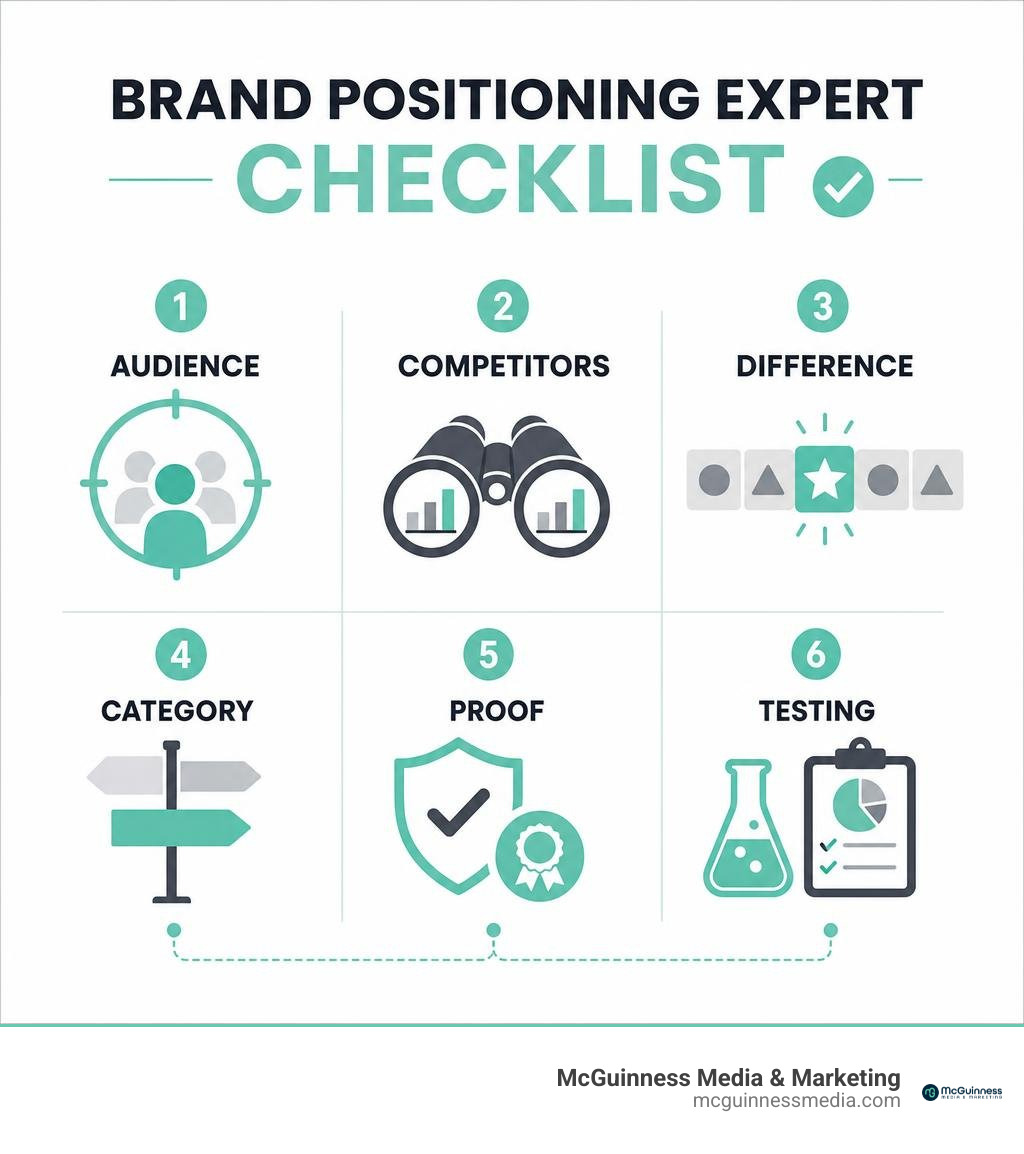
Simple brand positioning experts word guide:
The Core Mechanics: Positioning vs. Messaging vs. Strategy
Ever since Jack Trout and Al Ries introduced the concept of positioning to the business landscape in 1969, executives have wrestled with what it actually means. Too often, organizations treat positioning, messaging, and overall business strategy as interchangeable synonyms. Confusing these disciplines leads to muddled campaigns, wasted ad budgets, and confused prospects.
Positioning is the deliberate act of establishing a distinct, relevant place in the minds of your target buyers relative to their alternative choices. It defines your market context. If you sell database software, are you competing against enterprise giants like Oracle, or are you an agile business intelligence tool tailored specifically for financial fraud analysts? The choice of category context determines everything: what features matter, what price point buyers expect, and who sits across the sales table.
By contrast, messaging represents the verbal expression of that position. It translates your strategic stance into headlines, pitch decks, elevator pitches, and web copy. Strategy is the overarching master blueprint detailing where the company invests capital, how operations scale, and how the business sustains a long-term competitive advantage.
Our team at McGuinness Media & Marketing anchors high-performing campaigns in comprehensive branding and strategy to guarantee that market context informs every creative asset before execution begins.
| Dimension | Strategy | Positioning | Messaging |
|---|---|---|---|
| Primary Question | Where do we play and how do we win as an organization? | Why should a specific buyer pick us over every available alternative? | How do we articulate our value clearly and persuasively across channels? |
| Core Output | Business model, operational priorities, resource allocation | Category definition, differentiated value drivers, competitive frame | Value propositions, elevator pitches, taglines, ad copy, sales decks |
| Primary Audience | Board, leadership, internal teams, investors | The target market and prospective buyers | Customers, prospects, media, channel partners |
| Evaluation Metric | Revenue growth, profit margins, market share | Win rates against competitors, pricing power, category leadership | Brand recall, message resonance, ad click-through, conversion rates |

Why Modern Companies Hire Brand Positioning Experts
The modern commercial marketplace is louder and more saturated than at any point in history. Buyers do not suffer from a lack of options; they suffer from cognitive overload. When dozens of vendors claim to offer “high-quality solutions” or “innovative customer-first service,” those generic descriptors fade into background noise.
Firms that achieve explosive expansion do not rely on generic claims. In fact, research demonstrates that companies with a deep, research-backed understanding of their audiences and competitive landscapes are more than twice as likely to achieve high-growth status (expanding 20% or more year over year). When organizations hire experienced positioning professionals, they bypass the internal echo chamber and identify what truly moves the needle for buyers.
How Brand Positioning Experts Differentiate From General Marketers
General marketers excel at distribution, campaign management, media buying, and content generation. However, running ad campaigns on top of broken positioning simply amplifies market confusion faster. Positioning specialists examine the psychological underpinnings of consumer decision-making.
Top practitioners look beyond superficial demographics to map subconscious buyer motivations, utilizing behavioral modeling to evaluate consumer search intent and competitive dynamics. Strategic frameworks focus on competitive displacement rather than merely trying to outspend rivals on ad inventory.
Furthermore, leading strategists treat positioning as an evolving discipline. Modern buyers navigate complex evaluation journeys and use AI-assisted tools to compare solutions. According to insights shared across Harvard Business Review, winning organizations employ dynamic positioning frameworks that continuously adapt to market shifts rather than treating positioning as a static document written once and shelved.
Key Signs It Is Time to Hire Brand Positioning Experts
How do you know when your current market stance is actively holding your enterprise back? Look for these operational warning signs:
- Prolonged, Stalled Sales Cycles: Your sales team spends half of every introductory call explaining what your product is not, or prospects consistently fail to understand your core value proposition.
- Aggressive Price Compression: Prospects treat your offering as an interchangeable commodity, demanding steep discounts because they perceive no meaningful difference between you and your competitors.
- Feature-Led Pitching: Your sales collateral reads like an exhaustive technical spec sheet instead of articulating the high-impact business outcomes your solution unlocks.
- “Beige” Marketing and Safe-Zone Storytelling: Your marketing materials could easily swap logos with your top three competitors without anyone noticing a difference.
- Declining Market Momentum: Inbound lead volume softens, customer acquisition costs climb, and newer, more focused entrants begin chipping away at your market share.
Addressing these issues requires structured strategic planning for brand growth that re-evaluates customer needs and repositions your strengths to dominate your niche.
Proven Methodologies and Frameworks from Industry Leaders
The positioning discipline has moved far beyond fill-in-the-blank templates. Historical Mad-Libs-style positioning statements (“For [target customer] who [need], our product is a [category] that [benefit]…”) often yield clumsy, uninspiring Frankenstein paragraphs that sit buried in corporate folders.
Instead, modern practitioners employ dynamic frameworks that bridge human psychology, cultural relevance, and commercial strategy. Seasoned brand strategists champion first-principles thinking to push executive teams to boldly reject industry clichés and create category-disrupting identities. Bold narrative development and performance-driven metrics turn strategic clarity into enterprise momentum, scaling multimillion-dollar brands by refusing safe-zone positioning.
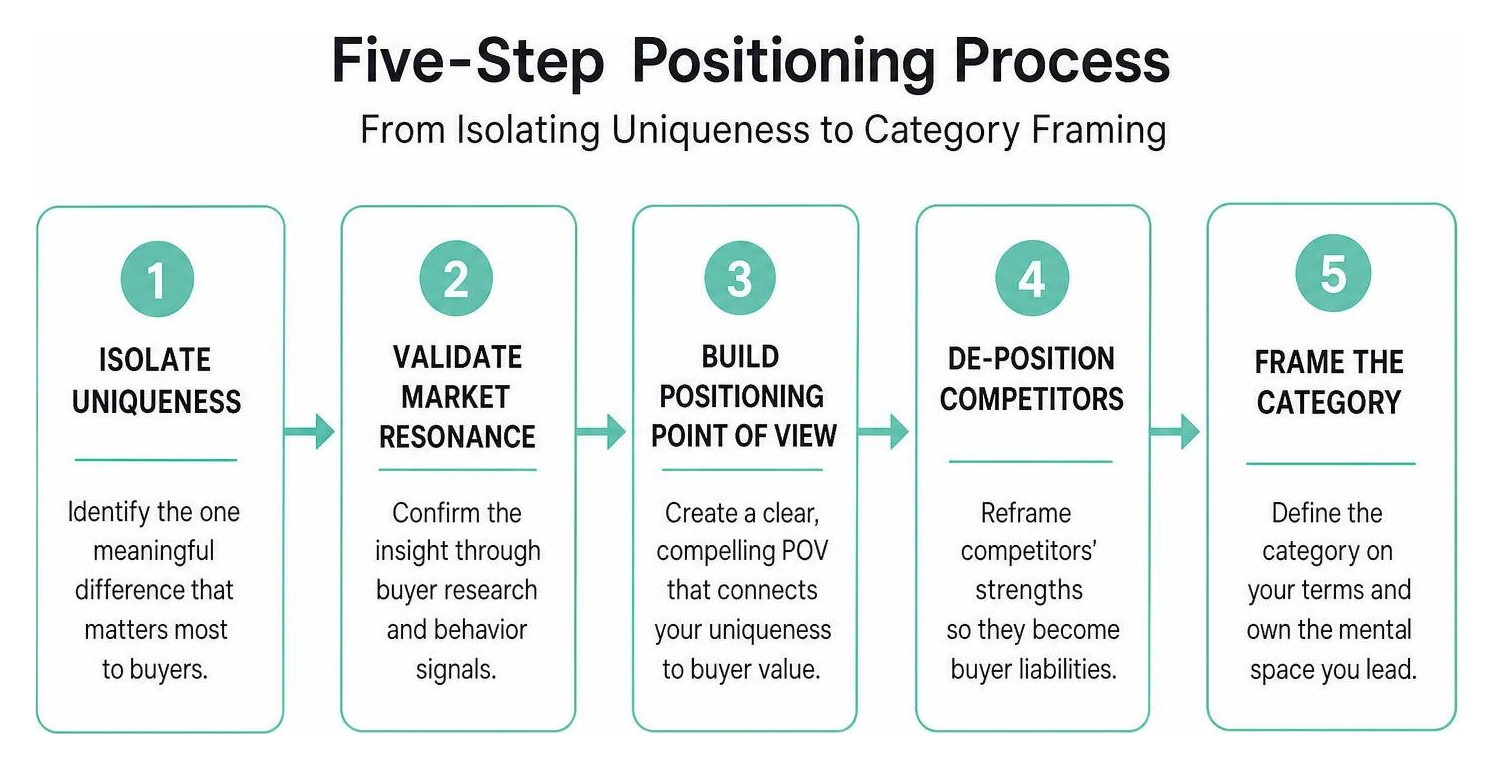
De-Positioning and Competitive Displacement
True market differentiation rarely happens in a vacuum. To win market share, you must often dislodge an incumbent vendor. This discipline is known as de-positioning: re-framing how prospective buyers view your competitors’ supposed strengths so that those attributes become liabilities.
Consider how disruptive brands enter established markets. When streaming platforms emerged, they de-positioned cable television not simply on price, but by framing cable’s vast channel lineups as bloated, rigid, and inconvenient.
A comprehensive de-positioning matrix evaluates three strategic levers:
- Competitor Strength Inversion: Identify what your competitor brags about most (e.g., “We have 500 features”) and reframe it into an operational burden for the buyer (e.g., “Bloated software that requires six months of painful employee onboarding”).
- Intent Psychology Analysis: Examine the subconscious intent behind customer search queries and evaluation criteria. When enterprise buyers search for solutions, what unspoken risks are they trying to avoid?
- Friction Point Exposure: Highlight where traditional legacy solutions fail modern expectations, making your specialized workflow the obvious, low-risk alternative.
Strength-Centered Market Framing
One of the most effective modern methodologies is the five-step positioning sequence popularized by product strategist April Dunford. This framework discards legacy category assumptions in favor of differentiated value:
- Isolate Your True Uniqueness: Catalog the specific capabilities, proprietary processes, domain expertise, or technical attributes that your business possesses which competitors cannot easily duplicate.
- Translate Uniqueness into Differentiated Value: Ask the critical “So what?” question. If your turnaround time is 48 hours faster than the industry average, what tangible business outcome does that speed create for your client?
- Define Who Cares Deeply: Pinpoint the exact customer segment that values your differentiated benefit above all else. Instead of targeting “all mid-market companies,” narrow your focus to “mid-market logistics firms running multi-facility distribution hubs.”
- Select Your Best Market Frame of Reference: Choose the category context that makes your differentiated value immediately intuitive. Context sets buyer expectations around pricing, capabilities, and direct competitors.
- Operationalize Across the Enterprise: Embed the chosen positioning into every customer touchpoint, from sales discovery scripts and pitch decks to onboarding sequences and paid advertising.
Testing, Validating, and Executing Your Market Position
Formulating positioning on a whiteboard is only half the battle. Rolling out an unvalidated market position across expensive marketing channels carries significant commercial risk.

Positioning should never be validated solely through digital A/B tests on a website homepage. Homepage traffic contains too many casual browsers who lack genuine buying intent. Instead, the most reliable testing environment is live sales conversations.
When your sales team introduces the new category frame and differentiated value drivers on discovery calls, observe prospect reactions carefully:
- Do prospects lean in and immediately ask about implementation and pricing?
- Does the new framing eliminate repetitive objections during the first ten minutes?
- Do prospective clients repeat your exact positioning phrases when justifying the purchase to their internal executive stakeholders?
Once validated in direct customer interactions, package your positioning into compelling marketing presentation decks to align your internal leadership, sales reps, and customer success teams around a single narrative.
From there, deploy your messaging into multichannel digital, broadcast, and print campaigns via services/marketing to dominate your category and generate sustainable pipeline velocity.
Frequently Asked Questions About Brand Positioning
What is the primary role of a brand positioning consultant?
A brand positioning consultant conducts comprehensive competitive audits, analyzes buyer psychology, uncovers hidden customer insights, and identifies uncontested market space. Rather than focusing on surface-level visual design, they determine the optimal category context, define provable differentiators, and develop strategic playbooks that guide sales conversations, product roadmaps, and marketing execution.
How long does a strategic brand repositioning exercise take?
A thorough repositioning initiative typically spans 6 to 12 weeks. This timeframe encompasses four distinct phases:
- Discovery and Qualitative Research (Weeks 1–3): Conducting deep-dive interviews with leadership, high-value customers, churned accounts, and lost prospects.
- Competitive Analysis and Synthesis (Weeks 4–6): Mapping competitor claims, identifying category conventions, and pinpointing white-space opportunities.
- Framework Development and Messaging (Weeks 7–9): Constructing the differentiated value proposition, selecting the category frame, and crafting messaging pillars.
- Validation and Activation (Weeks 10–12): Testing narratives in live sales environments, training internal teams, and rolling out updated go-to-market assets.
How do you measure the ROI of brand positioning?
The return on investment from brand positioning shows up directly across core commercial efficiency metrics:
- Shortened Sales Velocity: Deals close faster because buyers immediately understand why your offering fits their specific needs.
- Increased Win Rates: Your sales team wins a higher percentage of competitive head-to-head bake-offs without relying on discounting.
- Higher Average Selling Prices (ASP): Premium positioning supports pricing power by clearly demonstrating differentiated, provable ROI.
- Reduced Customer Acquisition Cost (CAC): Paid campaigns convert higher when creative assets reflect precise audience resonance and sharp messaging.
Conclusion: Transforming Market Clarity into Scalable Growth
In a hyper-competitive commercial environment, clarity is your greatest strategic advantage. Safe, beige marketing that attempts to appeal to everyone inevitably resonates with no one. When you clarify your differentiated value, align your market category, and boldly de-position competitive alternatives, you transform your brand from an easily ignored vendor into an indispensable market leader.
At McGuinness Media & Marketing, our team operates from our home base in Rhode Island, helping ambitious businesses carve out commanding market positions and accelerate growth. Discover how our leadership team drives measurable client results by visiting our about page, and explore how we translate strategic clarity into market dominance with our integrated media planning and buying services.