
Numbers vs Negotiation: A Practical Field Guide to Media Buying Analytics
Why Media Buying Analytics Matters for Every Advertising Dollar
Media buying analytics helps you decide where to place ads, what to pay, and what to change based on real business results – not just platform-reported clicks or conversions. Start by bringing campaign, sales, and customer data into one view; track cost, reach, conversion, and revenue by channel; then shift budget toward the placements that create incremental growth.
The goal is to balance two essential skills: smart negotiation for inventory, rates, and placement quality, plus reliable measurement across search, social, display, TV, and retail media.
That matters because attribution can over-credit the last ad someone clicked. A social campaign may create demand that later appears as branded search or an Amazon purchase. Without measuring those cross-channel effects, a business can cut the very campaigns that make lower-funnel ads work.
I am Megan McGuinness, owner and CMO of McGuinness Media & Marketing, with more than 20 years of experience building media strategies for regional, national, and global brands. My work in media buying analytics connects clear strategy, effective creative, and accountable media placement to measurable growth.
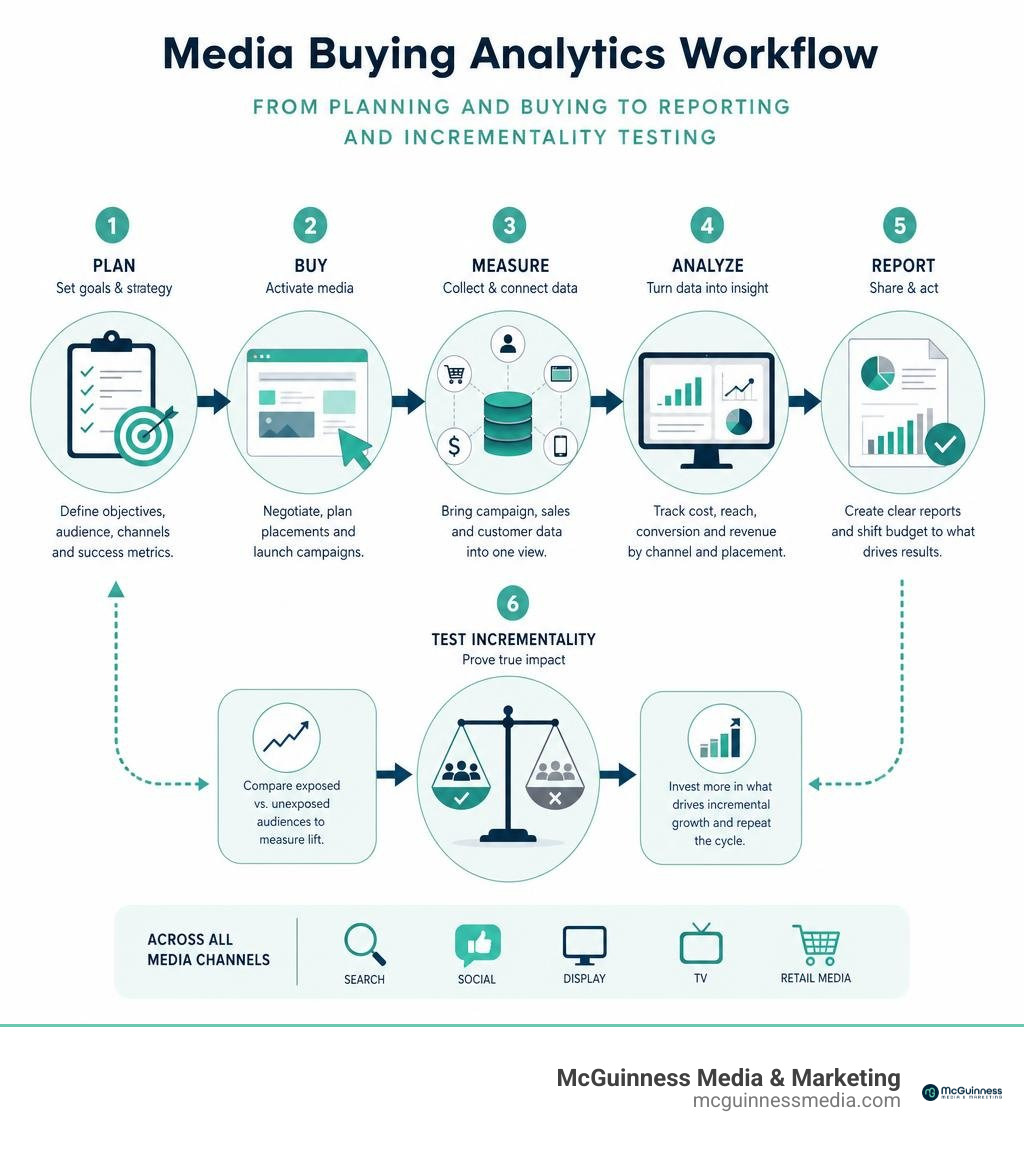
Media buying analytics terms to remember:
Core Pillars of Media Buying Analytics Across Modern Channels

Modern media buying is no longer just about picking a channel and setting an automated daily budget. It requires a continuous loop of audience segmentation, placement evaluation, cost per thousand (CPM) management, and cost per acquisition (CPA) optimization across programmatic display, search, social, streaming, and linear media.
When you review our step-by-step guide to media buying services, the common denominator is data transparency. Effective media analytics rests on four core pillars:
- Audience Segmentation and Target Validation: Pinpointing who is interacting with your creative versus who is completing a purchase.
- Real-Time Cost Control: Actively evaluating CPMs, effective cost per click (eCPC), and bid floors to avoid paying inflated platform prices.
- Cross-Device and Cross-Channel Pathing: Tracking how prospective customers discover your brand on mobile video, research on desktop search, and convert through retail or direct channels.
- Programmatic Delivery Monitoring: Auditing ad viewability, domain placements, and brand safety to prevent wasted ad spend on low-quality inventory.
Understanding these pillars ensures that media planning and execution work together, eliminating blind spots before ad spend scales.
Integrating First-Party Data into Media Buying Analytics
Industry shifts toward privacy and the loss of third-party tracking cookies have made first-party data the cornerstone of modern media analytics. When media operations rely on fragmented platforms, ad data gets trapped in disconnected silos. Sales teams look at CRM pipelines, ad buyers look at DSP delivery logs, and finance reviews bank deposits—often with massive discrepancies.
To build an accurate analytics pipeline, ad operations must connect raw delivery data directly with customer relationship management systems. Using tools like the YuktaMedia unified ad revenue management platform, media teams eliminate data leakage by automating reconciliation between booked ad volume and delivered impressions.
Unifying your CRM data with campaign tracking allows you to:
- Suppress existing customers from prospecting campaigns to save ad budget.
- Build high-intent lookalike audiences using confirmed high-lifetime-value buyers.
- Reconcile invoice line items against actual ad delivery in real time, preventing unbilled ad inventory and wasted spend.
Balancing Algorithmic Bidding with Strategic Human Negotiation
Demand-side platforms (DSPs) and automated bidding algorithms are exceptional at optimizing for micro-conversions in split seconds. However, an algorithm only optimizes for the specific mathematical goal you assign it. If you tell an algorithm to maximize clicks, it will gladly purchase cheap, low-intent clicks on spammy ad inventory.
This is why human oversight and traditional rate negotiation remain irreplaceable. Strategic buyers step in to negotiate custom rate cards, secure guaranteed direct inventory, lock in sponsorships, and apply placement frequency capping across publishers.
Knowing how media buying houses can spend your ad budget better comes down to this exact balance: using automated bidding for programmatic scale while applying experienced human negotiation to secure premium placements that algorithms cannot access.
Advanced Measurement: Moving Beyond Flawed Attribution to Media Mix Modeling
One of the biggest issues in digital advertising today is attribution bias. Industry research reveals that more than 30% of advertising budgets are misallocated based on flawed attribution data.
Standard last-click attribution models give 100% of the credit to the final touchpoint—typically branded search or a direct visit. Meanwhile, native platform dashboards (like Meta Ads Manager or Google Ads) each claim full credit for the exact same sale. If you add up the platform-reported conversions from each ad network, you will often find they claim two to three times your actual bank revenue.
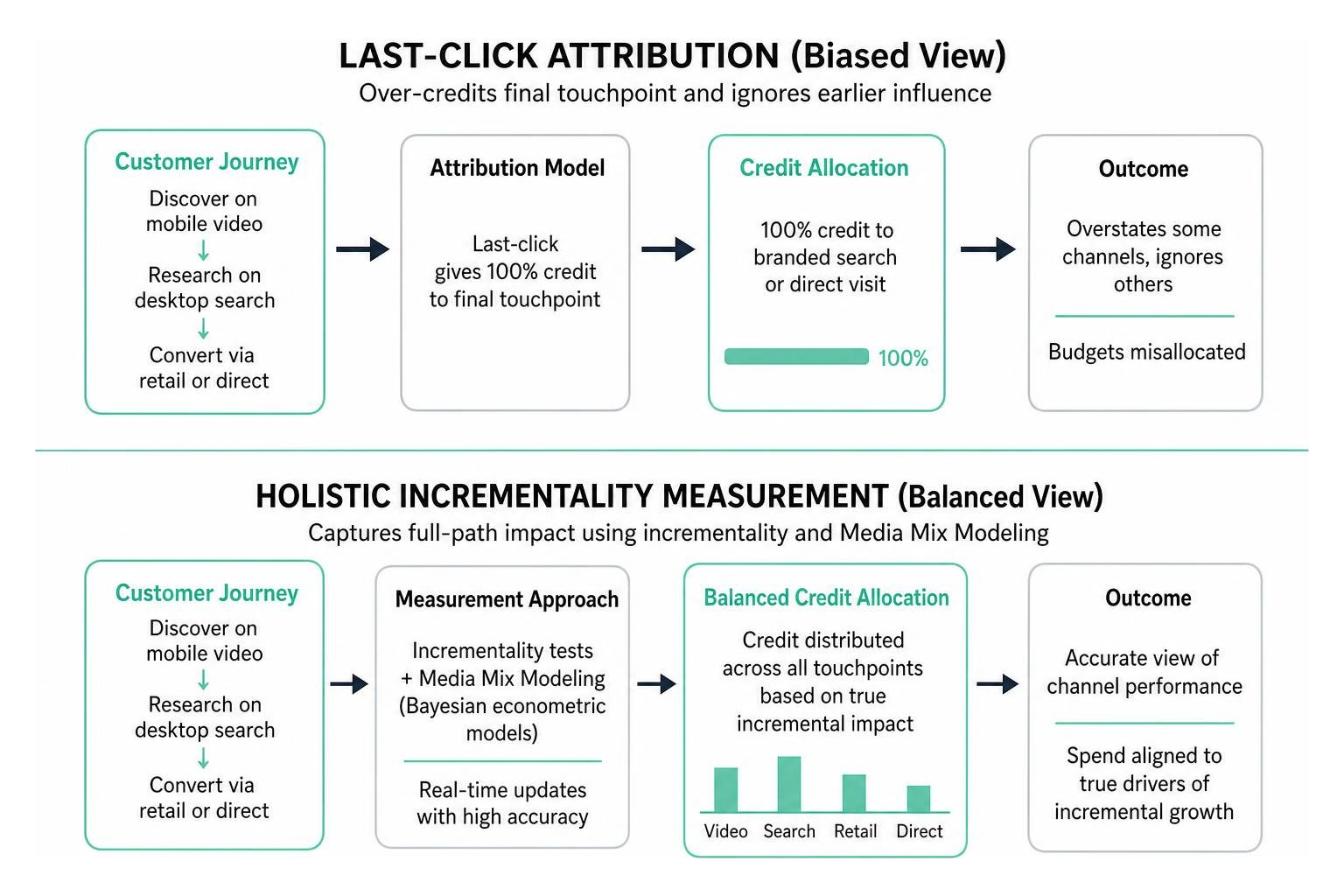
To solve this, advanced marketers use Media Mix Modeling (MMM). Unlike traditional MMM consulting engagements that take 6 to 12 weeks to deliver a static report, modern machine-learning models use Bayesian econometric frameworks to deliver real-time intelligence.
Leading solutions, such as the Media Mix Model research by Prescient AI, measure billions in ad spend and achieve over 90% model accuracy by updating on a daily cadence. Brands utilizing these modern econometric models see an average 24% improvement in ROAS within the first 90 days by reallocating capital away from over-credited channels and into genuinely incremental growth drivers.
Quantifying Halo Effects and Channel Lift with Media Buying Analytics
Advertising channels do not operate in a vacuum. Upper-funnel discovery channels create powerful “halo effects” that drive downstream conversions across other platforms.
For instance, running video ads on Meta or Connected TV often creates awareness that directly lifts branded search volume on Google and drives purchase surges on Amazon. If you look purely at last-click reporting, your video ads might look unprofitable, prompting you to turn them off. The moment you do, your Google Ads conversion rates drop and Amazon sales decline.
Connecting your cross-channel analytics reveals these hidden dependencies. When evaluating the art of the bid how to win big with google ads management, incorporating halo metrics ensures you are bidding appropriately on high-intent search terms generated by your brand awareness campaigns.
Validating Performance with Geo-Lift and Holdout Testing
Statistical models are only as good as their real-world validation. To verify that your media buying analytics reflect true incrementality, you must run controlled experiments.
The gold standard for validation includes:
- Geo-Lift Tests: Turning on or scaling ad spend in specific geographic test regions while holding demographically matched control markets at baseline spend, measuring the resulting revenue delta.
- Holdout Groups: Excluding a random 5% to 10% sample of your audience from receiving ads to observe baseline organic conversion rates.
- Switchback Experiments: Alternating spend on and off across defined weekly intervals to evaluate channel elasticity.
Applying these experimental designs provides grounded lessons in managing local ad spend, allowing you to calibrate econometric models against undeniable business revenue.
Multi-Platform Budget Allocation and Optimization Strategies
Allocating an advertising budget across search, social, digital video, streaming TV, and retail networks requires understanding diminishing returns. Every channel has an optimal spend threshold. Beyond that point, each additional dollar yields progressively fewer conversions as you saturate the available audience.

The table below illustrates how relying on standard in-platform ROAS leads to misinformed budget decisions compared to analyzing incremental ROAS through econometric modeling:
| Advertising Channel | Platform-Reported ROAS | Modeled Incremental ROAS (iROAS) | Attribution Distortion | Strategic Action |
|---|---|---|---|---|
| Branded Paid Search | 8.5x | 1.4x | Heavy over-crediting (captures existing intent) | Cap spend at exact search demand; reduce bids |
| Non-Branded Search | 2.8x | 2.6x | Accurate / slight under-credit | Scale budget aggressively |
| Upper-Funnel Social / Video | 1.1x | 3.4x | Heavy under-crediting (ignoring halo impact) | Increase spend to fuel top-of-funnel demand |
| Connected TV (CTV) | 0.8x | 2.9x | Under-credited due to unclickable format | Maintain consistent awareness spend |
| Retail Media Networks | 4.2x | 2.1x | Moderate over-crediting (re-targeting shoppers) | Optimize bids for net-new brand discovery |
By mapping your channels against real incrementality curves, you can design your blueprint for success crafting a winning media buying strategy that moves capital where it creates the highest marginal return.
Cross-Channel Synergy: TV, Retail Media, and Digital Performance
Integrating traditional broadcast, Connected TV (CTV), and retail media networks into a unified digital ecosystem creates an compounding effect. Linear and streaming television establish broad cultural resonance and brand credibility, digital channels capture active evaluation, and retail networks convert purchase-ready shoppers.
Analyzing this multi-channel journey requires moving beyond bids mastering googles advertising ecosystem to look at how programmatic video, YouTube, search, and retail networks reinforce one another. Media buying analytics tracks audience progression across these touchpoints, preventing campaign overlap and controlling overall household frequency.
Creative Performance Analytics and Message Fatigue Monitoring
A media plan is only as effective as the creative it carries. Even the most precisely targeted ad placement will fail if the creative messaging is stale or mismatched to the audience’s intent.
Media analytics must actively monitor creative fatigue. When click-through rates (CTR) decay and cost per acquisition begins to climb over a 14-to-21-day window, it is rarely an audience targeting issue—it is creative burnout.
Key metrics for creative health include:
- Hook Rate: The percentage of impressions that watch the first 3 seconds of a video.
- Hold Rate: The percentage of viewers who complete at least 50% of the creative duration.
- CTR-to-Conversion Ratio: Evaluating whether high-clicking ads deliver real purchases or empty clicks.
Learning how to effectively manage your ad creatives for maximum roi ensures your production team refreshes creative assets before performance drops.
Frequently Asked Questions About Media Buying Analytics
What is the difference between media buying analytics and standard attribution?
Standard attribution relies on click-based tracking tags (such as last-click or rule-based multi-touch attribution) to assign conversion credit to individual digital interactions. This approach heavily favors bottom-of-funnel channels while failing to measure unclickable touchpoints like TV, radio, or upper-funnel display.
Media buying analytics combines econometric modeling (MMM), first-party CRM data, and controlled incrementality experiments to measure the net revenue lift generated by every marketing channel, regardless of click pathing.
How often should media mix models and analytics dashboards be refreshed?
Legacy media mix modeling historically required quarterly or semi-annual consulting engagements that took months to deliver insights. In today’s digital advertising environment, analytics dashboards and automated econometric models should refresh daily or weekly.
Daily data refreshes allow media buyers to catch performance changes quickly, shift budgets dynamically, and optimize live campaigns without waiting for end-of-quarter post-mortems.
What key metrics best indicate true media buying ROI?
While surface-level metrics like CPM, CPC, and platform ROAS are helpful for day-to-day tactical adjustments, true business ROI is measured by:
- Incremental ROAS (iROAS): The incremental revenue generated divided by the media spend.
- Marginal Customer Acquisition Cost (mCAC): The cost required to acquire each additional customer beyond your baseline organic volume.
- Customer Lifetime Value to CAC Ratio (LTV:CAC): The total gross margin a customer generates over time relative to the media cost of acquiring them.
Conclusion: Mastering the Art and Science of Modern Media Buying
High-performance advertising requires both analytical precision and creative intuition. Media buying is neither pure mathematics nor pure relationship negotiation—it is the strategic intersection where numbers guide negotiation and creative excellence unlocks scale.
Applying structured measurement allows brands to eliminate wasted spend, capture cross-channel halo effects, and scale profitably. For growing businesses, deploying these principles starts with maximizing roi media planning tips for small businesses, ensuring every media dollar works toward verified growth.
At McGuinness Media & Marketing, our Rhode Island-based team blends deep strategic planning, top-tier creative development, and rigorous media analytics to help ambitious brands lead their markets. Explore our expert media planning services and full-service digital marketing solutions to turn your advertising investments into accountable, scalable revenue engines.