
The Art of the Bid: How to Win Big with Google Ads Management
Fundamentals of Strategic Google Ads Bid Management
At its core, google ads bid management is the process of putting your money where your market is. Every single time a user enters a search query into Google, an automated auction takes place in milliseconds. Your bid acts as your entry ticket into this auction, determining whether your ad appears on the search engine results page, where it sits, and how much you will pay if a user clicks through.
However, winning in Google Ads isn’t as simple as shouting the highest dollar amount. Google uses a metric called Ad Rank to decide ad positioning. Ad Rank is calculated using your bid amount, your Quality Score (which evaluates your expected click-through rate, ad relevance, and landing page experience), the context of the user’s search, and the expected impact of ad extensions.
Without conversion tracking set up properly, bid management becomes a game played in the dark. Conversion tracking feeds actual business outcomes—like form fills, calls, or online sales—back into the account. This data translates simple cost-per-click (CPC) mechanics into actionable return on ad spend (ROAS) and cost-per-acquisition (CPA) evaluations.
Goal-Driven Strategies for Effective Google Ads Bid Management
Every campaign needs a target before you set a single bid. Matching your bidding methodology to your overarching business objectives prevents wasted ad spend and helps you focus on what really moves the needle:
- Brand Visibility: When launching a new offering or protecting brand terms, visibility is king. Target Impression Share or Cost Per Thousand Viewable Impressions (vCPM) ensure your brand stays front and center.
- Website Traffic: If your primary goal is bringing sheer volume to a high-converting blog post or landing page, Maximize Clicks focuses your budget on capturing the highest quantity of traffic available.
- Lead Generation: For service businesses or B2B brands looking for form submissions and phone calls, bidding to optimize conversions at a set Target CPA ensures you acquire leads at a sustainable cost.
- Revenue Optimization: For e-commerce stores with varying product price points, bidding toward conversion value and Target ROAS aligns your bids directly with high-margin product sales.
Manual Bidding vs Automated Bidding
Choosing between manual bidding and automated bidding comes down to control versus scale. Manual CPC gives you complete control over every ad group, keyword, or placement bid. You can consult Google Keyword Planner estimates and set initial bids roughly 20% to 30% above the estimated first-page bid to land comfortably in middle-to-top positions without overspending right out of the gate.
Automated bidding, on the other hand, hands the daily execution over to machine learning algorithms. While manual bidding requires constant manual adjustments, automated bidding continuously evaluates performance trends to adjust bids automatically.
| Bidding Tactic | Control Level | Time Required | Best Used For |
|---|---|---|---|
| Manual CPC | Granular control per keyword | High ongoing maintenance | Brand-new campaigns, niche terms, strict low budgets |
| Maximize Clicks | Automated within budget caps | Low setup and maintenance | High-volume traffic generation without conversion history |
| Target CPA / Target ROAS | High algorithmic control | Low routine maintenance | Mature campaigns with consistent conversion tracking |
| Target Impression Share | Position-focused control | Medium oversight | Brand defense and high-visibility Search campaigns |
Master Automated Bidding and Smart Bidding Strategies
Google’s automated bidding ecosystem has evolved dramatically over the past few years. Smart Bidding represents a powerful subset of automated bidding that specifically leverages Google AI to optimize for conversions or conversion value in every single auction.
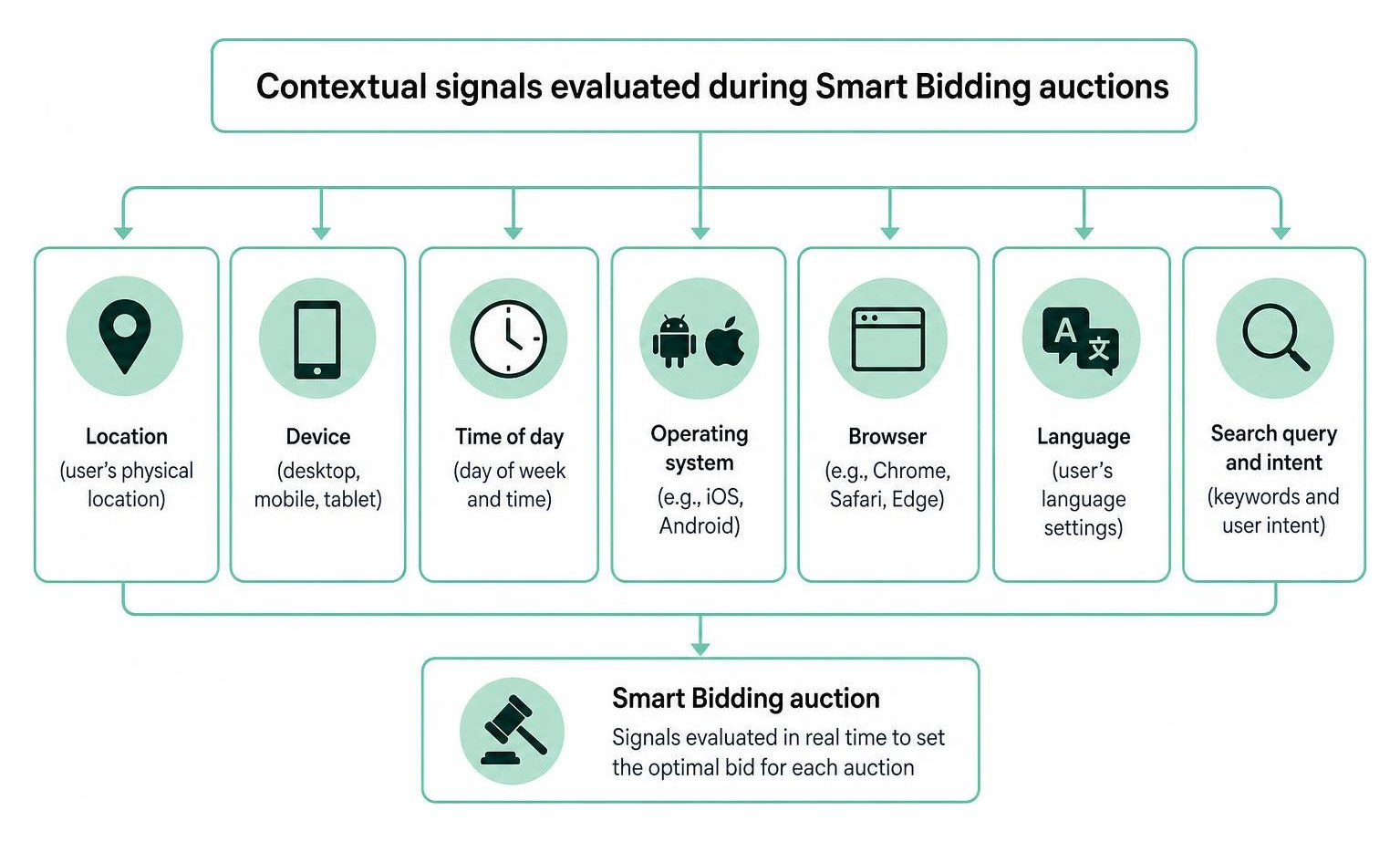
Rather than looking at keyword performance in static, historical blocks, Smart Bidding relies on auction-time optimization. It evaluates rich contextual signals—including the searcher’s physical location, device, time of day, operating system, browser, language settings, and actual search query intent—all in real time. Learn more about these foundational mechanics in About automated bidding – Google Ads Help.
When you align Smart Bidding with structured account structures, you give machine learning the historical conversion volume it needs to refine its predictive accuracy. To see how account structure impacts automation, check out our guide on Unlock Growth: How Google Ads Manager Streamlines Your Business.
Core Smart Bidding Models: Target CPA, Target ROAS, and Beyond
Smart Bidding features several primary models built for direct response performance:
- Target CPA (Cost Per Acquisition): Automatically sets search bids to get as many conversions as possible at or near your targeted cost per lead.
- Target ROAS (Return on Ad Spend): Sets auction bids to maximize total conversion value while aiming for a specific average percentage return on ad spend.
- Maximize Conversions: Spends your full daily budget to get the maximum number of conversions, regardless of individual CPA.
- Maximize Conversion Value: Focuses entire campaign spend on generating the highest dollar value of revenue possible.
In June 2026, Google streamlined bidding strategy labels across accounts. Options previously styled as “Maximize conversions with a Target CPA” or “Maximize conversion value with a Target ROAS” were simplified to Target CPA and Target ROAS directly. While the names are cleaner, the underlying machine learning logic remains identical. You can review official capabilities via AI-powered Smart Bidding & Bid Optimizations – Google Ads.
ECPC Deprecation and Modern Smart Bidding Evolution
For years, Enhanced Cost Per Click (ECPC) served as a transitional bridge for advertisers wanting partial manual control with subtle automated adjustments. However, Google officially deprecated Enhanced CPC for Search and Display campaigns back in March 2025. Campaigns that were not proactively migrated to modern Smart Bidding strategies automatically defaulted back to standard Manual CPC.
This shift accelerated the transition toward full query-level learning. Modern Smart Bidding doesn’t just evaluate keywords in isolation; it shares query performance insights across entire accounts. This query-level adaptive learning allows brand-new or low-volume keywords to benefit immediately from historical search data collected across the wider account.
Practical Execution: How to Set and Adjust Keyword Bids
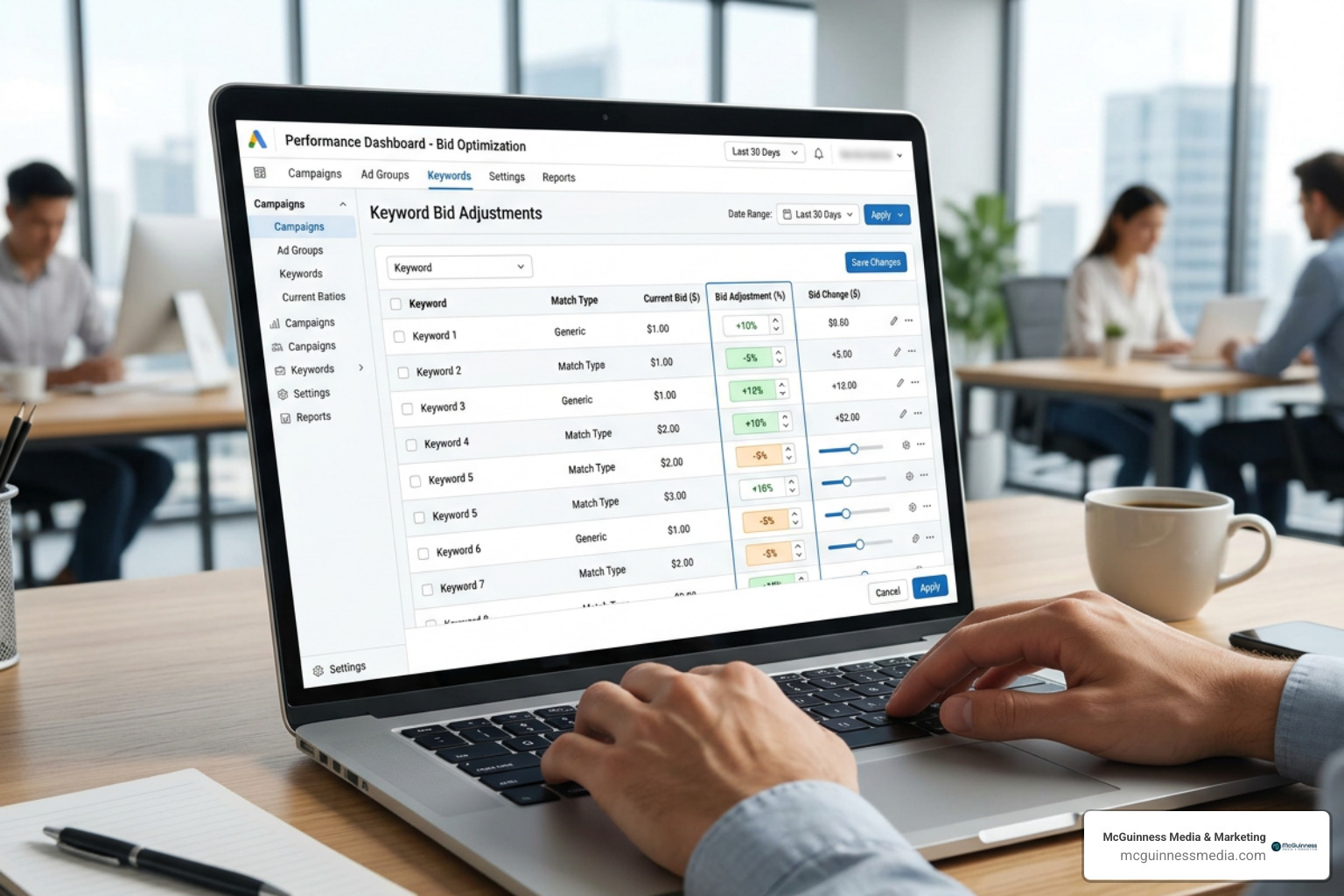
Setting initial keyword bids requires a grounded mathematical approach. When launching a manual campaign, start by using Google Keyword Planner to find top-of-page and estimated first-page bids. A helpful rule of thumb is adding 20% to 30% to the first-page bid estimate to secure good initial placement without overpaying.
When calculating target bids for lead generation campaigns manually, you can derive your target maximum CPC using your acceptable target CPA and landing page conversion rate:
$$\text{Target CPC} = \text{Target CPA} \times \text{Conversion Rate}$$
For example, if your business can afford a $100 Target CPA and your landing page converts traffic at 5%, your target base bid should be $5.00 ($100 × 0.05). Setting sensible bid caps when testing automated strategies like Maximize Clicks ensures CPC spikes won’t eat through your daily budget unexpectedly. For a deeper look at budgeting and media allocation, see our guide on Maximizing ROI: Media Planning Tips for Small Businesses.
When to Raise vs Lower Your Keyword Bids
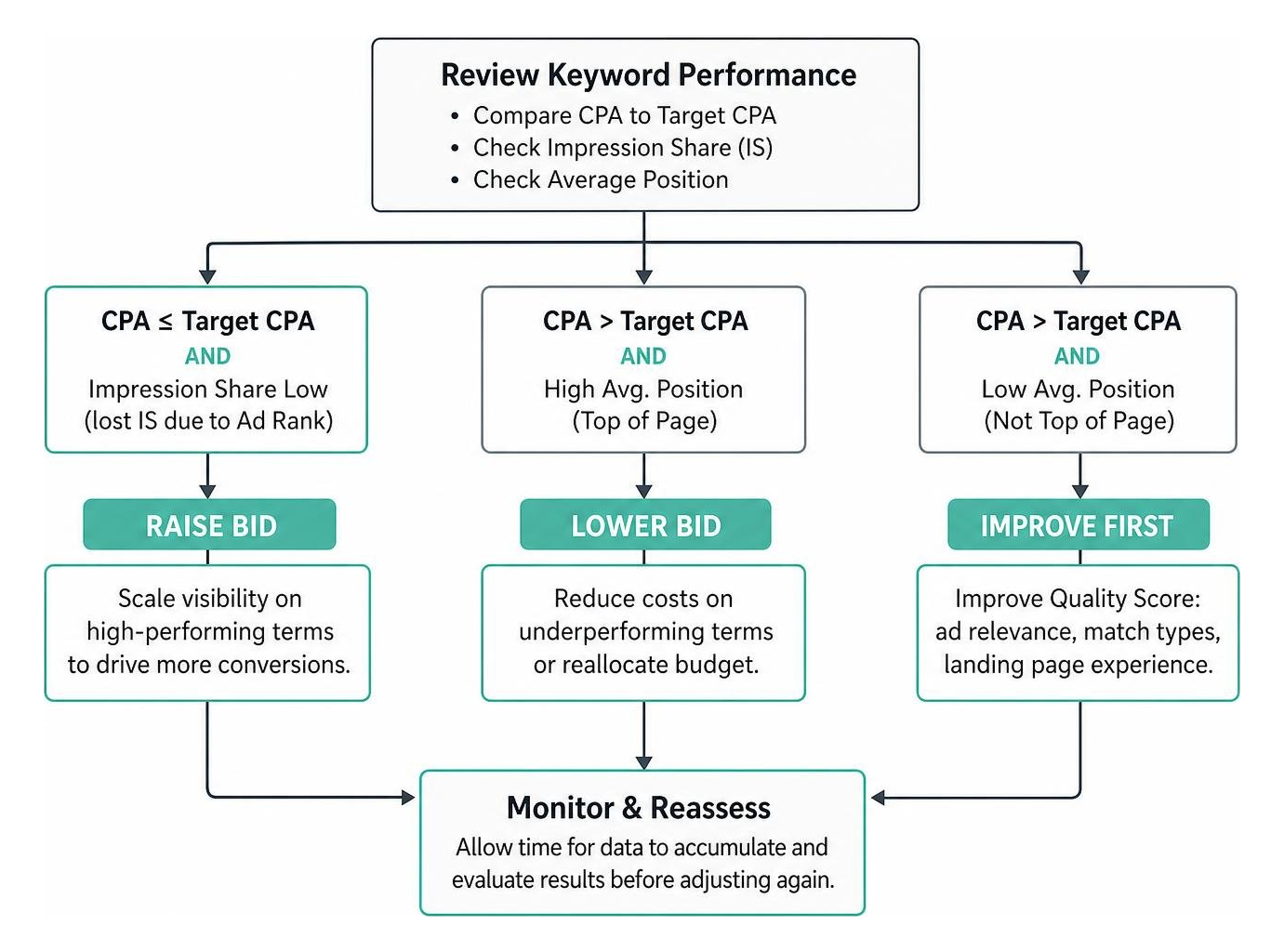
Managing bids is an ongoing, continuous process. Here is how to know when to make adjustments based on performance data:
- When to Raise Bids: If a keyword generates conversions at a CPA below your target, but you are losing Impression Share due to Ad Rank, raise the bid. Increasing bids on high-performing terms scales your impression volume on terms that generate real revenue.
- When to Lower Bids: If a keyword consistently incurs high costs and drives CPAs well above your target threshold despite sitting in top positions, lower the bid. This forces the auction to acquire clicks at a cheaper rate or frees up budget for better-performing terms.
- Improving Quality Score: Before aggressively raising bids on low-performing terms, review your Quality Score. Improving ad relevance, refining match types, and tightening landing page content can elevate your position without increasing your actual CPC.
Advanced Optimization: Device, Location, and Time Signals
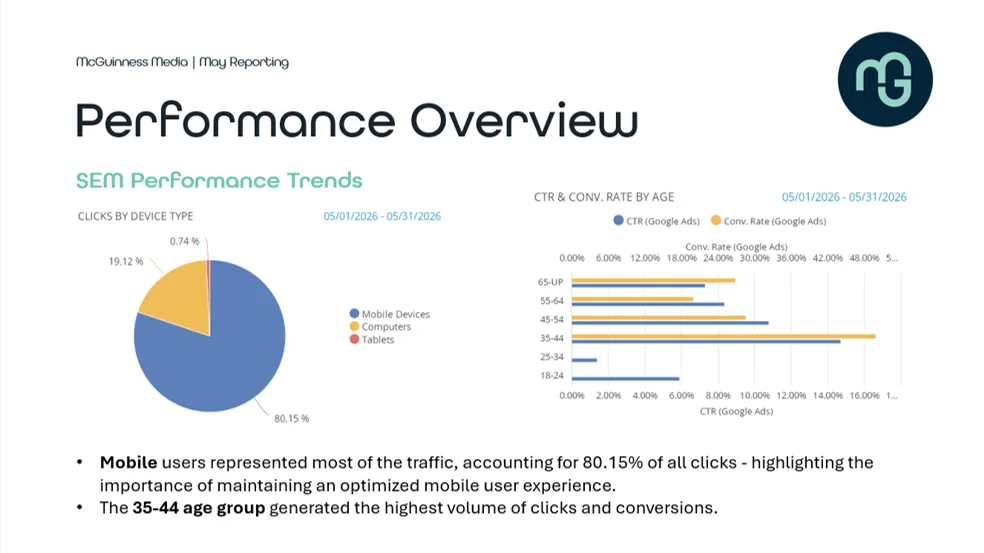
Manual bid adjustments allow you to apply percentage modifiers based on user parameters. You can adjust bids higher or lower for specific devices (mobile vs. desktop), physical locations (zip codes, cities, or radiuses), and ad schedules (peak operating hours).
While manual bid modifiers multiply linearly (e.g., location bid adjustment × device adjustment), Smart Bidding handles these factors through cross-signal analysis. Rather than applying independent static multipliers, Smart Bidding evaluates how location, time, device, browser, and user context interact simultaneously during the live auction.
Best Practices for Scaling Bids and Creative Performance

When scaling successful Google Ads campaigns, slow and steady wins the race. Sudden, drastic bid changes can throw automated algorithms into a disruptive learning period, causing temporary performance volatility.
When adjusting targets or budgets, keep changes within 10% to 15% incremental steps. Allow the algorithm several days to calibrate to the new baseline before introducing further modifications.
To keep machine learning algorithms performing at their peak, combine strategic bid management with robust creative and fee management:
- Review continuous creative testing insights in How to Effectively Manage Your Ad Creatives for Maximum ROI.
- Understand media agency pricing structures and operational costs in What’s the Price Tag? A Deep Dive into Google Ads Management Fees.
Troubleshooting Common Google Ads Bid Management Challenges
Even properly structured campaigns hit hurdles. Here is how we diagnose and fix common bidding issues:
- Fixing Overbidding & Wasted Spend: High CPCs and rapid budget depletion usually stem from overly broad targeting or uncapped automated bidding on low-intent queries. Implement strict negative keyword lists, set target bid caps, and review search term reports weekly to weed out irrelevant traffic.
- Resolving Underbidding & Low Impressions: If ads aren’t getting impressions, your bids may sit below the first-page minimum required by competition. Check Impression Share lost to rank, slightly raise target CPAs or maximum CPC limits, and ensure Quality Scores aren’t dragging your Ad Rank down.
- Budget Constraints: When daily budgets hit strict caps early in the day, lower keyword bids or tighten target CPAs slightly. This allows your budget to stretch across more total clicks throughout the entire day rather than burning out during morning hours.
Frequently Asked Questions About Google Ads Bidding
How does Google Ads determine which ad shows in search results?
Google Ads runs an instant auction every time an ad space is available. The system calculates an Ad Rank for every eligible ad using your Max CPC bid (or automated bid target), Quality Score (evaluating expected CTR, ad relevance, and landing page experience), ad extension impact, and searcher context. The ad with the highest Ad Rank earns the top position.
How many conversions do you need for Smart Bidding to perform well?
While Google notes that Smart Bidding can function with as few as 15 conversions per month, optimal performance and algorithmic stability occur when a campaign generates 50+ conversions within a 30-day window. Higher conversion volumes provide the historical data machine learning needs to identify subtle cross-signal patterns reliably.
Should I choose manual bidding or automated bidding for new campaigns?
For brand-new campaigns lacking historical account data, starting with Manual CPC or Maximize Clicks with a maximum bid cap is often best. This allows you to gather clean initial conversion data, test ad copy, and establish search term relevance without letting uncapped algorithms overspend. Once the campaign gathers consistent conversion history, you can seamlessly transition to Target CPA or Target ROAS portfolio strategies.
Conclusion
Mastering google ads bid management is an ongoing blend of mathematical analysis, continuous testing, and clear business alignment. Whether you are using manual bid adjustments for granular term-by-term control or taking advantage of AI-driven Smart Bidding cross-signal analysis, your bid strategy must always serve your overarching financial goals.
At McGuinness Media & Marketing, based right here in Warwick, Rhode Island, we help local and regional businesses turn complex digital media channels into clear revenue drivers. From building high-converting media strategies to refining bid management across competitive markets, we ensure every advertising dollar works toward measurable growth.
Ready to eliminate wasted ad spend and scale your campaign ROI? Explore our full suite of Services/Digital Marketing and partner with our expert team today!