How Media Buying Houses Can Spend Your Ad Budget Better
Understanding Media Buying Houses and Core Agency Services
At its core, media procurement is the art and science of acquiring advertising space on the platforms where your prospective customers spend their time. Media buying houses serve as the specialized intermediaries between brands and publishers. Rather than expecting an in-house team to navigate hundreds of ad platforms, linear networks, and digital publishers, brands leverage these agencies to manage their entire media investment.
A primary advantage of working with established media buying houses is their deep publisher relationships. Because agencies manage substantial cumulative ad spend across multiple clients, they hold direct lines to major media networks, local broadcasting stations, programmatic exchanges, and outdoor inventory providers. These relationships unlock preferred placement opportunities, premium inventory access, and favorable bulk rate negotiations that individual businesses rarely secure on their own.
Effective ad procurement goes far beyond securing a low cost per thousand impressions (CPM). It requires systematic rate negotiation, audit-backed impression verification, and precise inventory management. Media buying houses actively monitor campaign pacing to ensure ad units run as scheduled, prevent placement overlap, and hold publishers accountable through make-goods if ad placements fall short of contracted performance standards.
Core Offerings of Modern Media Buying Houses
Modern advertising requires a holistic approach that bridges traditional formats with cutting-edge digital ecosystems. The core offerings provided by media buying houses ensure every dollar spent serves a specific business objective.
- Media Planning and Research: Before spending a single dollar, agencies conduct market research, demographic segmentation, and media consumption analysis to pinpoint ideal target channels.
- Ad Space Acquisition and Rate Negotiation: Agencies negotiate terms across digital and traditional media formats, leveraging network volume to secure competitive rates.
- Cross-Channel Execution: Managing synchronized placements across diverse touchpoints, including paid search, social platforms, connected TV, broadcast radio, and digital out-of-home (DOOH).
- Ad Placement and Traffic Management: Overseeing technical setup, ad tag placement, dynamic creative delivery, and timeline scheduling.
- Performance Tracking and Campaign Optimization: Continuously analyzing live campaign data to reallocate funds away from underperforming placements toward high-converting inventory.
To see how these elements fit into a full campaign lifecycle, read our Step By Step Guide To Media Buying Services.
Comparing Media Buying Houses to Full-Service Ad Agencies
When selecting an agency partner, brands often weigh the choice between specialized media buying houses and full-service creative agencies. Understanding their core differences ensures your budget matches your strategic priorities.
| Feature / Capability | Specialized Media Buying Houses | Full-Service Ad Agencies |
|---|---|---|
| Primary Focus | Media planning, rate negotiation, programmatic buying, ad trafficking, and channel optimization. | Holistic brand management, creative strategy, copy, graphic design, and media procurement. |
| Creative Execution | Relies on client-provided assets or external design partners; focuses strictly on ad distribution. | In-house creative production, messaging, branding assets, video production, and visual identity. |
| Strategic Scope | Focused on distribution efficiency, ROI, impression share, dynamic placement, and media efficiency. | High-level Services/Branding And Strategy, public relations, event marketing, and brand identity. |
| Service Packaging | Flexible pricing centered around ad spend, retainer fees, or performance metrics. | Comprehensive project bundling, covering creative concepts through media execution under unified retainers. |
While specialized agencies excel at execution efficiency, full-service partners eliminate communication silos between creative teams and media planners, ensuring messaging directly aligns with media placements.
The 2026 US Media Procurement Landscape: Programmatic, CTV, and AI Trends

As we navigate 2026, the media buying landscape is evolving rapidly. Media buyers now rely heavily on sophisticated data intelligence platforms, automated bidding algorithms, and connected ecosystems to maximize reach and return. Classified under NAICS code 54183, the US media buying agency industry reflects a dynamic market balancing technological advancement with strategic consolidation.
Industry Growth and Market Consolidation
The total number of media buying agencies operating in the United States stands at 606 as of 2026. This represents a modest 1.3% decline compared to 2025, continuing a broader consolidation trend observed over recent years. From 2021 to 2026, the number of media buying businesses declined at a Compound Annual Growth Rate (CAGR) of -2.5%.
This annualized business decline is driven primarily by market consolidation and technological adoption. Larger global agency networks hold significant market share. Simultaneously, independent media buying houses are adopting human strategy backed by AI efficiency, allowing leaner teams to manage substantial global ad volumes without expanding headcount. For instance, integrated international networks demonstrate this shift by managing over 21 million euros in advertising spending across 30+ countries with hyper-efficient operational models.
Technology-Driven Shifts: Programmatic, CTV, and AI
Technology continues to reshape ad buying strategies. By adopting an advanced approach, brands can navigate three core drivers in today’s media environment:
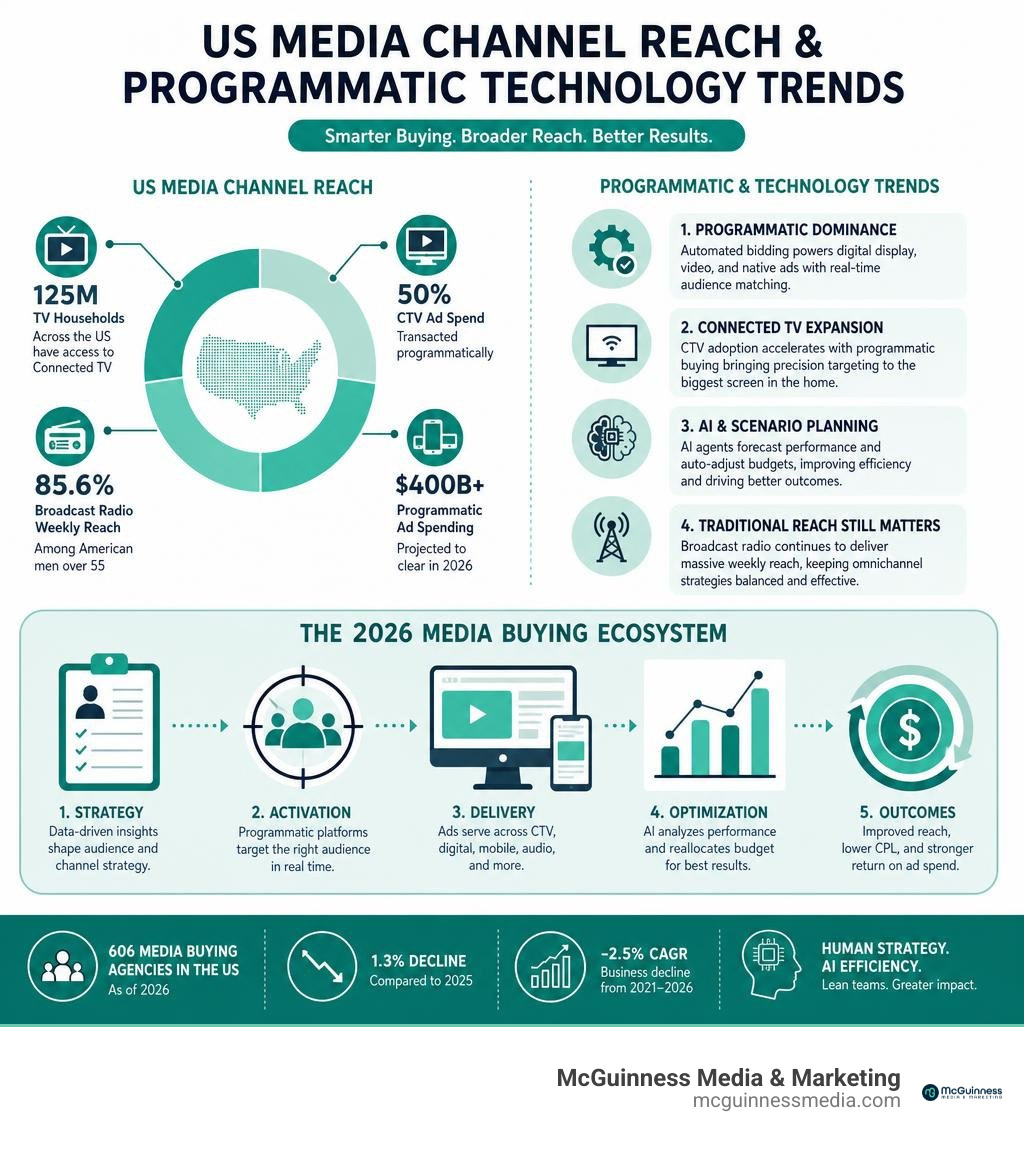
- Programmatic Dominance: Programmatic advertising ad spending in the US is projected to clear $400 billion by 2026. Automated bidding algorithms now handle the vast majority of digital display, video, and native ad inventory, offering real-time audience matching.
- Connected TV (CTV) Expansion: Linear television continues its shift toward digital streaming formats. Today, 50% of connected TV advertising budgets are transacted programmatically. With 125 million TV households across the US, CTV allows brands to pair high-impact living room viewing with precise digital targeting.
- Artificial Intelligence and Scenario Planning: AI agents are no longer novelties; they are foundational to media workflows. Agencies use AI scenario planning models to process briefs, forecast channel performance, and automate budget reallocations in real time. In practice, leveraging AI-driven scenario adjustments can cut cost per lead (CPL) by as much as 18%.
- Traditional Media Reach: Despite digital acceleration, traditional channels remain powerful reach tools. Broadcast radio continues to reach 85.6% of American men over 55 every week, demonstrating why omnichannel strategies must balance modern programmatic tools with high-performing broadcast channels.
To learn how to merge modern programmatic technology with creative outreach, explore Your Blueprint For Success Crafting A Winning Media Buying Strategy.
Agency Pricing Models and Cost Breakdowns
Understanding agency pricing structures allows brands to select partners that fit their fiscal parameters while maintaining fee transparency.
Common Pricing Models: Percentage of Spend, Retainers, and Hourly Rates
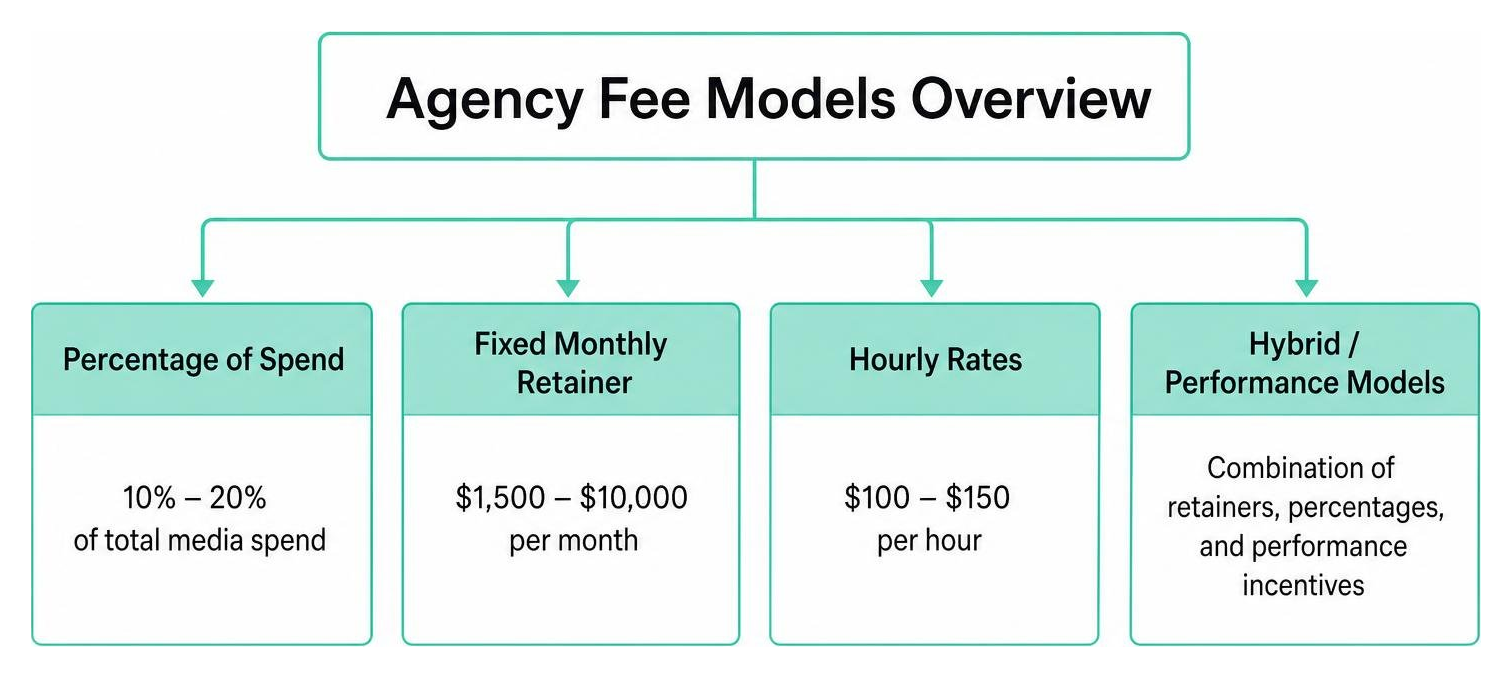
Media buying houses typically structure their compensation models using one of three standard methods:
- Percentage of Media Spend: The industry standard for active spend management. Agencies charge a fee ranging from 10% to 20% of total media spend. This model scales directly with campaign volume and incentivizes continuous optimization.
- Monthly Retainers: A fixed fee covering ongoing planning, campaign maintenance, optimization, and reporting. Typical monthly retainers for media buying agencies range from $1,500 to $10,000 depending on scope, channel count, and campaign complexity.
- Hourly Rates: Used for strategic consulting, media auditing, or project-based setups. Most media buying agencies charge between $100 and $150 per hour, though market rates cross the spectrum from $15/hr for basic administrative tasks up to $250/hr for executive strategic direction.
- Hybrid and Performance Incentives: Some performance-driven agencies offer base retainers paired with lower percentage charges, tied directly to key performance indicators like target cost per acquisition (CPA) or return on ad spend (ROAS).
Budget Allocation Strategies for Small Businesses
Small and mid-sized businesses do not need multi-million-dollar budgets to work effectively with media buying houses. Many agencies establish minimum budget thresholds starting under $1,000 per month, making strategic procurement accessible to emerging brands.
To maximize budget efficiency, smaller advertisers should prioritize high-intent channels. By pairing localized hyper-targeting with CRO (conversion rate optimization) tactics, businesses can scale spending gradually. Read our guide on Maximizing Roi Media Planning Tips For Small Businesses to see how small ad spend adjustments yield meaningful sales growth. Furthermore, utilizing integrated Services/Digital Marketing ensures traffic sent from paid channels converts efficiently on your site.
Evaluating Agencies and Selecting the Ideal Strategic Partner
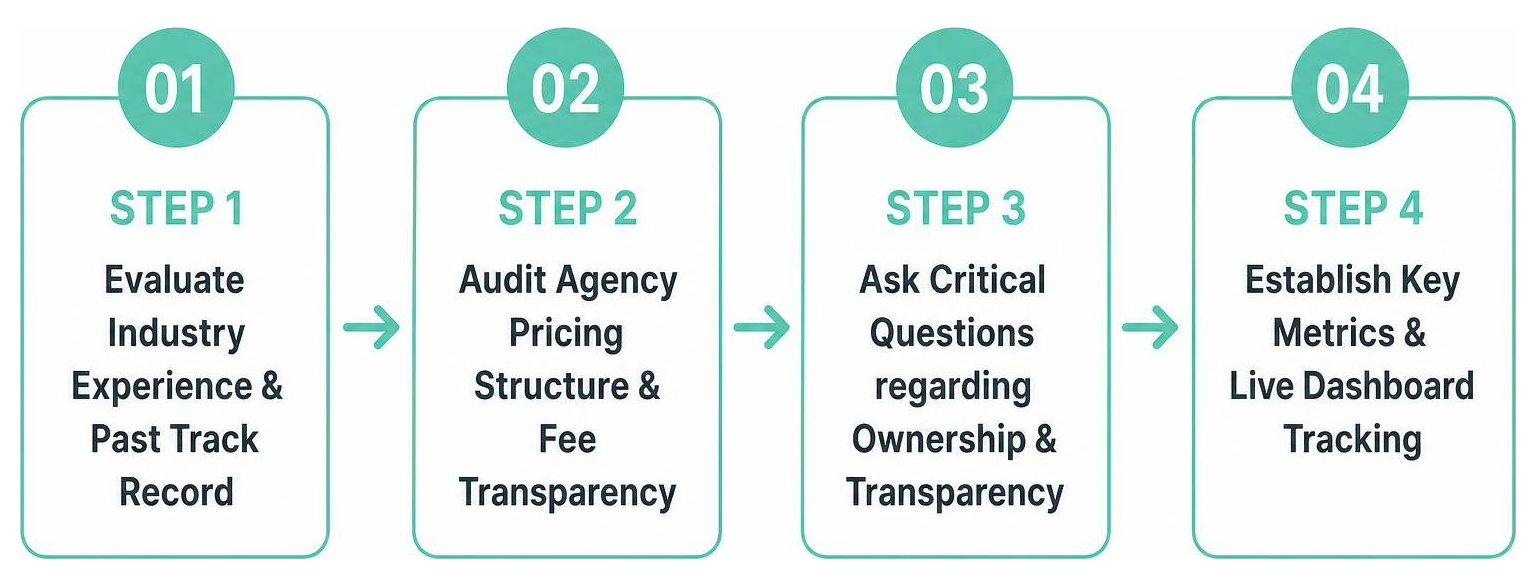
Selecting the right partner requires assessing technical execution, market expertise, and fee transparency.
Key Questions to Ask Before Hiring a Media Buyer
Before signing a contractual agreement, ask potential partners these essential vetting questions:
- “How are your media buying fees structured, and do you receive rebates or kickbacks from publishers?” Ensure complete financial transparency so your ad spend translates into direct inventory purchasing power.
- “Who owns the ad accounts and data generated during our campaigns?” Your business should always maintain direct ownership of ad accounts, pixel data, and historical performance logs.
- “What experience do you have in our specific industry or geographic market?” Agency familiarity with local media markets, regional regulations, and niche audience behaviors reduces testing timelines.
- “How frequently do you audit campaign placements and perform brand safety checks?” Verify that the agency actively monitors placements to prevent ads from running alongside inappropriate content or fraud-prone inventory.
- “What level of direct access will we have to our day-to-day media team?” Strong relationships rely on responsive client services. Explore our dedicated approach to client communication via Services/Client Service.
Crucial Metrics and KPIs to Measure Success
To evaluate campaign efficiency, brands should track clear key performance indicators through real-time dashboards rather than waiting for delayed monthly static reports.
- Return on Ad Spend (ROAS): Gross revenue generated directly per dollar invested in ad placements.
- Cost Per Acquisition (CPA) / Cost Per Lead (CPL): The exact media cost required to drive a single conversion or qualified business lead.
- Conversion Rate (CVR): The percentage of users clicking through ad placements who complete desired actions on landing pages.
- Impression Share and Frequency: The proportion of target audience impressions captured versus the total available inventory, coupled with how often individual users view your creative.
- Cost Per Thousand Impressions (CPM) and Click-Through Rate (CTR): Primary metrics gauging media buying efficiency and creative resonance across target channels.
Frequently Asked Questions About Media Buying
What is the primary role of a media buying agency?
A media buying agency plans, negotiates, purchases, and optimizes ad inventory across digital and traditional channels. Their core objective is ensuring ad budgets achieve maximum reach, drive target conversions, and deliver measurable return on ad spend by leveraging rate negotiations, publisher relationships, and continuous data optimization.
How much do media buying agencies typically charge?
Agency fee structures vary depending on scope and media spend. Standard billing models include percentage of ad spend (typically 10% to 20%), fixed monthly retainers (ranging from $1,500 to $10,000 per month), or hourly fees (commonly between $100 and $150 per hour). Minimum project budgets can start under $1,000, though larger performance packages often require higher minimum commitments.
What is the difference between programmatic and manual media buying?
Programmatic media buying uses automated software platforms and real-time bidding algorithms to purchase digital ad impressions instantly based on target audience data. Manual media buying involves direct human negotiation and direct insertion orders (IOs) with specific publishers, commonly used for high-impact sponsorships, custom integrations, or traditional broadcast inventory.
Conclusion: Elevating Your Brand Strategy with McGuinness Media & Marketing
Navigating ad placement costs, tech platforms, and programmatic platforms requires strategic expertise. Media buying houses serve as crucial partners in translating ad spend into sustainable, measurable revenue growth. By eliminating ad spend waste, securing negotiated rates, and continuously optimizing across channels, the right agency partner transforms advertising from an expense into an engine for expansion.
As a premier Rhode Island-based marketing and advertising agency with deep regional root strength, McGuinness Media & Marketing brings clarity, creative excellence, and media performance to your brand. Whether scaling regional presence or optimizing national programmatic campaigns, our hands-on approach ensures your budget works harder across every channel.
Ready to optimize your media investment? Visit Services/Media Planning today to discover how our team can transform your campaign ROI.