
Step-by-Step Blueprint: Creating a Strategic Marketing Plan From Scratch
How to Create a Strategic Marketing Plan
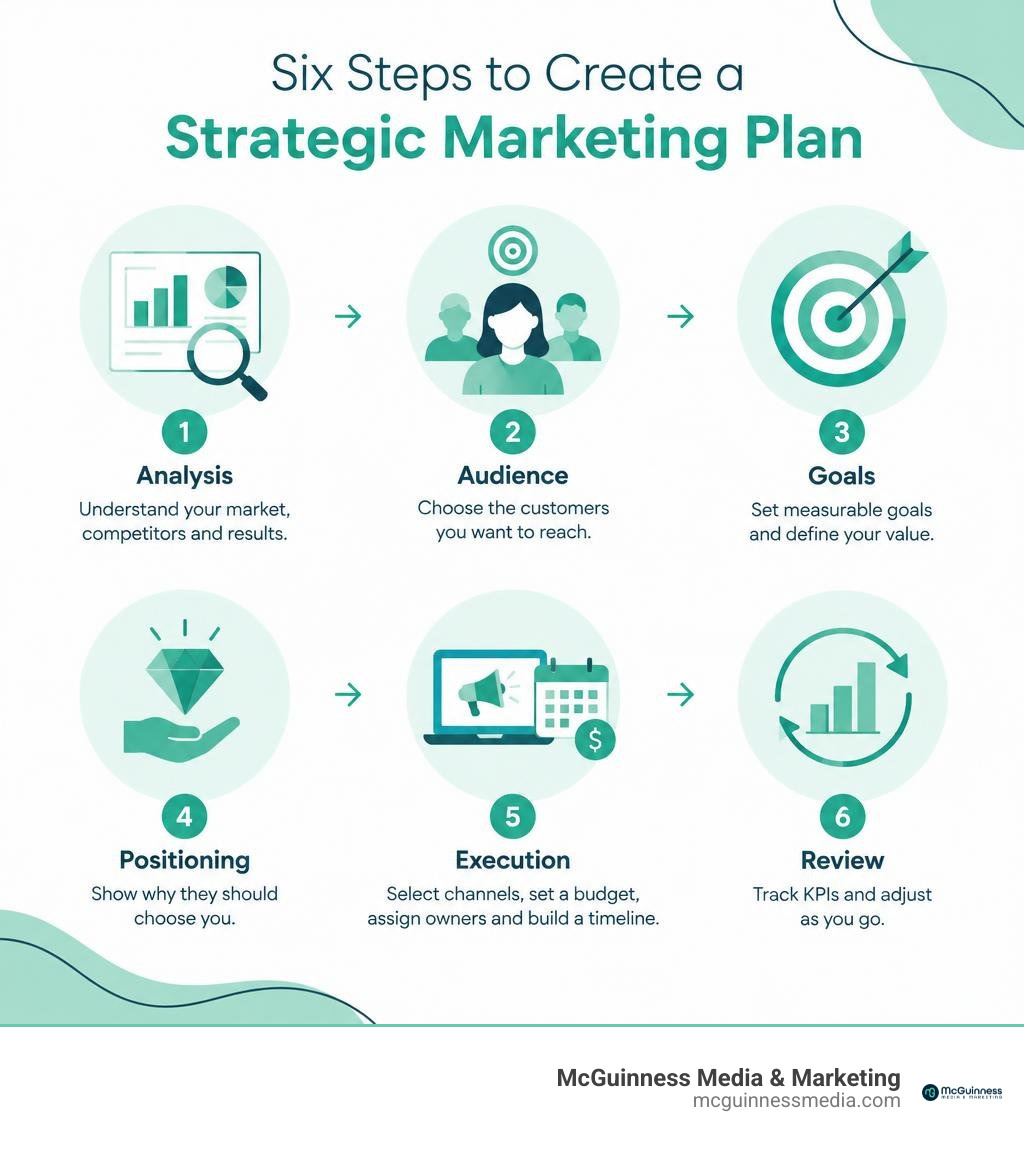
Start with the business goal, not a list of campaigns. Review your market, competitors, and current results. Choose the customers you want to reach, set measurable goals, and spell out why they should choose you. Then select channels, assign a budget and owners, and build a timeline with KPIs you can review and adjust.
A strategic plan makes those choices work together. It helps you focus your time and money on growth you can measure, rather than marketing activity for its own sake.
I’m Megan McGuinness, owner and chief marketing officer of McGuinness Media & Marketing. I’ve spent more than 20 years creating a strategic marketing plan and related campaigns for regional, national, and global brands across industries including retail, finance, and hospitality.
Creating a strategic marketing plan helpful reading:
- brand communications strategy
- developing marketing strategies and plans ppt
- control of marketing plan
Strategic vs. Tactical Marketing: Understanding the Core Differences
Too many marketing teams confuse busywork with real momentum. They jump straight into posting daily on social media, redesigning logos, or experimenting with ad platforms without asking why those tasks matter to the bottom line.
Tactics are the individual actions you take—writing a blog post, sending an email newsletter, or running a paid search campaign. Strategy is the overarching blueprint that determines which actions are worth taking, who they are built for, and how they drive commercial growth. Without a solid strategic foundation, tactical execution simply accelerates wasted spend. Research shows that marketing leaders who plan out 18 months or more are 1.5 times more likely to report high marketing and business performance compared to those who operate month-to-month.
Understanding the difference between long-term vision and short-term execution ensures you build a sustainable competitive advantage in dynamic markets. For an in-depth look at structuring this process, explore a comprehensive guide to the strategic marketing planning process.
| Strategic Marketing Plan | Tactical Execution Plan |
|---|---|
| Focus: Long-term market positioning and sustainable revenue growth (12–36 months). | Focus: Short-term delivery of specific initiatives, campaigns, and tasks (weekly to quarterly). |
| Core Question: Why are we competing, where should we play, and who are our most profitable buyers? | Core Question: How, when, and where will specific creative assets be deployed? |
| Governance: Grounded in market research, competitive audits, and business unit objectives. | Governance: Driven by content calendars, sprint boards, creative briefs, and production cycles. |
| Metrics: Market share, Customer Acquisition Cost (CAC), Lifetime Value (LTV), pipeline velocity, net revenue. | Metrics: Impressions, clicks, open rates, form submissions, social engagement. |
| Adaptability: Stable overarching vision; adjusted strategically during quarterly or annual business reviews. | Adaptability: Iterated constantly based on weekly channel performance and A/B test data. |
Essential Components of an Actionable Strategic Plan
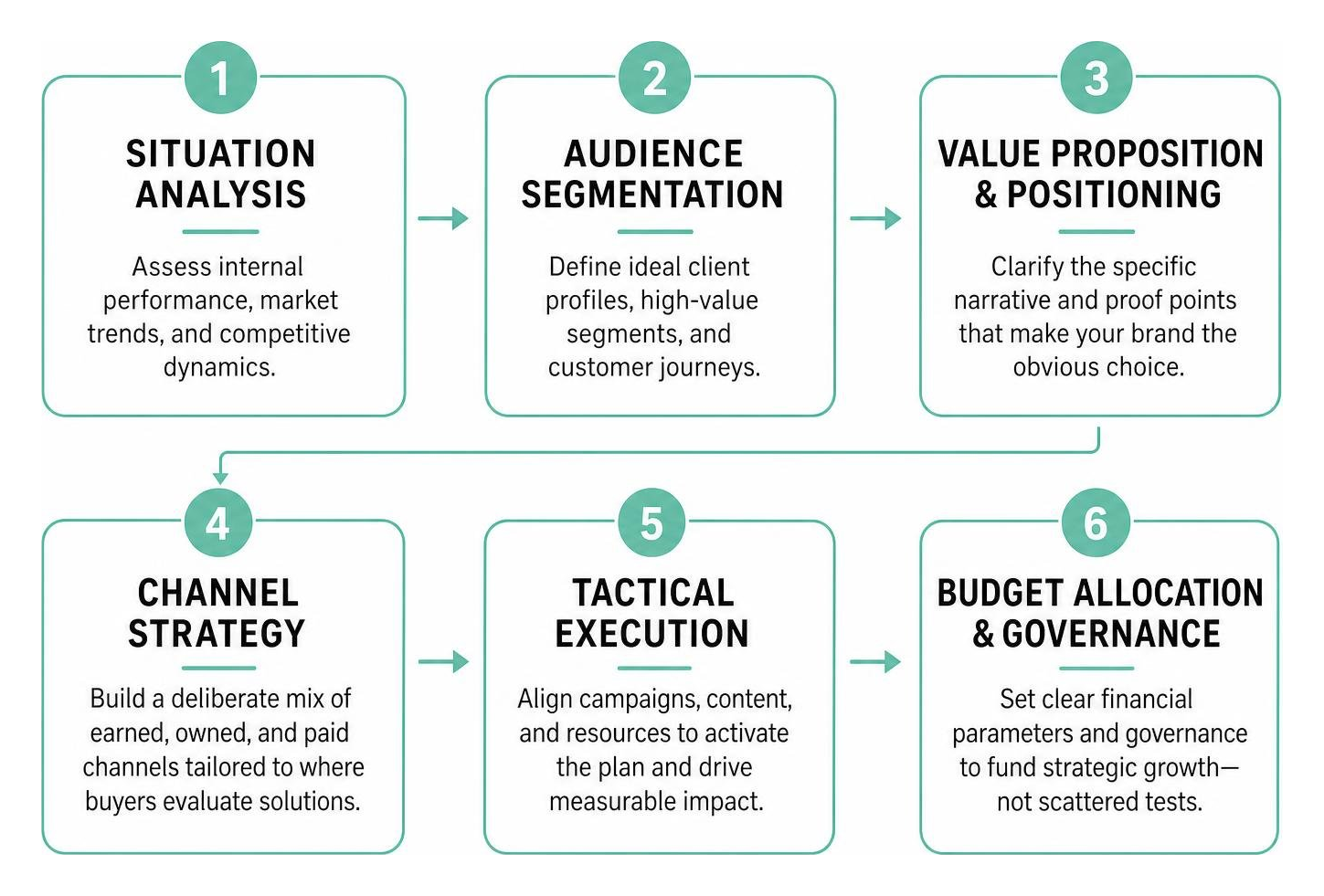
A complete strategic plan aligns every dollar invested with enterprise outcomes. If any single component is missing, the plan quickly loses direction:
- Mission and Vision: The clear purpose behind your business, outlining your distinctive competence and long-term trajectory.
- Situation Analysis: An honest assessment of your internal performance capabilities, market trends, and competitive dynamics.
- Audience Segmentation: Granular definitions of your ideal client profiles, high-value segments, and customer journeys.
- Value Proposition and Positioning: The specific narrative and proof points that make your brand the obvious choice over alternatives.
- Channel Strategy: A deliberate mix of earned, owned, and paid channels tailored to where your buyers actively evaluate solutions.
- Budget Allocation and Governance: Clear financial parameters that fund strategic growth rather than scattered promotional tests.
Establishing these components mirrors the core principles outlined in official guidelines for business planning, establishing a baseline for sustainable commercial expansion.
The 6-Step Roadmap to Creating a Strategic Marketing Plan
Developing an actionable plan requires a structured methodology that moves logically from market intelligence to tactical execution. Rather than building endless, dense documents that gather digital dust, high-performing organizations use structured frameworks like SOSTAC (Situation, Objectives, Strategy, Tactics, Action, Control) to bridge executive vision and day-to-day work.

Whether you are scaling a regional enterprise or refining an established brand, our approach to practical brand growth planning provides the structured sequence required to achieve predictable, measurable results.
Step 1: Conducting a Situation and SWOT Analysis
You cannot chart a course to where you want to go until you take a hard, objective look at where you stand right now. A thorough situation analysis evaluates both your external operating climate and your internal functional health.
Start with your external environment by looking at macro factors through the DESTEP lens (Demographic, Economic, Social, Technological, Ecological, and Political forces) and meso factors using Porter’s Five Forces. This reveals shifts in buyer behavior, emerging technological tools, and competitive pressures.
Next, conduct an internal gap analysis to uncover operational bottlenecks, resource deficits, or asset limitations. Summarize these findings into a strategic SWOT analysis:
- Strengths: Proprietary technology, strong brand reputation, established distribution networks, or seasoned internal talent.
- Weaknesses: Gaps in creative production, legacy technical infrastructure, or lack of channel diversification.
- Opportunities: Underserved customer niches, declining competitor visibility, or shifts in regional consumer demand.
- Threats: Margin compression from rising media costs, aggressive price undercutting, or shifting regulatory requirements.
Translate these quadrants into strategic actions using a confrontation matrix—cross-referencing your internal strengths against market opportunities to prioritize your highest-yield initiatives.
Step 2: Defining Target Audiences and Buyer Personas
Vague targeting guarantees wasted budget. If your plan attempts to appeal to everyone, it will resonate with no one. Winning marketing strategies rely on clearly defined Ideal Client Profiles (ICPs) and detailed buyer personas.
Segment your addressable market by combining firmographic/demographic data with deep psychographic and behavioral insights:
- Core Pain Points: What specific operational headaches or emotional frustrations are costing your prospects time, money, or peace of mind?
- Buying Triggers: What distinct internal or external events prompt them to actively search for a solution?
- Information Gathering Habits: Where do they research potential partners? Do they read specialized industry publications, evaluate peer recommendations on LinkedIn, or rely on search engines?
- Decision Criteria: What matters most to them during the evaluation phase? (e.g., speed to implementation, custom creative excellence, proven ROI, or high-touch account service).
Map each persona across their buying journey—from initial problem awareness to final vendor selection—ensuring your upcoming messaging speaks directly to their decision-making criteria.
Step 3: Setting SMART Goals and Revenue Objectives
Only 16% of employees report that their organizations set and communicate goals effectively. A strategic marketing plan bridges that gap by connecting every campaign directly to top-line commercial outcomes.
Set SMART objectives (Specific, Measurable, Attainable, Relevant, and Time-bound) that support company-wide targets:
- Ineffective Goal: “Increase brand awareness and generate more qualified leads this year.”
- SMART Objective: “Generate 120 Sales Qualified Opportunities yielding $1.8M in pipeline revenue by Q4, maintaining a Customer Acquisition Cost under $3,200.”
To build realistic targets, use reverse-engineering revenue models that work backward from your commercial targets. For example, if your annual growth goal requires $2,000,000 in new revenue and your average contract value is $50,000, you need 40 closed deals. If your sales team closes 25% of proposals, you need 160 discovery calls or proposals. If your site and lead-generation channels convert prospects into calls at 4%, your marketing plan must generate 4,000 high-intent visitors. This mathematical approach grounds your plan in commercial reality.
Step 4: Crafting Brand Positioning and Value Propositions
Your positioning statement defines the mental real estate your brand owns in the mind of the customer. It answers one fundamental question: Why should your ideal prospect choose you over every alternative on the market, including doing nothing at all?
A clear positioning framework includes:
- Target Segment: The precise audience you serve.
- Category Frame of Reference: The specific market space in which you compete.
- Differentiated Value Proposition: The primary commercial, functional, or emotional benefit you deliver that competitors cannot replicate.
- Proof Points: Verifiable case studies, client outcomes, proprietary methodologies, or operational milestones that substantiate your claims.
Connecting your market position with cohesive brand communications keeps your value proposition unified across every touchpoint, from paid ads to direct sales conversations.
Step 5: Channel Selection and Tactical Execution
A common mistake in marketing is spreading resources across too many channels. It is far more profitable to master two or three core channels than to maintain an ineffective presence across eight.
Select channels based on where your ideal buyers actively spend their attention:
- High-Intent Search & Paid Media: Capture buyers who are actively searching for solutions via Google Search and targeted pay-per-click campaigns.
- Authority-Building Owned Channels: Develop long-term organic search rankings, conversion-focused website hubs, and weekly value-driven email newsletters.
- Targeted Social & Community: Reach B2B decision-makers on LinkedIn or direct-to-consumer audiences across visual and interactive social platforms.
- High-Touch Outbound & Account-Based Marketing: Run personalized outreach and direct mail campaigns tailored to high-value enterprise accounts.
Ensure every selected channel has a dedicated tactical plan detailing content formats, publishing schedules, and conversion paths, as detailed in our guide on digital marketing strategy execution.
Step 6: Budget Allocation and Financial Modeling
Marketing budgets should be treated as strategic investments tied to revenue targets, not arbitrary cost centers.
Academic research on high-performing organizations reveals a clear budget allocation pattern that separates market leaders from laggards:
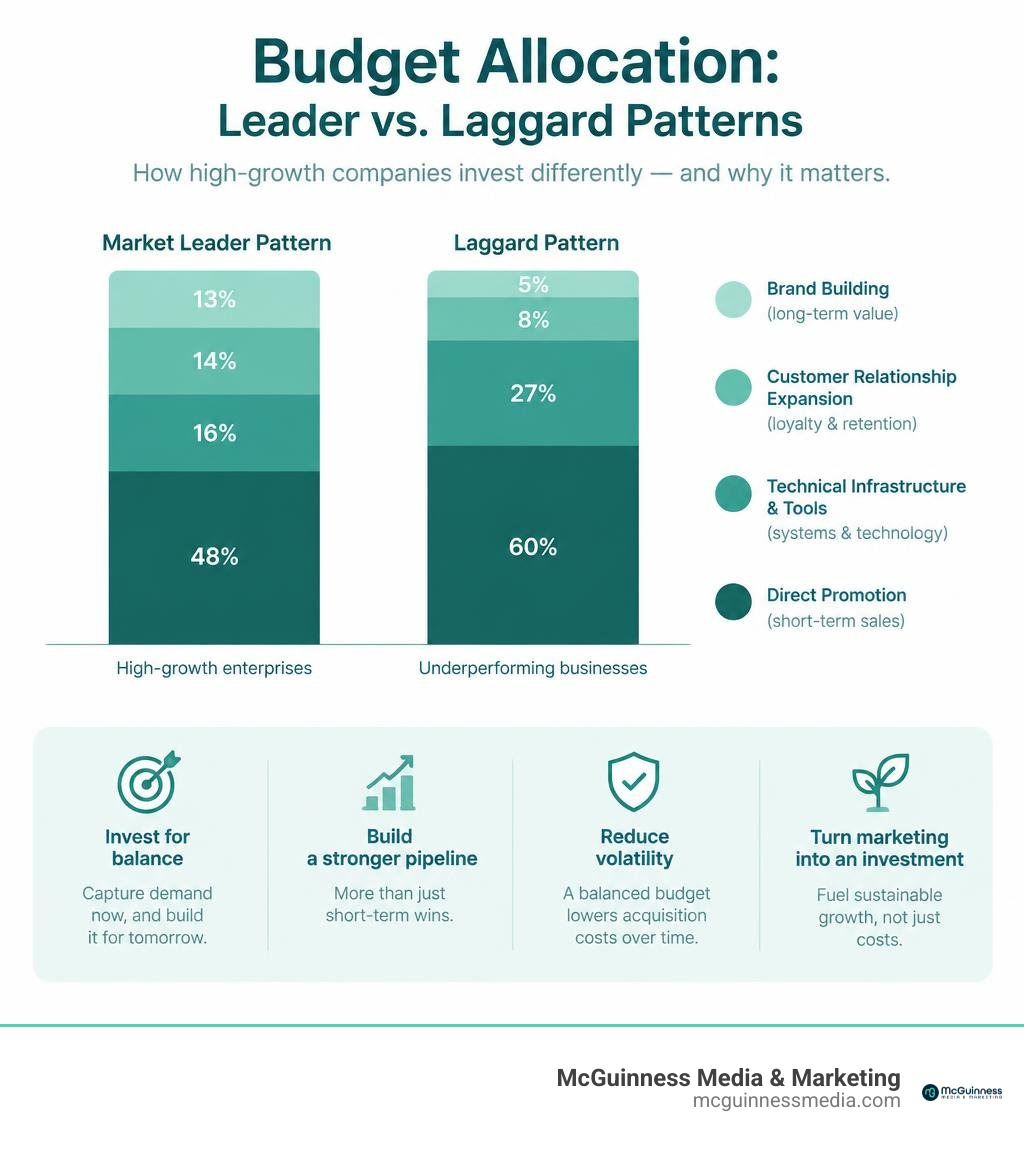
- Market Leader Pattern: High-growth enterprises allocate approximately 48% of their budget to direct promotion, 16% to technical infrastructure and tools, 14% to customer relationship expansion, and 13% to long-term brand building.
- Laggard Pattern: Underperforming businesses often over-index on short-term promotion (allocating 60% or more) while neglecting infrastructure (under 10%) and foundational brand building, leading to volatile acquisition costs.
Balance your capital across demand capture (short-term sales) and demand creation (long-term brand affinity) to build predictable pipeline velocity.
Implementation Roadmap: Execution Timelines and KPI Dashboards
Even the strongest strategy fails without a clear implementation roadmap. A structured execution timeline bridges strategic planning and tactical delivery by establishing phases, assigning ownership, and defining milestones.

Senior leaders looking to scale operational execution can reference the executive playbook for corporate marketing planning to align cross-functional teams around key milestones.
Phased Timelines for Creating a Strategic Marketing Plan
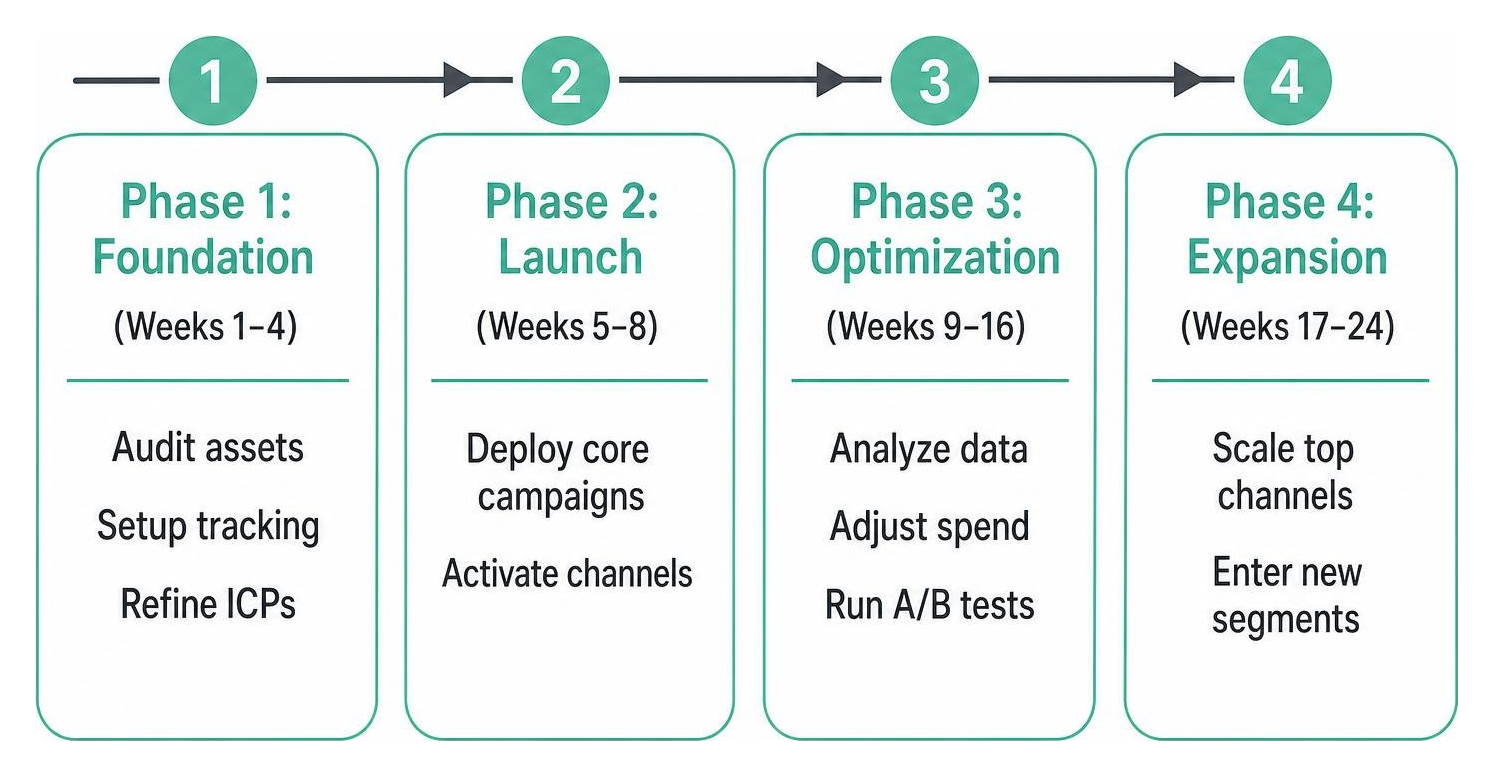
Organizing your execution into four distinct phases prevents your team from burning out or launching unvetted campaigns:
- Phase 1: Foundation (Weeks 1–4): Complete competitive research, configure CRM and analytics tracking, update website conversion pages, and finalize brand messaging guidelines.
- Phase 2: Initial Launch (Weeks 5–8): Deploy targeted search campaigns, initiate lead generation assets, launch refreshed content calendars, and activate email nurture tracks.
- Phase 3: Optimization & Iteration (Weeks 9–16): Review initial conversion data, eliminate underperforming ad sets, reallocate spend to top-performing keywords, and refine sales enablement collateral.
- Phase 4: Scale & Expansion (Weeks 17–24): Expand into secondary audience segments, test new media formats, automate repeatable marketing workflows, and scale programmatic advertising budgets.
Monitoring KPIs and Performance Dashboards
A marketing dashboard tracks the health of your strategy in real time. Organize your metrics across four operational tiers:
- Brand & Awareness Metrics: Organic search visibility, share of voice, branded search volume, media placements.
- Engagement & Lead Metrics: Click-through rates, cost per lead (CPL), content downloads, newsletter growth.
- Pipeline & Sales Metrics: Marketing Qualified Leads (MQLs), Sales Accepted Leads (SALs), opportunity pipeline value, win rates.
- Unit Economics: Customer Acquisition Cost (CAC), Customer Lifetime Value (LTV), Payback Period, Return on Ad Spend (ROAS).
Establish clear “decision triggers” in your measurement framework. For example, if a paid channel’s CAC exceeds your target threshold for three consecutive weeks, that triggers an automatic budget reallocation to higher-performing campaigns. Learn how to maintain operational control with our marketing plan control framework.
Overcoming Strategic Roadblocks and Avoiding Common Pitfalls
Building a strategic marketing plan is only half the battle; maintaining its execution amidst organizational shifts requires deliberate management. Grounding your operational roadmap in established frameworks, such as state business planning fundamentals, ensures compliance and operational stability.
Common Mistakes When Creating a Strategic Marketing Plan
Avoid these five critical pitfalls that frequently derail marketing initiatives:
- Tactical Distraction: Launching new campaigns based on personal preference rather than data from your situation analysis.
- Overcomplicated Documentation: Writing a 60-page PDF that is too dense to execute. Keep your core plan concise, practical, and accessible.
- Attribution Gaps: Failing to connect digital engagement metrics to actual CRM revenue, leaving executive leadership uncertain of marketing’s financial contribution.
- Under-Investing in Creative Execution: Building a brilliant strategic plan but relying on uninspired creative assets that fail to capture audience attention.
- Ignoring Infrastructure: Spending entirely on media placement while using broken landing pages, poorly integrated CRMs, or slow-loading websites.
Managing Stakeholder Alignment and Governance
A strategic plan requires cross-functional buy-in to succeed. Marketing cannot operate in an organizational silo; it must work hand-in-hand with sales, product, finance, and executive leadership.
Maintain governance through a structured communication cadence:
- Weekly Scorecards: Tactical review of active campaigns, ad spend pacing, and immediate lead volume.
- Monthly Operational Reviews: Cross-functional meetings with sales leadership to assess lead quality, pipeline velocity, and conversion feedback.
- Quarterly Strategic Overhauls: Executive presentations comparing actual pipeline contributions against original revenue goals, making planned adjustments for the upcoming quarter.
Frequently Asked Questions About Strategic Marketing Plans
How far in advance should a strategic marketing plan be developed?
We recommend planning your high-level strategy across an 18-month horizon, with detailed tactical execution mapped in rolling 12-week or 90-day sprints. Data shows that CMOs who plan 18 months ahead consistently outperform peers who operate on short-term horizons. Formal planning should ideally take place in October and November to secure executive alignment and budget approvals well before the new fiscal year begins.
How long should a strategic marketing plan document be?
Your strategic plan should exist in two formats:
- The Executive Plan (1–3 pages): A concise summary of high-level goals, market positioning, target audiences, budget allocations, and key milestones designed for executive leadership and board reviews.
- The Working Operational Playbook (5–12 pages): A functional document detailing channel strategies, persona profiles, tactical calendars, KPI scorecards, and team responsibilities. Avoid 40+ page documents; they slow down execution.
How do you measure marketing ROI across diverse channels?
Measuring ROI across diverse channels requires closed-loop reporting that connects front-end marketing analytics directly to your customer relationship management (CRM) database:
- UTM Tracking and Channel Attribution: Tag every digital link with standardized UTM parameters to track lead origins.
- Multi-Touch Attribution Models: Evaluate first-touch (awareness), last-touch (conversion), and linear touchpoints across the entire buyer journey.
- Revenue Integration: Track opportunities through your sales pipeline to calculate actual revenue generated relative to total channel and labor spend. Use the formula: Marketing ROI = (Net Revenue Generated – Marketing Costs) / Marketing Costs.
Conclusion
Creating an effective strategic marketing plan is not an academic exercise—it is the engine that drives predictable business growth. By taking the time to thoroughly analyze your market, define precise audience personas, set mathematical revenue goals, and build a phased implementation roadmap, you eliminate guesswork and focus your resources where they generate the highest return.
At McGuinness Media & Marketing, we partner with growing regional and national brands to build data-driven strategies, award-winning creative campaigns, and high-performance media buying systems. If you are ready to transform your marketing into a scalable revenue driver, connect with our team for comprehensive strategic branding and marketing services.