
A Practical Framework for Marketing Plan Control and Analysis
Control Your Marketing Plan Before Small Gaps Become Big Misses
The control of marketing plan is the ongoing practice of checking results against goals, finding gaps, and making timely changes. It keeps marketing spend, campaigns, and teams focused on measurable business outcomes rather than activity for activity’s sake.
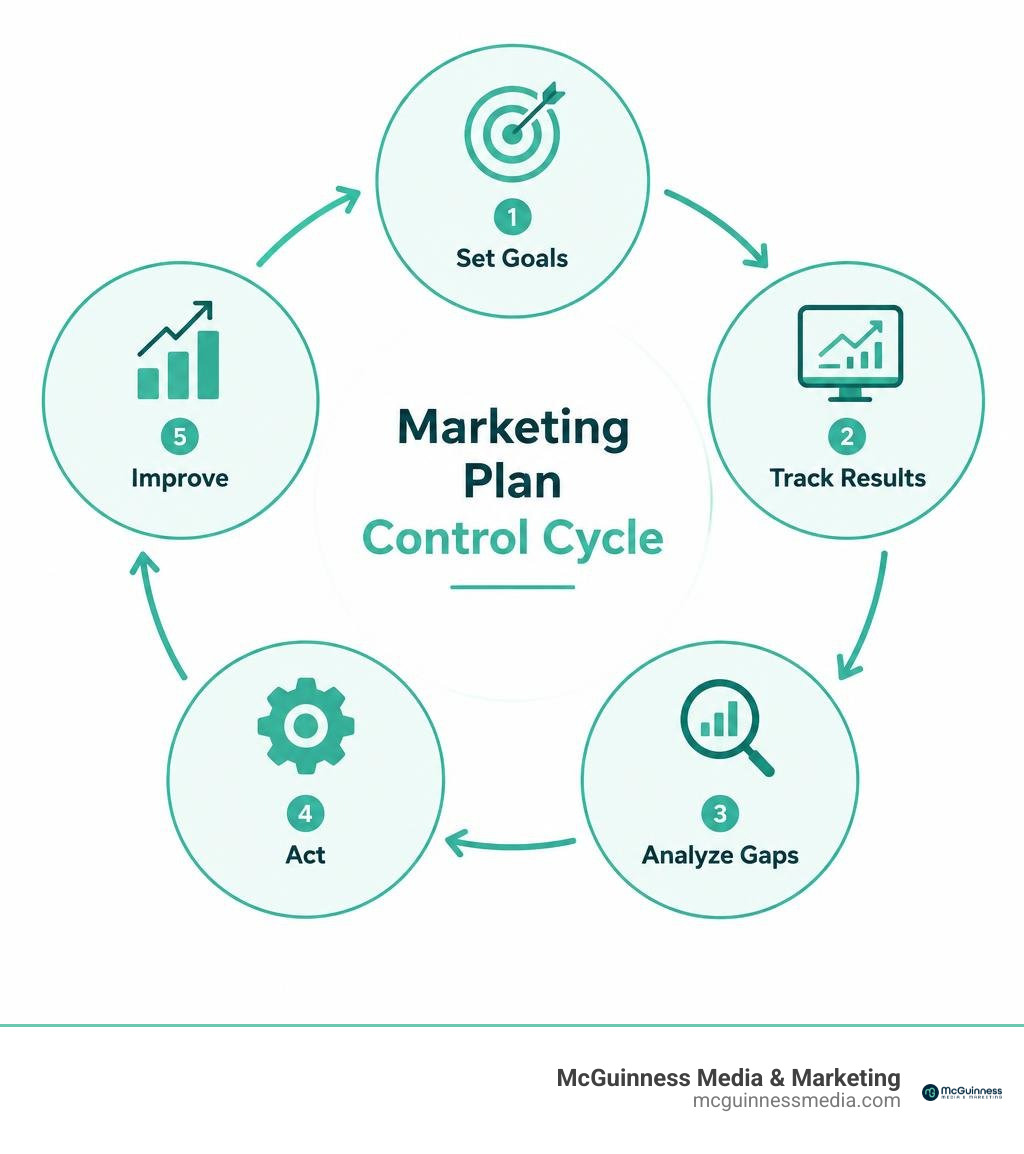
A practical control system does five things:
- Sets clear targets for sales, leads, market share, cost per acquisition, and return on investment.
- Tracks actual performance on a regular schedule.
- Compares results with the plan and identifies meaningful variances.
- Finds the cause, such as weak creative, a poor channel fit, pricing issues, or sales follow-up gaps.
- Takes corrective action, then uses what the team learned to improve the next cycle.
Marketing control is not a once-a-year report. It is a feedback loop that connects strategy to real-world results. The strongest plans balance financial outcomes with customer and market signals, so leaders can protect short-term performance without losing sight of long-term brand growth.
I am Megan McGuinness, owner and chief marketing officer of McGuinness Media & Marketing, with more than 20 years of experience building strategies, creative, and media programs for regional, national, and global brands. My work in the control of marketing plan operations helps teams connect their marketing decisions to accountable, measurable growth.
Must-know control of marketing plan terms:
Four Essential Types in the Control of Marketing Plan Operations
To build a resilient business in dynamic markets, marketing control cannot be treated as a single, blunt instrument. Organizations that actively monitor and control their marketing plans are 2.5 times more likely to achieve their annual sales targets compared to those that let their plans sit idle in a drawer. Modern marketing governance relies on four distinct types of control: annual plan control, profitability control, efficiency control, and strategic control.
Academic research on exploring marketing control mechanisms from a strategy perspective demonstrates that high-performing business units align both formal controls (like automated performance dashboards and strict budget milestones) and informal controls (such as team autonomy and peer review cadences) to match their strategic typology. When you integrate these four mechanisms into a comprehensive guide to the strategic marketing planning process, you protect your capital while empowering your marketing team to move quickly.
| Control Type | Primary Purpose | Key Focus Areas | Core Performance Metrics | Typical Review Cadence |
|---|---|---|---|---|
| Annual Plan Control | Verify whether planned operational targets are being achieved over the fiscal year. | Sales volume, market share, target budget adherence. | Sales growth rate, market share %, customer acquisition volume, sales-to-expense ratio. | Monthly to Quarterly |
| Profitability Control | Identify where the company is actually generating or losing net margin. | Products, geographic territories, customer segments, channels. | Net profit margin by segment, Customer Lifetime Value (CLV), Activity-Based Costing (ABC) overhead. | Quarterly to Biannually |
| Efficiency Control | Optimize resource spending and tactical execution across all channels. | Sales team output, paid advertising, logistics, collateral. | Cost Per Lead (CPL), Cost Per Sale (CPS), media ROAS, conversion rate, pipeline velocity. | Weekly to Bi-weekly |
| Strategic Control | Assess whether marketing strategy remains aligned with shifting market conditions. | Macro-environment, customer trends, competitive threats. | Marketing audit scores, SWOT re-evaluations, brand positioning benchmarks, share of voice. | Biannually to Annually |
Annual Plan Control and Sales Performance Tracking
Annual plan control evaluates whether operational milestones are hitting their intended targets across a 12-month period. Without it, leadership teams cannot determine whether missed revenue stems from macroeconomic downturns or underperforming campaigns.
The foundation of annual plan control rests on five core metrics:
- Sales Volume and Revenue Variance: Measuring gross and net revenue against monthly forecasts to catch downward trends before they compound.
- Market Share Tracking: Monitoring whether overall industry fluctuations or specific competitive losses are driving revenue shifts. A drop in market share indicates that competitors are winning your target buyers.
- Customer Acquisition Rate: Calculating the velocity of new client onboarding across each pipeline stage.
- Sales-to-Expense Ratios: Tracking the relationship between marketing spend and incoming revenue. A benchmark ratio of 4:1 means that every dollar invested generates four dollars in revenue; dropping to 2:1 indicates operational friction.
- Customer Retention Rate: Ensuring that acquired accounts remain active and continue generating predictable revenue over time.
Businesses that implement continuous sales analysis and market share tracking can improve their marketing ROI by up to 20% within the first year of rollout. Monitoring these numbers ensures that campaigns built through a winning media buying strategy stay profitable rather than draining resources unchecked.
Profitability Control and Segment Performance
Top-line revenue can hide major balance-sheet vulnerabilities. A product line generating record sales may actually be unprofitable once you factor in customized onboarding, continuous client support, and specialized distribution costs. Profitability control uncovers the real financial health across specific product categories, sales territories, and customer segments.
To implement rigorous profitability control, organizations use three proven accounting methodologies:
- Segment Profit-and-Loss Statements: Creating dedicated P&L sheets for each territory, product tier, and distribution channel to reveal hidden operational drag.
- Activity-Based Costing (ABC): Assigning direct overhead costs—such as sales engineering hours, logistics overhead, and customized client services—to specific accounts rather than blending them into generic company expenses.
- Customer Lifetime Value (CLV) Analysis: Comparing the total lifetime value of accounts against their initial Cost Per Acquisition (CPA) to establish healthy payback horizons.
Applying profitability control is essential when managing enterprise selling and long revenue cycles, where complex deal mechanics can disguise unprofitable contracts. By calculating accurate channel margins, leadership can confidently eliminate unprofitable offerings and double down on high-yield accounts.
Analytical Techniques: Efficiency, Audits, and Profit Concentration
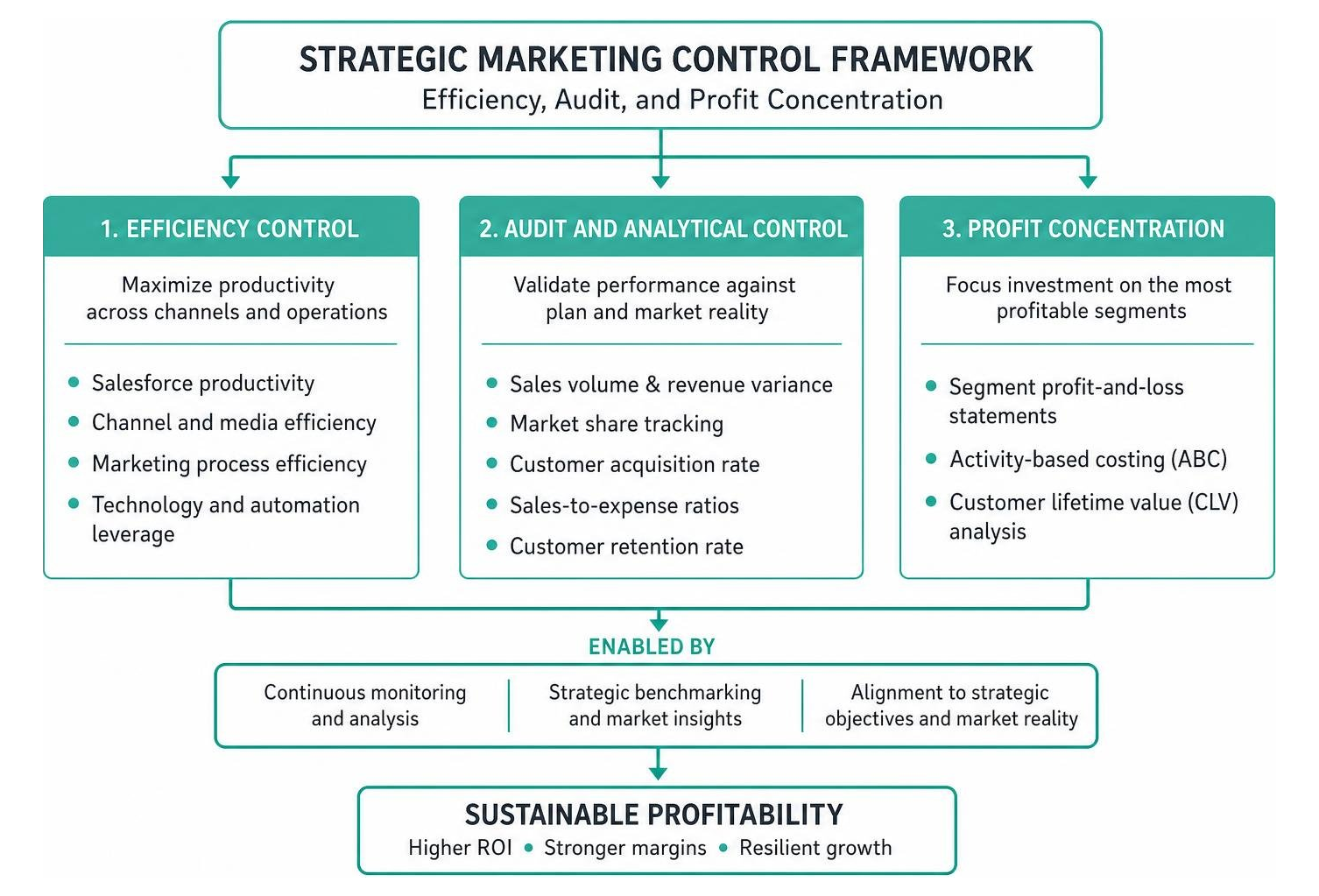
Running a marketing plan requires evaluating how efficiently your capital is deployed and confirming that your strategic assumptions match market reality. Empirical findings published in The Concept of Strategic Control in Marketing Management in Connection to Measuring Marketing Performance emphasize that modern strategic governance must combine financial performance with non-financial indicators like customer brand equity and operational efficiency.
When your leadership team leverages strategic benchmarking alongside a practical guide to brand growth, you build an organization capable of defending its margins in any economic climate.
Efficiency Controls Across Channels and Distribution
Efficiency control evaluates the operational productivity of every tactical program, ensuring your budget produces maximum pipeline impact. Implementing efficiency control involves tracking performance across four primary operational areas:
- Salesforce Productivity: Tracking deal closure rates per rep, average sales cycle duration, meetings held per pipeline opportunity, and active CRM follow-through rates.
- Paid Media and Advertising ROI: Monitoring Cost-Per-Click (CPC), Cost-Per-Lead (CPL), and Cost-Per-Sale (CPS). If spending $500 on ads generates a customer worth only $450 in net revenue, efficiency controls trigger immediate adjustments to targeting, creative assets, or pricing tiers.
- Distribution and Logistics: Evaluating channel partner performance, shipping overhead, digital asset loading speeds, and customer conversion rates across e-commerce checkouts.
- Content Conversion Efficiency: Analyzing lead generation rates across middle-of-funnel collateral to ensure every asset drives qualified pipeline value.
Consistently monitoring these touchpoints allows teams executing a solid digital marketing strategy to eliminate low-performing ad spend and reallocate budget to top-performing channels.
Profit Concentration Analysis and the 80/20 Rule
In most businesses, approximately 80% of total profits originate from just 20% of products or customer accounts. This Pareto principle reveals that a large portion of marketing and operational activity may be subsidizing unprofitable client segments.

A Lorenz curve maps the cumulative percentage of sales or profits against the cumulative percentage of customers or product SKUs. A steep upward curve signals intense profit concentration, showing that a small group of high-value buyers produces the bulk of your margin, while a long tail of small customers drives up service costs.
To rationalize operations using profit concentration analysis:
- Identify bottom-tier customers consuming disproportionate account support and adjust their service tiers or contract terms.
- Discontinue low-margin product variations that dilute marketing focus.
- Target your best prospects by building ideal customer profiles (ICPs) based on your top 20% of high-yield accounts.
Designing an Operational Framework for Marketing Governance
Effective governance provides clear guardrails so your team knows when to scale winning campaigns and when to cut underperforming initiatives. Scholarly insights in Toward a Theory of Marketing Control: Environmental Context, Control Types, and Consequences show that marketing control systems directly influence team morale and execution speed, making it essential to pair structured operational boundaries with strategic clarity.
When combined with an executive playbook for corporate marketing planning, these governance rules prevent costly delays and keep everyone moving in the same direction.
The Step-by-Step Process for Rigorous Control of Marketing Plan Execution
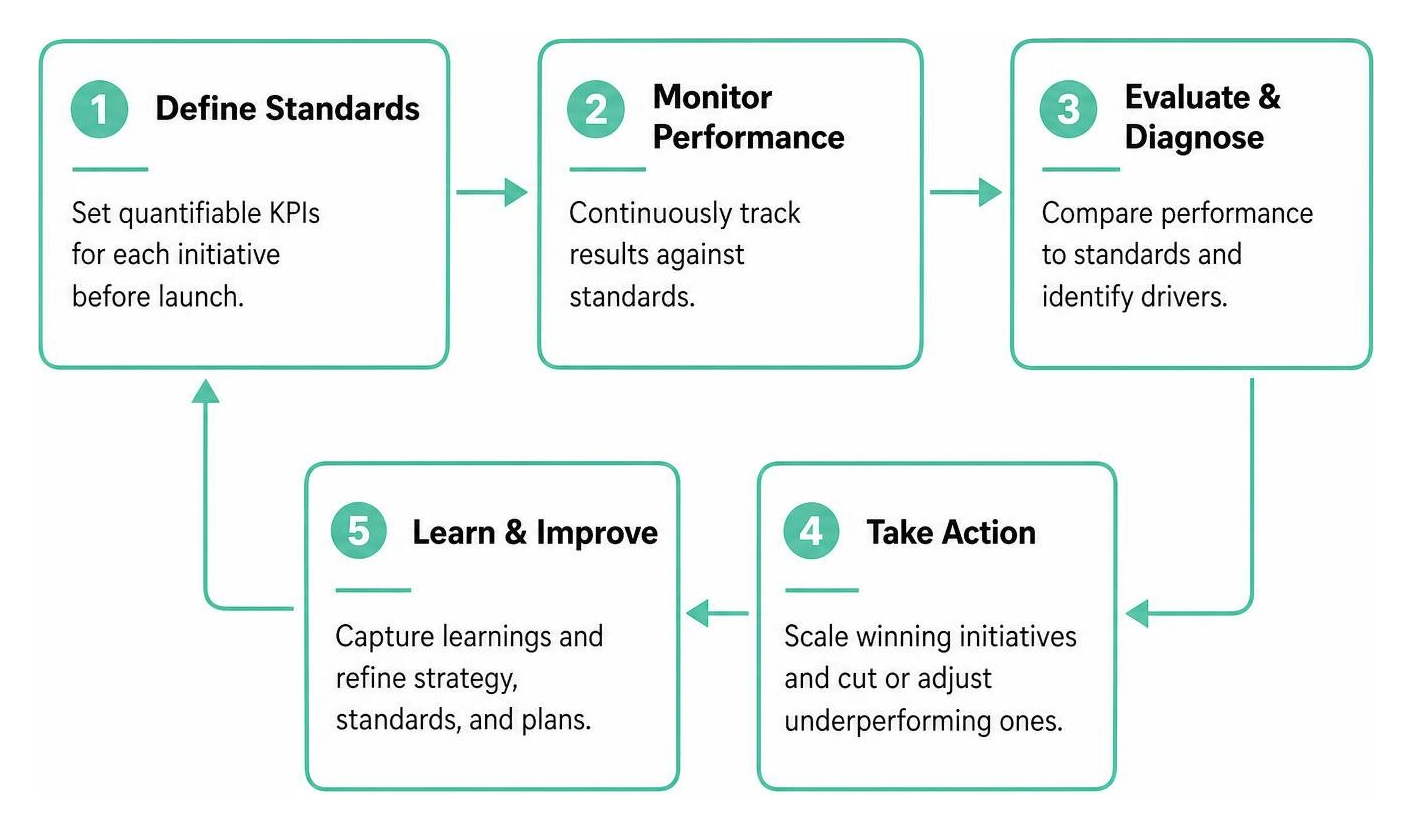
Building a closed-loop governance framework involves five actionable steps:
- Define Quantifiable Performance Standards: Establish specific KPIs for each initiative before launching campaigns (e.g., target CPL below $45, marketing qualified lead volume of 250 per month, customer acquisition cost payback under 6 months).
- Deploy Real-Time Measurement Systems: Use centralized dashboards connected to your CRM, web analytics, and ad platforms to monitor performance daily and weekly.
- Conduct Variance Diagnosis: Compare actual results against targets using predefined variance thresholds. Flag any deviation greater than 10% for immediate review.
- Execute Root-Cause Analysis: Determine whether the gap stems from creative fatigue, shifting buyer behavior, misaligned pricing, or poor lead handoff between marketing and sales.
- Implement Corrective Action and Feedback: Reallocate budget, update messaging, refresh audience targeting, and document findings to strengthen your ongoing strategic content plan.
Effective annual plan control can reduce marketing waste by 15% to 30% by surfacing unprofitable campaigns early in their lifecycle.
Overcoming Modern Obstacles to the Control of Marketing Plan Activities
Even well-designed control systems run into operational challenges. The table below outlines four common marketing control obstacles alongside practical strategies to solve them:
| Operational Challenge | Root Cause | Practical Solution |
|---|---|---|
| Multi-Touch Attribution Blindspots | Complex customer journeys across paid, organic, offline, and social channels make it difficult to identify the true revenue drivers. | Implement hybrid measurement models combining marketing mix modeling (MMM), first-party data capture, and post-purchase customer surveys. |
| Siloed Departmental Data | Marketing, sales, and finance teams use disconnected reporting tools, producing conflicting metrics. | Build a centralized data dashboard that ties CRM revenue directly to initial marketing touchpoints. |
| Behavioral Resistance to Controls | Team members view performance tracking as micromanagement rather than an optimization tool. | Establish open review cadences that celebrate quick optimizations and frame metrics as learning opportunities. |
| Short-Term vs. Long-Term Friction | Focusing exclusively on immediate monthly sales leads to neglecting brand-building investments. | Balance short-term demand capture metrics (CPL, ROAS) with long-term brand equity measures (organic search share, brand recall). |

Organizations that conduct regular marketing audits are 40% more likely to spot and fix major market threats before they hurt the bottom line. Adapting your governance model helps your business navigate the challenges of adapting to the new media landscape with confidence and clarity.
Frequently Asked Questions About Marketing Plan Controls
What is the primary difference between strategic control and annual plan control?
Annual plan control is operational and short-term, focusing on whether the business is hitting its 12-month targets for sales volume, CPL, and budget variance. Strategic control is broader and long-term, evaluating whether the core marketing strategy remains aligned with competitive dynamics, customer demand, and market changes.
How often should marketing plan control reviews be conducted?
Review cadences should match the speed of the decisions you need to make:
- Weekly: Track campaign delivery sprints, ad spend pacing, and tactical conversion rates.
- Monthly: Review channel efficiency, lead quality, and monthly budget variance.
- Quarterly: Audit segment profitability, Customer Acquisition Cost (CAC) payback, and product line margins.
- Annually: Conduct comprehensive marketing audits and complete strategic SWOT reviews.
How do Lorenz curves identify underperforming marketing segments?
A Lorenz curve visualizes how sales and profits are distributed across your customer base or product catalog. When the curve reveals that a small fraction of clients generates the vast majority of net profit (the 80/20 rule), it flags the long tail of low-margin, high-overhead accounts so leadership can reprice or discontinue them.
Conclusion
A marketing plan is only as good as the controls that govern it. Without continuous measurement, clear variance thresholds, and disciplined corrective action, even the most innovative strategies will drift off target. High-growth organizations treat marketing control as an ongoing feedback loop that connects operational execution directly to sustainable revenue growth.
At McGuinness Media & Marketing, our team in Warwick, Rhode Island builds integrated growth systems that align high-impact creative with accountable media buying and clear performance analytics. Explore our expert branding and strategic planning services to design a marketing framework that protects your budget and scales your business.