
The Modern Strategic Guide to Enterprise Selling and Long Revenue Cycles
Build a Corporate Sales Strategy That Wins Complex Deals
A strong corporate sales strategy helps your team win high-value business by focusing on the right accounts, engaging the full buying committee, proving measurable value, and managing every stage from first outreach through renewal.
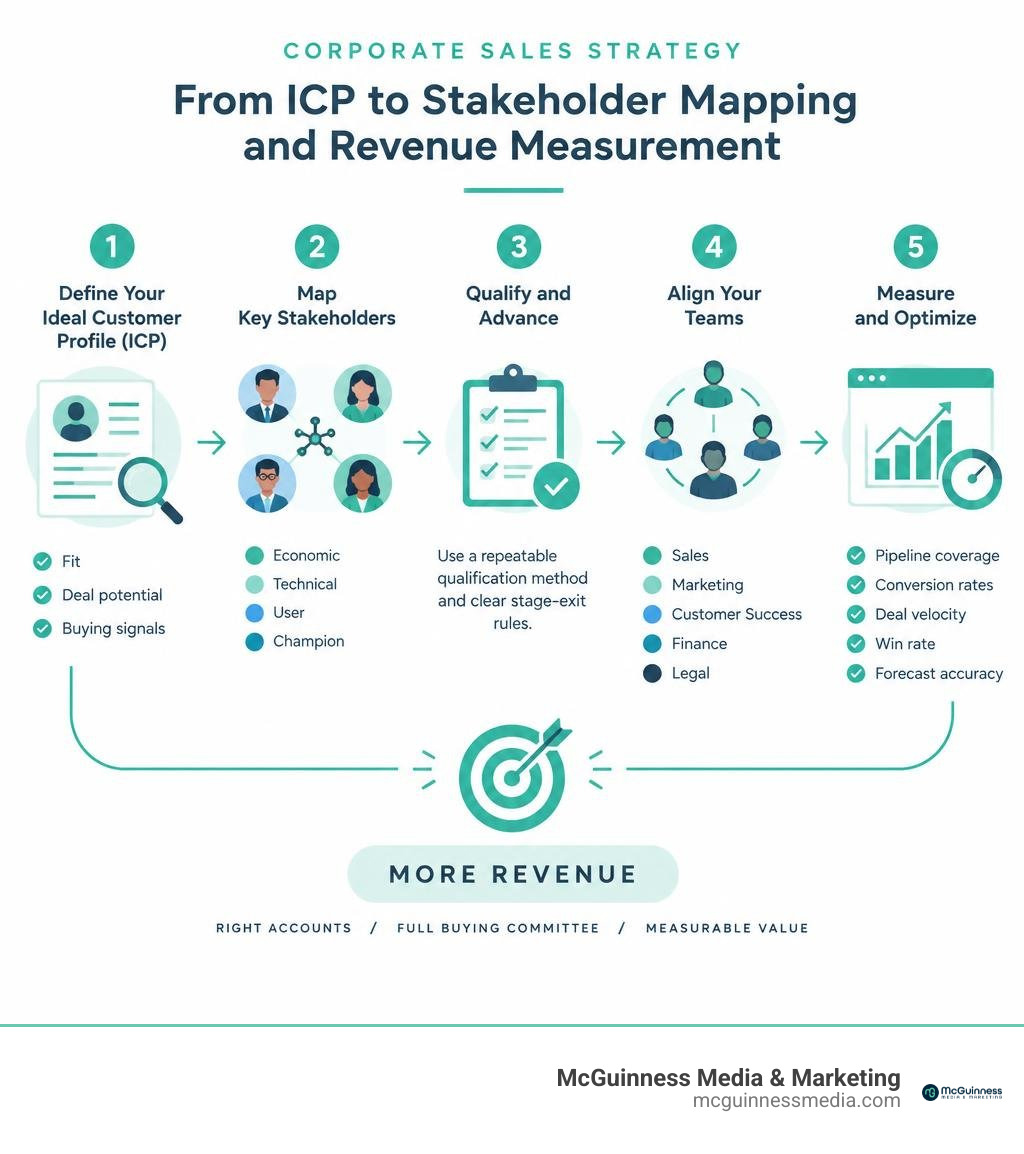
For most enterprise teams, the practical starting point is simple:
- Define an ideal customer profile based on fit, deal potential, and buying signals.
- Map the economic, technical, user, and champion stakeholders for each target account.
- Use a repeatable qualification method and clear stage-exit rules.
- Coordinate sales, marketing, customer success, finance, and legal around the same revenue goals.
- Measure pipeline coverage, conversion rates, deal velocity, win rate, and forecast accuracy – then adjust quickly.
Enterprise selling is not just a longer version of small-business sales. Deals can involve six to ten decision-makers, formal procurement, security reviews, legal approval, and sales cycles lasting months. That complexity makes generic pitches and single-contact outreach risky. The teams that succeed combine sharp positioning, disciplined account planning, useful content, and consistent follow-through.
I am Megan McGuinness, owner and chief marketing officer of McGuinness Media & Marketing, with more than 20 years of experience creating growth-focused marketing strategies for regional, national, and global brands. My work in corporate sales strategy connects brand positioning, compelling creative, and targeted media to help businesses reach the right decision-makers and turn ambitious goals into measurable results.
Must-know corporate sales strategy terms:
What Is Enterprise Selling and How Does Corporate Sales Strategy Differ?
Enterprise selling represents the high-stakes discipline of navigating multi-layered corporate hierarchies, formal governance structures, and extensive evaluation cycles. Unlike transactional sales environments where individual consumers or small-business owners make rapid purchasing decisions based on personal preference or immediate operational needs, corporate deals involve substantial capital, organizational restructuring, and heightened operational risk.
In enterprise B2B environments, average contract values (ACVs) routinely range from $50,000 to well over several million dollars. Consequently, sales cycles stretch from 3 to 18 months, requiring sustained relationship-building, rigorous stakeholder alignment, and extensive organizational endurance. In complex commercial engagements, applying foundational business planning frameworks helps organizations build the structural governance and cross-functional alignment necessary to manage high-value risk.
| Sales Dimension | Consumer Sales (B2C) | Small & Medium Business (SMB) | Enterprise Selling (Corporate) |
|---|---|---|---|
| Target Audience | Individual consumers | Single owners or small teams | Multi-layered corporate buying committees |
| Deal Size / ACV | $10 – $1,000+ | $1,000 – $25,000 | $50,000 – $1,000,000+ |
| Sales Cycle Length | Minutes to days | 2 weeks to 2 months | 3 to 18+ months |
| Decision Makers | 1 individual | 1 to 3 stakeholders | 6 to 10+ decision-makers |
| Procurement Process | Instant checkout / Point-of-sale | Simple invoice or credit card approval | Formal RFP/RFQ, legal, security, & compliance reviews |
| Risk Exposure | Minimal individual risk | Low-to-moderate operational risk | Substantial enterprise-wide financial & security risk |
Strategy vs. Plan vs. Process: Core Distinctions
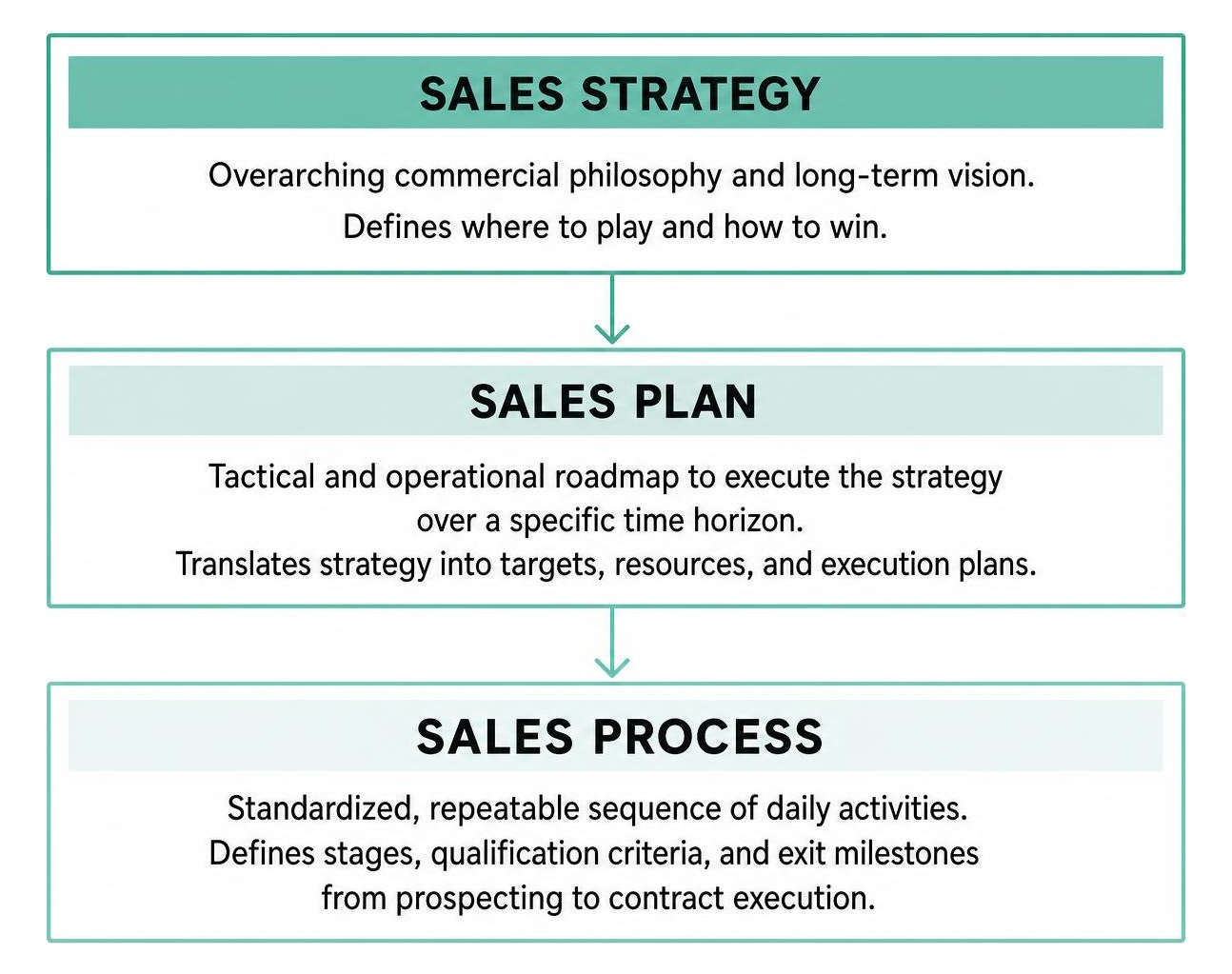
Revenue leaders frequently confuse sales strategy, sales planning, and sales processes, treating them as interchangeable terms. In reality, each serves a distinct operational tier within the revenue architecture:
- Sales Strategy: The overarching commercial philosophy and long-term vision. It defines target markets, competitive differentiation, chosen routes-to-market, and value propositions. Strategy answers where to play and how to win.
- Sales Plan: The tactical and operational roadmap for executing the strategy over a specific fiscal time horizon. It translates high-level strategic ambitions into territory designs, quota allocations, headcount modeling, resource distribution, and revenue targets.
- Sales Process: The standardized, repeatable sequence of operational stages that sales representatives execute daily. It outlines specific stage gates, qualification criteria, activity cadences, and exit milestones from initial prospecting to contract execution.
Understanding the Modern Buying Committee and Stakeholder Dynamics
Research shows that the average enterprise buying group includes 6–10 decision-makers, each bringing distinct operational priorities, risk tolerances, and personal agendas to the table. In fact, 74% of buyer teams experience unhealthy conflict during purchasing decisions. Winning complex deals requires navigating these dynamics by establishing strategic brand positioning that resonates across every tier of the buying group.
Modern corporate sales frameworks segment the buying committee into four foundational roles:
- The Economic Buyer: The senior executive who controls the budget and possesses final veto authority. They focus strictly on business outcomes, return on investment (ROI), strategic alignment, and overall financial payback.
- The Technical Evaluator: Stakeholders from IT, security, legal, or procurement tasked with assessing feasibility, compliance, system integration, and data security. They act as corporate gatekeepers looking for reasons to disqualify vendors.
- The User Stakeholder: Line-of-business managers and employees who will interact with the product or service daily. They evaluate ease of use, daily efficiency, implementation disruptions, and direct job impact.
- The Internal Champion (Coach): A trusted internal stakeholder who genuinely wants your solution to succeed. They provide crucial organizational intel, guide you through procurement politics, and advocate on your behalf when you are not in the room.
The Essential Stages of the Enterprise Sales Motion
Managing an enterprise deal requires strict pipeline discipline across seven core stages. Moving deals through these stages without formal exit criteria creates pipeline bloat and inaccurate revenue forecasting.

- Account Research & Intelligence: Profiling target corporate accounts, mapping organizational hierarchies, and analyzing buying signals.
- Multi-Threaded Outreach & Discovery: Initiating multi-channel cadences across multiple stakeholders to uncover deep business pain points.
- Needs Analysis & Solution Architecture: Synthesizing discovery findings to construct a tailored commercial and technical proposal.
- Value-Based Presentation & Proof-of-Concept (POC): Demonstrating measurable business outcomes to the buying committee with documented success criteria.
- Technical, Security & Compliance Review: Navigating security audits (e.g., SOC 2), legal governance, and IT architectural assessments.
- Procurement Negotiation & Commercial Approval: Finalizing contract terms, commercial policies, pricing governance, and executive sign-offs.
- Deal Closure & Customer Success Hand-off: Executing legal contracts and orchestrating onboarding workflows to secure long-term customer retention.
Designing a High-Converting Corporate Sales Strategy Process
To prevent deal slippage and inaccurate pipeline forecasts, leading enterprise organizations implement proven qualification frameworks such as MEDDPICC (Metrics, Economic Buyer, Decision Criteria, Decision Process, Paper Process, Identify Pain, Champion, Competition).
Embedding proven strategic selling methodologies into CRM deal gates ensures that sales representatives gather verifiable evidence before advancing deals. For example, rather than relying on rep optimism, a stage-exit gate might require verified confirmation of the budget owner’s identity, documented technical success criteria, and direct access to legal counsel before committing a deal to the executive forecast.
Multi-Channel Cadences and Outbound Account Penetration
Relying solely on cold email outreach is ineffective in corporate environments; data confirms that multi-channel cadences reach 30–40% of Tier 1 accounts, while email-only reaches fewer than 10%. Effective outbound account penetration requires coordinated touchpoints across verified direct dials, targeted LinkedIn messaging, personalized executive video briefings, peer introductions, and hyper-relevant content assets.
Engaging Tier 1 corporate targets demands custom messaging mapped to each stakeholder’s functional role. Sales professionals must conduct rigorous pre-call research to understand recent executive hires, regulatory shifts, and public strategic initiatives before initiating outreach.
Aligning Revenue Operations, Enablement, and Technology Stacks
A major cause of corporate sales underperformance is operational misalignment across internal business functions. When marketing generates leads that sales disregards, or when legal requirements surprise account executives at the final contracting phase, pipeline velocity stalls. Aligning sales, marketing, and customer success behind unified revenue Service Level Agreements (SLAs) ensures shared accountability across the entire revenue funnel. For comprehensive alignment frameworks, our executive playbook for corporate marketing planning offers structured templates for cross-departmental coordination.

How AI and Data-Driven Selling Transform Execution
Sales technology is undergoing rapid evolution. Today, 60% of B2B sales organizations are transitioning to data-driven selling approaches by 2025, and AI-powered sellers are 3.7 times more likely to meet sales quotas compared to those using traditional methods.
With 72% of sellers feeling overwhelmed by job demands, artificial intelligence provides critical relief by automating manual administration and surfacing actionable pipeline intelligence:
- Predictive Risk Scoring: AI agents monitor deal velocity, communication frequency, and stakeholder participation, automatically flagging stalled opportunities before they fall out of the forecast.
- Conversation Intelligence: Machine learning platforms analyze recorded sales calls, assessing prospect sentiment, tracking competitor mentions, and evaluating rep adherence to qualification frameworks.
- Automated Workflow Orchestration: Modern systems draft personalized follow-up communications, update CRM pipeline fields, and prompt reps with recommended next-best-actions in real time.
Furthermore, tool consolidation and unified sales platforms reduce technology costs by 50% while dramatically improving cross-team performance by eliminating data silos.
Structuring Quotas, Capacity, and Territory Design
A recurring failure in enterprise sales planning is the arbitrary distribution of top-down quotas without validating pipeline capacity. Teams that formalize backward-math revenue planning see 20–30% higher quota attainment than teams that distribute targets top-down without validating capacity.
Backward-math planning calculates the exact operational inputs required to hit top-line revenue targets:
Sales leaders must also factor new-hire ramp times into capacity models and design balanced sales territories based on Ideal Customer Profile (ICP) fit scoring and Total Addressable Market (TAM) density rather than simple geographic boundaries. Implementing disciplined strategic planning for brand growth ensures that sales capacity matches actual market demand.
How to Measure, Scale, and Optimize Enterprise Revenue Performance
Scaling a corporate sales engine requires ongoing visibility into leading and lagging revenue metrics. Measuring pipeline health across the complete customer lifecycle allows revenue operations leaders to identify operational bottlenecks and deploy targeted sales coaching.
Measuring and Diagnosing Your Corporate Sales Strategy
To evaluate strategy execution, enterprise sales leaders monitor several core performance benchmarks:
- Pipeline Coverage Ratios: Enterprise teams typically require 3x to 4x qualified pipeline coverage relative to quota targets to ensure consistent attainment.
- Stage Conversion Velocity: Tracking the average number of days deals spend in each pipeline stage highlights procedural friction points, such as prolonged legal or security evaluations.
- Forecast Accuracy: Comparing initial quarterly commits against actual closed-won business reveals whether sales reps are qualifying opportunities accurately or suffering from optimistic bias.
Overcoming Buyer Conflict, Long Cycles, and Deal Stalls
Enterprise deals rarely collapse because of aggressive competitor tactics; they collapse due to internal buyer inertia and stakeholder disagreement. When 74% of enterprise buying groups experience internal conflict, account executives must act as consensus-building facilitators.
To maintain deal momentum and overcome buyer friction:
- Implement Mutual Action Plans (MAPs): Co-create documented project roadmaps with your champion that clearly detail mutual milestones, assigned owners, and target completion dates for technical, legal, and procurement reviews.
- Arm Champions with Internal Selling Tools: Equip your primary contacts with one-page executive business cases, vendor comparison matrixes, and security compliance briefs designed to persuade internal skeptics.
- Parallel-Track Procurement and Legal Reviews: Initiate non-disclosure agreements, standard terms reviews, and security assessments alongside technical evaluations to prevent administrative delays at the end of the quarter.
Frequently Asked Questions About Enterprise Selling
What is the typical sales cycle length for corporate and enterprise deals?
Enterprise sales cycles typically range between 3 and 18 months, depending directly on deal complexity and total contract value. Deals valued between $50,000 and $100,000 average approximately 128 days, while multi-year contracts exceeding $500,000 frequently require 270 days or more. In addition, enterprise legal, compliance, and formal procurement reviews typically add 30 to 45 days to the final closing timeline.
How many stakeholders are involved in modern corporate buying decisions?
Modern corporate buying committees generally include 6 to 10 distinct decision-makers representing executive management, finance, information security, operations, and end-user departments. In large multinational enterprises, the broader evaluation and approval committee can expand to 12 or more cross-functional stakeholders.
What is the difference between a sales strategy and a sales plan?
A sales strategy defines long-term competitive positioning, target market segments, value propositions, and overarching go-to-market motions (where to play and how to win). A sales plan is the operational roadmap that translates that strategy into tangible execution over a specific fiscal period, outlining quota allocations, headcount hiring plans, territory designs, and pipeline targets.
Conclusion
Succeeding in enterprise sales requires moving beyond transactional tactics and implementing an integrated corporate sales strategy that combines multi-threaded relationship building, disciplined qualification frameworks, and modern revenue intelligence. By uniting sales, marketing, and operations around a single source of truth, organizations turn long, complex revenue cycles into predictable commercial growth.
At McGuinness Media & Marketing, we help growing brands and corporate revenue leaders align their market positioning, outbound messaging, and creative strategy to capture enterprise accounts. Explore our full-service branding and strategy services to discover how we can help your team streamline complex sales cycles, engage executive decision-makers, and drive sustainable revenue performance.