From Zero to Hero: Crafting Your Winning Marketing Strategy
Why Your Business Needs a Marketing Plan
Marketing plan development is the process of creating a strategic roadmap that outlines your specific marketing actions, target audience, budget, timeline, and success metrics to achieve your business goals.
Key Components of Marketing Plan Development:
- Situation Analysis – Assess your current market position using SWOT and PESTEL frameworks
- Target Audience Definition – Identify and create detailed buyer personas
- SMART Goals – Set Specific, Measurable, Achievable, Relevant, Time-bound objectives
- Marketing Strategy – Define your 7 P’s (Product, Price, Place, Promotion, People, Process, Physical Evidence)
- Channel Selection – Choose the right mix of marketing channels for your audience
- Budget Allocation – Determine spending (typically 3-5% of revenue for established businesses, 10%+ for new ventures)
- Action Plan – Create a timeline with assigned responsibilities
- Measurement Framework – Establish KPIs to track progress and ROI
Navigating the competitive business landscape without a clear roadmap is like sailing in a storm without a compass. You might be busy, but are you making progress? Research shows that businesses with plans succeed, outperform competitors, and retain staff more than those with no plan. Yet many businesses approach marketing haphazardly—placing an ad here, updating social media there—draining budgets with little to show for it.
Wasted budgets. Disjointed campaigns. Missed opportunities. These are the symptoms of directionless marketing efforts.
A well-crafted marketing plan is your solution. It’s not an impressive document that sits in a drawer. According to the American Marketing Association, a marketing plan is a roadmap connecting strategy, target audiences, and measurable execution. It translates your high-level business goals into concrete marketing activities, detailing who you’re trying to reach, how you’ll reach them, what message you’ll deliver, and how you’ll measure success.
Without this roadmap, you’re gambling with your marketing dollars. With it, you gain direction for your team, justification for your budget, accountability through clear goals and KPIs, and a proactive strategy that anticipates market shifts rather than reacting to them.
I’m Megan McGuinness, owner and chief marketing officer of McGuinness Media & Marketing, with over 20 years of experience in marketing plan development for regional, national, and global brands including Reebok, Bally’s Corporation, and Philips. Throughout my career, I’ve learned that successful marketing plan development requires both strategic thinking and tactical precision—the ability to see the big picture while executing the details that drive measurable results.
The Foundation: Strategy, Plan, and Business Goals
Before diving into marketing plan development, it’s crucial to understand three fundamental terms: the business plan, the marketing strategy, and the marketing plan. Clarifying how they interrelate is key to building a cohesive and effective approach.
A business plan is the overarching document for your entire organization. It outlines your company’s mission, goals, and financial framework, often serving as a tool to secure funding. Think of it as your long-term vision, typically spanning 3-5+ years. It answers the fundamental question: “What is our business, and where are we going?”
Your marketing strategy defines the high-level approach to achieving the marketing-related goals within that business plan. As Investopedia clarifies, it outlines the long-term positioning guiding every short-term campaign decision. The strategy answers the “why” and “what” of your marketing efforts—why you’re targeting a particular audience and what unique value you offer them. It’s your blueprint for market differentiation, usually covering a mid- to long-term horizon (1-3 years).
Finally, the marketing plan is the detailed, tactical execution roadmap. It translates your marketing strategy into specific actions, channels, budget allocations, and timelines. This is the “how,” “when,” and “where” of your marketing. It’s a dynamic document, often updated quarterly or annually, that guides your team’s day-to-day efforts.
The key here is alignment. Your marketing plan development must tie directly to your overall business goals. If your business plan aims to increase revenue by 20% in the next year, your marketing plan should detail precisely how marketing will contribute to that target, perhaps by generating a specific number of qualified leads or increasing brand awareness in new markets. Connecting your marketing efforts to the broader company mission ensures your resources are well-spent and helps secure vital buy-in from leadership. At McGuinness Media & Marketing, we specialize in Branding and Strategy to ensure this foundational alignment is rock-solid for our clients in Rhode Island and beyond.
Situation Analysis: Where Do You Stand?
Every great journey begins with understanding your starting point. In marketing plan development, this means conducting a thorough situation analysis. This foundational work ensures your strategies are creative, relevant, timely, and targeted. Without it, you’re just guessing.
The first step is often a marketing audit, a review of all past marketing activities, typically from the last three years. What worked? What didn’t? Why? Gathering this historical data provides context for future decisions.
Next, we dive into market research. This isn’t just about intuition; it’s about gathering hard data to understand your current position against competitors and the broader market landscape. Two powerful tools for this are:
- SWOT Analysis: This framework helps us assess internal Strengths (e.g., a unique service offering in Rhode Island, a strong local reputation), Weaknesses (e.g., limited budget, outdated website), external Opportunities (e.g., emerging market trends, new technology), and Threats (e.g., new competitors entering the Warwick, RI market, economic downturns).

- PESTEL Analysis: This broader environmental scan looks at Political, Economic, Social, Technological, Environmental, and Legal factors that could impact your business. For example, new local regulations in Rhode Island (Political/Legal), changing consumer spending habits (Economic/Social), or advancements in AI marketing tools (Technological).
To understand the local market, we leverage resources like the U.S. Census Bureau and local Chambers of Commerce. These sources provide invaluable data on demographics, population growth, and economic trends in Rhode Island, helping us make accurate projections and identify opportunities.
Defining Your Audience and Competitors
Once we understand the broader landscape, the next crucial step in marketing plan development is to clearly define who we’re talking to and who we’re up against.
Defining Your Target Audience and Creating Buyer Personas: Trying to market to “everyone” often results in messaging that resonates with no one. We need to identify the specific group of people most likely to buy our products or services. This involves understanding their demographics (age, gender, location in Rhode Island, income), psychographics (values, attitudes, interests, lifestyle), behavior (buying habits, online activity), and needs.
A powerful tool for this is creating buyer personas. These are semi-fictional representations of our ideal customers, based on real data and some educated guesses about their demographics, motivations, and needs. For example, for a local business in Warwick, RI, we might create a persona called “Busy Parent Brenda,” a 30-something living in the suburbs, juggling work and family, looking for convenient, high-quality solutions. Creating 3-8 detailed personas is usually adequate, and we recommend updating them annually to reflect evolving customer insights. HubSpot’s tool for creating buyer personas can be a great starting point for this process. Buyer personas help us fine-tune our marketing messages and build stronger brand rapport.
Conducting Competitor Analysis: Understanding your rivals is just as important as understanding your customers. A thorough competitor analysis involves examining their strengths, weaknesses, market positioning, product offerings, and marketing strategies. What are they doing well? Where are their gaps? How do their prices compare to ours?
This analysis isn’t about copying them; it’s about identifying opportunities to differentiate ourselves. If a competitor in Providence, RI, is failing to provide flexible service, that’s an area we can exploit. Tools like Google Alerts can help us track their mentions, news, and new product launches, allowing us to predict their next moves and avoid being caught off guard. The inability to differentiate is often more detrimental than having competition itself.
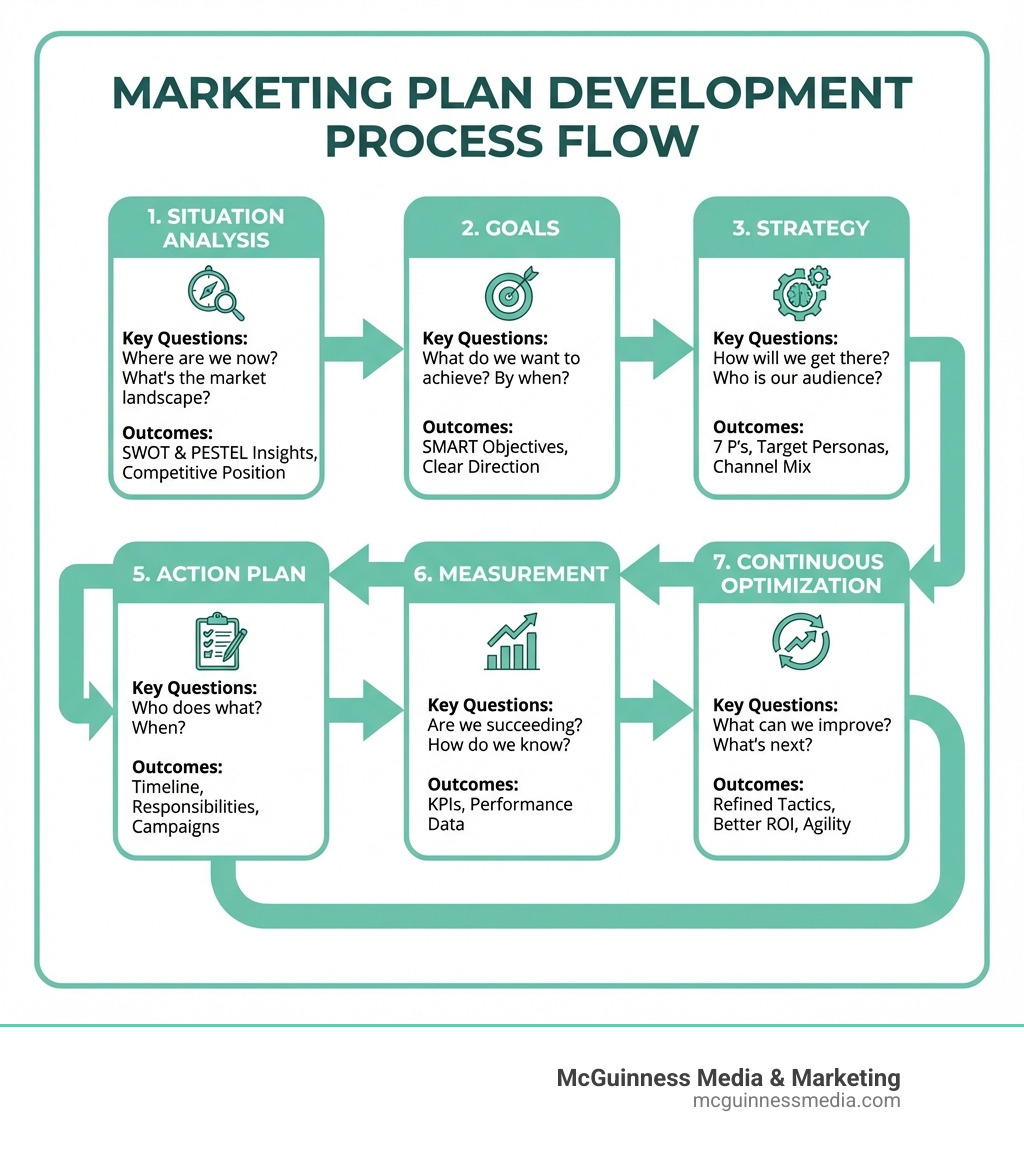
The 7-Step Marketing Plan Development Process
Now that we’ve laid the groundwork, let’s walk through our comprehensive 7-step process for marketing plan development. This structured approach ensures every aspect is considered, from setting ambitious goals to measuring tangible results.
Step 1: Set SMART Marketing Goals
Vague goals like “increase brand awareness” are impossible to measure. That’s why every successful marketing plan development hinges on setting SMART goals:
- Specific: Clearly state what you want to achieve. Instead of “increase sales,” aim for “increase sales of product X.”
- Measurable: Define how you’ll track progress and success. How will you know if you’ve hit your target?
- Achievable: Ensure the goal is realistic given your resources and market conditions. While we encourage ambition, unrealistic goals can demoralize a team.
- Relevant: The goal must align directly with your overall business objectives. Why is this goal important to your business in Rhode Island?
- Time-bound: Set a clear deadline for achieving the goal.
For example, instead of “increase website leads,” a SMART goal might be: “Generate 500 new Marketing Qualified Leads (MQLs) from our website by the end of Q2 2025.” This is specific, measurable, achievable (with proper planning), relevant to business growth, and time-bound. KPIs (Key Performance Indicators) are the metrics we track to work towards these goals, but they aren’t the goals themselves. For a deeper dive, the SMART goal framework is explained in detail by the Corporate Finance Institute.
Step 2: Master the 7 P’s of Marketing
The 7 P’s of Marketing provide a powerful framework for developing your strategy and activities within your marketing plan. These elements are interconnected and help us create a holistic approach for our clients in Providence, Newport, and throughout Rhode Island:
- Product: What are you offering? This includes not just the physical good or service, but also its features, benefits, quality, design, branding, and packaging. What unique problem does your product solve for your target customer?
- Price: How much does it cost? This involves pricing strategies, discounts, payment terms, and how your price positions your product in the market relative to competitors.
- Place: How do customers access your product? This covers distribution channels, logistics, physical locations (like your storefront in Warwick, RI), online platforms, and inventory management.
- Promotion: How do you communicate your product’s value? This includes advertising, public relations, sales promotions, content marketing, social media, and personal selling.
- People: Who is involved in delivering your product or service? This refers to your employees, customer service team, and any other individuals who interact with customers and influence their experience. Their training and attitude are crucial.
- Process: What are the systems and procedures involved in delivering your service? This includes customer onboarding, delivery, problem-solving, and any operational efficiencies that improve the customer experience.
- Physical Evidence: What tangible cues do customers use to evaluate your service or product? This can be your office decor, website design, branding materials, staff uniforms, or even customer testimonials.
By carefully considering each of these P’s, we can craft a compelling Unique Selling Proposition (USP)—that specific benefit or advantage that sets your product or service apart. This also informs your Positioning, which is how you want your customers to think about your offerings—what your business does, who it’s for, and why it’s different from others in the Rhode Island market. Our expertise in Digital Marketing often helps clients effectively leverage many of these P’s in the online field.
Step 3: Choose Your Channels and Tactics
With our goals set and our 7 P’s defined, it’s time to select the right marketing channels and tactics to reach our target audience effectively. This is where the strategy comes to life!
Marketing channels are the platforms or mediums we use to deliver our message. Common digital channels include:
- Search Engine Optimization (SEO): Optimizing your website and content to rank higher in search results for relevant keywords, driving organic traffic.
- Pay-Per-Click (PPC): Running paid advertisements on search engines (like Google Ads) or social media platforms to generate immediate visibility and traffic.
- Content Marketing: Creating and distributing valuable, relevant, and consistent content (blogs, videos, infographics) to attract and retain a clearly defined audience. It’s no wonder that 98% of marketers believe ‘having or following’ a content strategy is ‘important for marketing success’.
- Social Media Marketing: Engaging with your audience on platforms like Facebook, Instagram, LinkedIn, and Twitter to build brand awareness, foster community, and drive traffic. Our Social Media services are custom to help businesses in Rhode Island maximize their presence.
- Email Marketing: Building a list of subscribers and sending targeted emails for promotions, newsletters, and customer nurturing.
- Affiliate Marketing: Partnering with other businesses or individuals to promote your products in exchange for a commission.
To prioritize which channels will deliver the highest traction for our clients, we often use frameworks like the Bullseye Framework. This helps us focus our efforts and resources where they’ll have the biggest impact, rather than spreading ourselves too thin. For example, a local restaurant in Providence, RI, might prioritize social media and local SEO, while a B2B service provider might focus more on LinkedIn and content marketing. Complementary activities, such as combining a social media campaign with radio ads in key markets, can also significantly improve message delivery and market reach.
Step 4: Determine Your Marketing Budget
Ah, the budget—the practical reality check for any ambitious marketing plan development. Without a realistic budget, even the most brilliant strategies can fall flat. Your marketing budget is a detailed forecast of all expenditures required to execute your plan.
How much should you allocate? While there’s no one-size-fits-all answer, industry statistics provide a useful guide:
- Established businesses in open markets typically spend 3% to 5% of their annual gross incomes on marketing.
- New businesses, those in highly competitive markets, or those rolling out an ambitious new program or service (like a new product launch), can expect to spend 10% or more of their annual gross income in the first year of implementing a plan.
For small businesses in Rhode Island, this might mean carefully considering the cost of a corporate image package (logo, stationery, collateral pieces), which can exceed $5,000, with a brochure potentially adding another $5,000. These are significant investments that need to be justified.
The key is to connect your marketing budget directly to measurable business outcomes. As Harvard Business Review stresses, this approach secures executive buy-in and ensures strategic accountability. We calculate the cost of acquisition for each new customer (total marketing spend / number of new customers acquired) to understand our return on investment.
We also advocate for building agile budgets. The marketing landscape is constantly evolving, and a plan is a living document. Being flexible allows us to adjust spending based on real-time performance and market shifts. We manage marketing spend closely and monitor the Budget Burn Rate (BBR) to forecast spending velocity and avoid over or under-budgeting. Underfunding your plan guarantees underperformance.
Step 5: Create Your Action Plan and Timeline
This is where your marketing plan development transforms from a strategic document into an operational one. An action plan details who does what, and when. People often call it a marketing calendar or roadmap.
For each marketing initiative, we break it down into smaller, manageable tasks, assigning ownership and setting clear deadlines. Productivity experts at Asana recommend breaking initiatives into milestones and ownership tasks to maintain execution discipline. This ensures accountability and keeps everyone on the team aligned.
A visual tool like a Gantt chart can be incredibly helpful for visualizing project dependencies and timelines. For instance, launching a new campaign might involve tasks like “write blog posts” (owner: content manager, deadline: May 15), “design social media graphics” (owner: graphic designer, deadline: May 20), and “schedule ad campaign” (owner: media buyer, deadline: May 25).
Clear financial alignment between goals and spending, as stressed by Harvard Business Review, isn’t just about the budget; it’s about building stakeholder trust by demonstrating how every action contributes to measurable outcomes. Our team at McGuinness Media & Marketing excels at this, particularly in Maximizing ROI with Media Planning Tips for Small Businesses, ensuring our clients’ campaigns are not only strategic but also carefully executed on schedule.
Step 6: Establish KPIs and a Measurement Framework
How do we know if our marketing plan development efforts are actually working? This is where Key Performance Indicators (KPIs) and a robust measurement framework come into play. KPIs are measurable values that demonstrate how effectively we are achieving our business objectives. KPIs are metrics we track towards a goal, not the goal itself.
Depending on our SMART goals, our KPIs might include:
- Website Traffic: Number of visitors, unique visitors, page views, bounce rate.
- Conversion Rates: Percentage of visitors who complete a desired action (e.g., sign up for a newsletter, make a purchase, fill out a contact form).
- Lead Generation: Number of new leads, Marketing Qualified Leads (MQLs), Sales Qualified Leads (SQLs).
- Cost Per Lead (CPL): Total marketing spend divided by the number of leads generated.
- Customer Acquisition Cost (CAC): Total sales and marketing spend divided by the number of new customers acquired.
- Return on Investment (ROI): The financial gain or loss relative to the cost of a marketing campaign.
- Brand Awareness: Social media mentions, website direct traffic, brand search volume.
We establish a clear reporting framework, detailing what KPIs will be tracked, how often (weekly, monthly, quarterly), and who is responsible for reporting them. Leveraging analytics tools (like Google Analytics, social media insights, or CRM data) is essential for collecting and analyzing this data. This data-driven approach allows us to make informed decisions, understand what’s working, and identify areas for improvement. Marketing attribution, which analyzes consumer touchpoints on their path to purchase, is also crucial for multi-channel strategies, helping us understand the true impact of each channel.
Step 7: Evaluate, Adapt, and Optimize
The final, but continuous, step in marketing plan development is evaluation, adaptation, and optimization. A marketing plan is a living document, not a set-it-and-forget-it strategy. The marketing landscape, especially in digital, is constantly evolving, requiring flexibility and continuous adjustment.
We recommend regular reviews, typically quarterly, to assess performance against our KPIs and SMART goals. During these evaluations, we have three main options for the long-term outlook of our marketing campaigns: as Robin Samora explains, we can:
- Capitalize on what’s working by investing more capital and resources into successful initiatives.
- Stop or diminish resources for campaigns that are underperforming or not meeting objectives.
- Update tactics for campaigns that show potential but need refinement.
This iterative process of monitoring, measuring, and refining is critical. It allows us to identify pitfalls early, pivot from failures, and maximize successes. For example, if a social media campaign for a local Rhode Island business isn’t generating the expected engagement, we’ll analyze the data, adjust the content or targeting, and re-test.
Adapting for different business sizes or objectives:
- SMEs and Startups: For smaller businesses in Warwick, RI, a simpler “Opportunity > Strategy > Action” (OSA) model can be more effective than overly complex plans. The key is to be agile and focus on cost-effective marketing options, like building referral networks or engaging with the local community.
- New Product Launches: Launching a new product requires its own specialized planning. This process can be make-or-break, as seen with product launch plans that have generated billions in a short time. It demands precise targeting, messaging, and promotional tactics.
- Digital Marketing Focus: With the rise of AI in marketing, our The Rise of AI in Marketing: What It Means for Small Businesses blog post highlights how staying informed about new marketing trends and leveraging data and analytics are more important than ever for continuous optimization.
By treating our marketing plan as an evolving blueprint, we ensure our strategies remain relevant, effective, and continuously drive growth for our clients in Rhode Island.
Frequently Asked Questions about Marketing Plan Development
Navigating marketing can raise many questions. Here, we address some of the most common inquiries we receive about marketing plan development.
What are the most critical components of a marketing plan?
While specific structures can vary, the most critical components of a comprehensive marketing plan typically include:
- Executive Summary: A concise overview of the entire plan.
- Situation Analysis: A deep dive into your current market position, including SWOT and PESTEL analysis.
- Target Audience & Buyer Personas: A clear definition of who you’re trying to reach.
- SMART Goals: Specific, measurable, achievable, relevant, and time-bound objectives.
- Marketing Strategy (including the 7 P’s): Your high-level approach to achieving goals, considering Product, Price, Place, Promotion, People, Process, and Physical Evidence.
- Competitor Analysis: Understanding your rivals’ strengths, weaknesses, and strategies.
- Marketing Tactics & Channels: The specific actions and platforms you’ll use.
- Marketing Budget: A detailed forecast of expenses and resource allocation.
- Action Plan & Timeline: A roadmap of who does what, and when.
- Measurement Framework & KPIs: How you’ll track progress and measure success.
How much should a small business budget for marketing?
For small businesses, budgeting for marketing can feel like a tightrope walk. As a general guideline:
- Established practices in open markets typically spend between 3% to 5% of their annual gross incomes on marketing.
- New businesses, those in highly competitive markets (like parts of Rhode Island), or those launching ambitious new programs should anticipate spending 10% or more of their annual gross income in the first year of a plan.
It’s important to focus on the Return on Investment (ROI) and connect your budget directly to measurable business outcomes. Don’t forget about low-cost marketing options, such as building strong referral networks, engaging in community events (like sponsoring a local walkathon or speaking at a health fair), and leveraging organic social media.
How is a marketing plan different from a marketing strategy?
This is a common point of confusion, but the distinction is vital:
- A marketing strategy defines the “why” and “what.” It’s your long-term approach, outlining your market positioning and the overall direction for achieving your marketing goals. It sets the overarching principles and objectives.
- A marketing plan details the “how” and “when.” It’s the tactical execution roadmap, providing specific actions, chosen channels, allocated budget, and precise timelines to implement your strategy.
Think of it this way: your marketing strategy is like the game plan your coach devises for the season (e.g., “We will be an aggressive, defense-first team”). Your marketing plan is the playbook for each specific game, detailing individual plays, player assignments, and timing (e.g., “On 3rd-and-long, we’ll run a cover 2 zone blitz”). The strategy guides the plan, and the plan puts the strategy into action.
Conclusion: Turn Your Plan into Profit
We’ve covered a lot of ground in our journey through marketing plan development, from understanding the foundational differences between a business plan, strategy, and plan, to the critical 7-step process of setting SMART goals, mastering the 7 P’s, choosing channels, budgeting wisely, creating action plans, establishing KPIs, and continuously evaluating and adapting.
The takeaway is clear: a well-crafted marketing plan isn’t a luxury; it’s a necessity for any business aiming for sustainable growth and measurable success in Rhode Island and beyond. It eliminates wasted effort, focuses your resources, and provides the clarity needed to steer a dynamic market. Your plan is a living document—it needs regular review, adaptation, and optimization to remain effective.
At McGuinness Media & Marketing, we understand the unique challenges and opportunities businesses face. We’re passionate about helping our clients turn their marketing aspirations into tangible results, changing them from “zero to hero” in their respective markets.
Ready to stop guessing and start growing? Let our expertise guide your next steps. Start building your winning strategy with us today.