
Brand Strategy and Planning Blueprint for Growing Companies
How to Build a Brand Strategy That Guides Growth
Start brand strategy and planning by choosing the customers you most want to serve. Learn what they need, what they value, and what other options they consider. Then define a clear promise your business can deliver. Use that promise to guide your messaging, design, and customer experience. Track results such as brand recall, qualified leads, and repeat purchases, then refine the plan.
I’m Megan McGuinness, owner and chief marketing officer of McGuinness Media & Marketing. I’ve spent more than 20 years developing marketing strategies for regional, national, and global brands, and I’ll use that experience to make brand strategy and planning practical for growing companies.
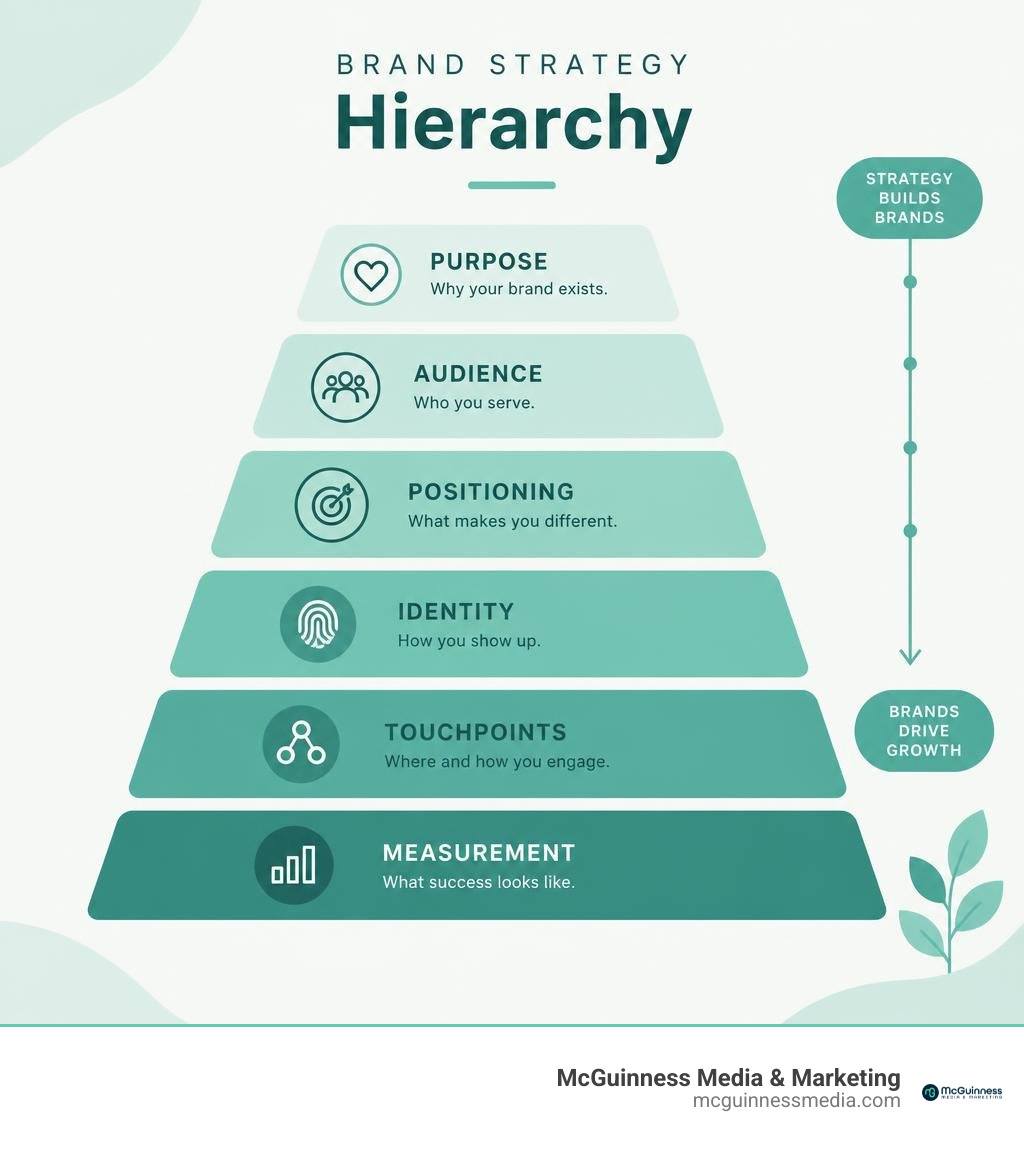
Easy brand strategy and planning glossary:
What Is Brand Strategy and Planning in Modern Business?
Your brand has roughly seven seconds to make a first impression. In an era overflowing with digital noise, that initial window determines whether a prospective buyer leans in or scrolls past. Without a roadmap, marketing can feel like setting out on a cross-country road trip without GPS—you will burn through fuel fast, but you probably will not reach your destination.
A solid brand strategy acts as an organization’s North Star. It is the comprehensive master plan that shapes how the public perceives, experiences, and trusts your company. Far from being a static document tucked away in a folder, effective planning establishes market relevance and gives your teams the clarity needed to make decisions quickly.
As outlined in Strategic Brand Management, 2nd Edition, the combined value of the world’s top 100 brands exceeds a trillion dollars. These organizations do not leave their reputation to chance; they use deliberate brand architecture and positioning to drive measurable enterprise value.
Beyond Logos: Defining Purpose, Values, and Positioning
Many business leaders mistake visual identity for brand strategy. While a polished logo, refined typography, and harmonious color palettes matter, they represent only the surface. Strategy is the substance beneath that creative expression.
At its core, strategic branding answers foundational questions:
- Purpose: Why do we exist beyond generating revenue?
- Vision: What does the world look like when we achieve our ultimate goal?
- Mission: What clear, actionable work do we perform every day to reach that vision?
- Core Values: What beliefs guide our internal culture and client relationships?
When growing businesses want to stand out in competitive markets, collaborating with brand positioning experts helps translate these philosophical statements into sharp, commercially viable positioning. A well-crafted strategy aligns internal company culture with external consumer beliefs, turning casual buyers into long-term brand advocates.
The Economic Value of Strategic Brand Alignment
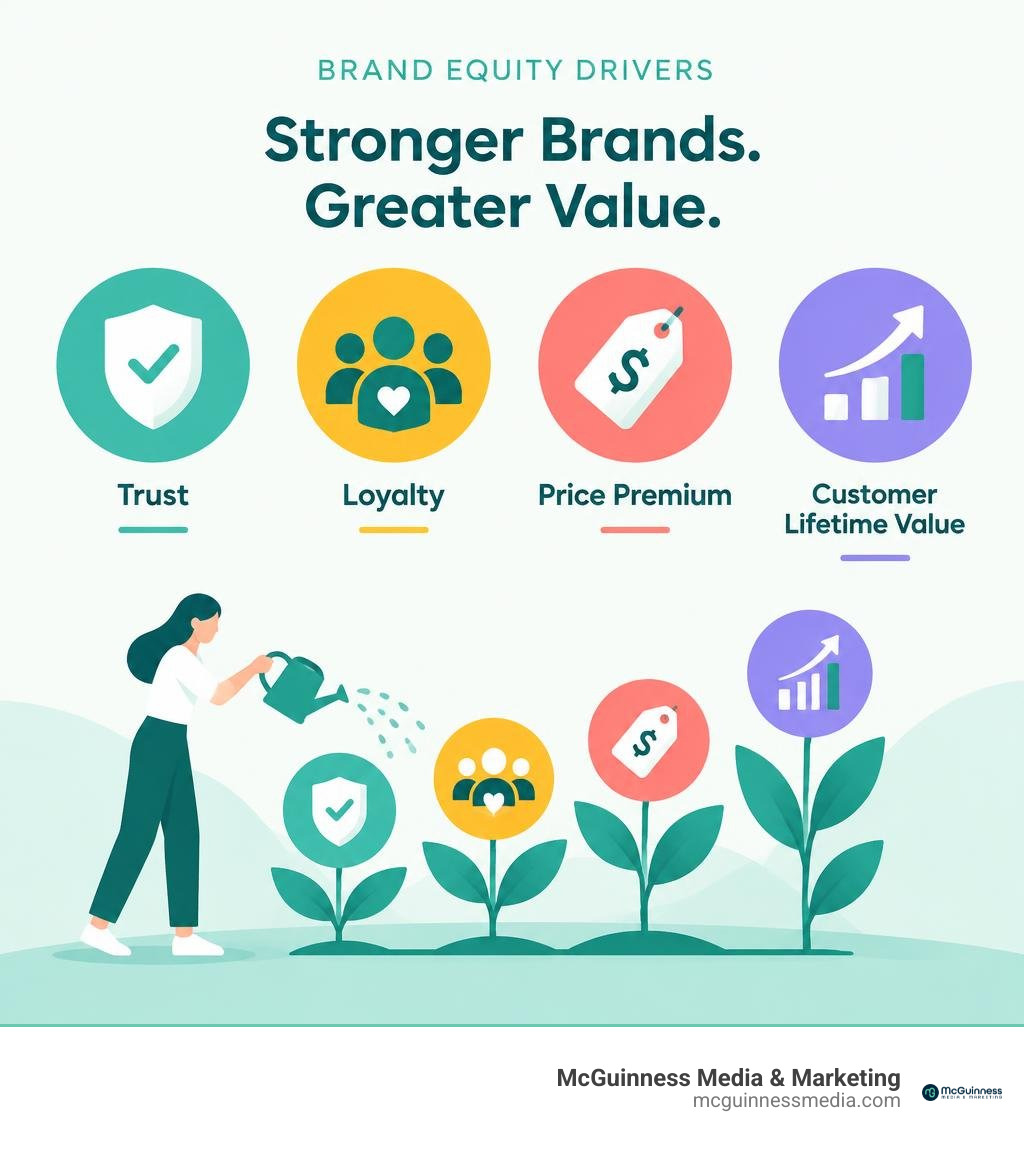
Strategic brand planning delivers clear financial returns. Research shows that over 80% of consumers need to trust a brand before even considering a purchase. Furthermore, 77% of customers prefer buying from companies that share their values.
Conversely, a landmark study revealed that consumers would not care if 77% of brands disappeared tomorrow. That statistic exposes the danger of commoditization. When you build a distinct identity backed by practical marketing strategy development, you protect your business against price wars, reduce customer acquisition costs, and command a healthy pricing premium.
Core Frameworks for Structuring Brand Architecture
To make brand planning manageable, marketing leaders rely on structured frameworks. These models distill abstract ideas about identity and positioning into actionable blueprints.
| Strategic Framework | Core Focus | Primary Applications | Best Suited For |
|---|---|---|---|
| Aaker Brand Identity Model | 4 Identity Perspectives (Product, Org, Person, Symbol) | Comprehensive brand architecture & multi-dimensional identity | Established brands, multi-product portfolios, organizations seeking deep personality |
| Unilever Brand Key | Insight-to-Discriminator Flow & Brand Essence | Single-page positioning, creative brief development, campaign alignment | Fast-moving consumer goods, B2B service lines, focused product launches |
| 5-C Market Analysis | Context, Company, Collaborators, Customers, Competitors | External market dynamics & business ecosystem alignment | Corporate strategic planning, new market entry, full-scale brand pivots |
As highlighted in MBA Skool brand management fundamentals, managing both tangible factors (pricing, packaging, features) and intangible factors (reputation, associations, emotional connection) is essential for maintaining sustained brand equity over time.
Applying Aaker’s Model to Brand Strategy and Planning
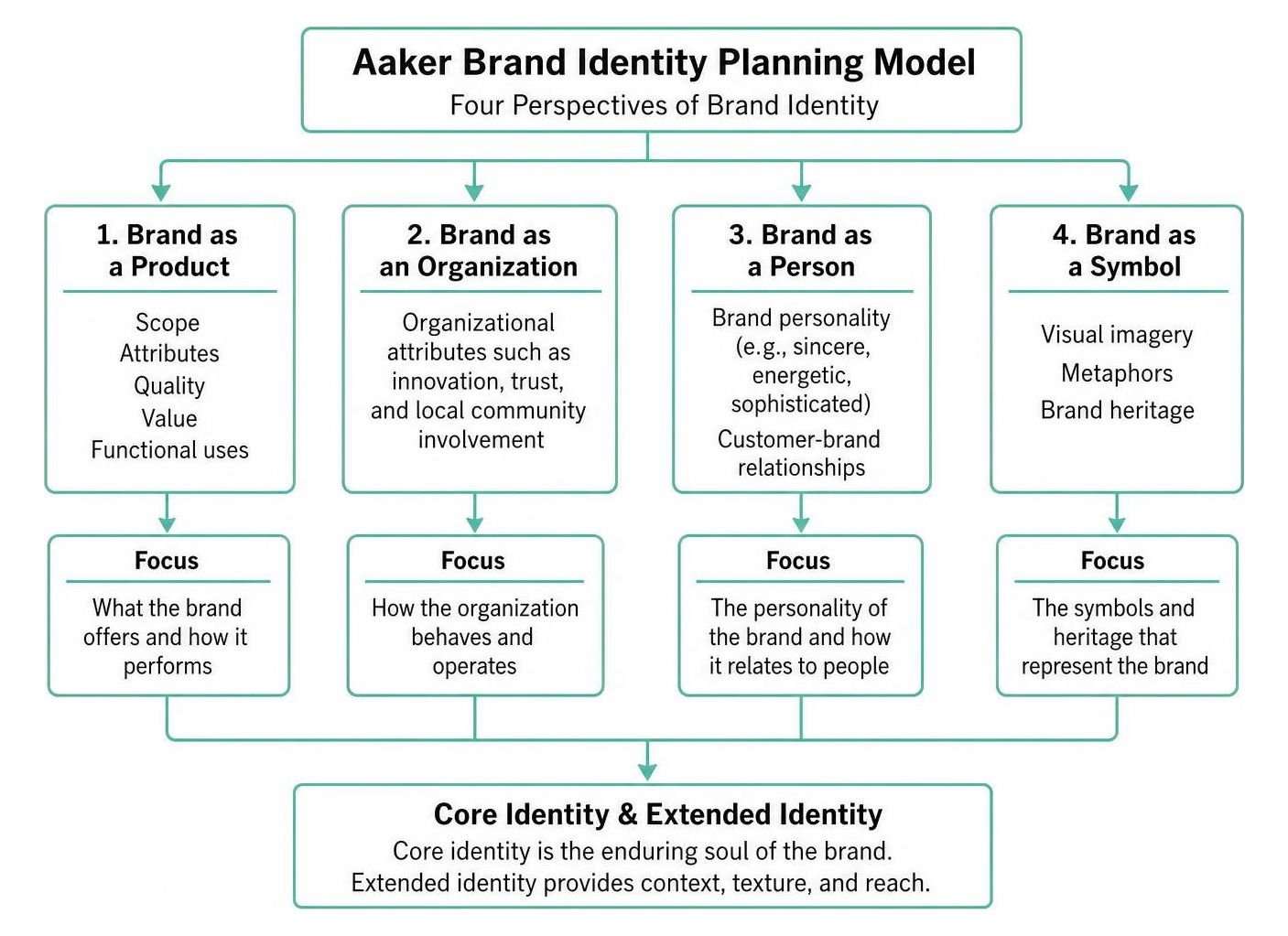
David Aaker’s Brand Identity Planning Model organizes a brand into four distinct lenses:
- Brand as a Product: Scope, attributes, quality, value, and functional uses.
- Brand as an Organization: Organizational attributes such as innovation, trust, and local community involvement.
- Brand as a Person: Brand personality (e.g., sincere, energetic, sophisticated) and customer-brand relationships.
- Brand as a Symbol: Visual imagery, metaphors, and brand heritage.
In the academic paper An Application of David A. Aaker’s Brand Identity Planning Model – A Case Study Approach, researchers demonstrated how top brands across different industries use these perspectives to structure their core identity (the enduring soul of the brand) and extended identity (contextual elements that provide texture and reach).
Deconstructing the Unilever Brand Key and 5-C Market Analysis
Another widely respected tool is the Unilever Brand Key, detailed in Unlock Brand Potential with Unilever Brand Key. This framework forces marketing teams to make disciplined choices on a single page by defining:
- Root Strengths: The historical foundations and assets the brand builds upon.
- Competitive Environment: The direct rivals, substitutes, and “do nothing” options in the market.
- Target Audience & Insight: The core customer and their unaddressed tension or desire.
- Benefits: Two to three functional and emotional outcomes delivered to the user.
- Reasons to Believe (RTBs): Concrete proof points supporting your claims.
- Discriminator & Essence: The single, defensible reason to choose your brand over others, condensed into a short phrase.
Pairing this model with the 3-V Principle (creating simultaneous value for Customers, Collaborators, and the Company) ensures your positioning supports your broader commercial goals.
Positioning, Differentiation, and Audience Prioritization
A sound strategy identifies where to play and how to win. Strategy expert Michael Porter famously observed that the essence of strategy is choosing what not to do. Trying to appeal to everyone usually means connecting deeply with no one.

By following a structured strategic marketing planning process guide, businesses can pinpoint market whitespace—unmet customer needs that competitors overlook.
Segmentation Models and High-Value Persona Mapping
Effective segmentation combines hard demographic data with soft psychographic insights:
- Demographics & Firmographics: Age, income, location, industry, team size, and annual revenue.
- Psychographics & Behaviors: Beliefs, professional aspirations, operational headaches, and media habits.
Nearly 60% of consumers believe businesses need to understand and address their needs better. When analyzing current marketing situations with examples, creating detailed buyer personas uncovers real customer motivations. This allows you to tailor campaigns to solve authentic friction points throughout the buying journey.
Crafting Defensible Value Propositions and Messaging
Once you identify your primary segments, use perceptual mapping to chart how competing brands are perceived along key buying criteria (such as high touch vs. automated, or budget-friendly vs. premium).
Your value proposition must bridge customer expectations and your unique strengths by delivering:
- Functional Benefits: Practical solutions to everyday problems (e.g., faster turnaround times, seamless platform integration).
- Emotional Benefits: How customers feel when working with you (e.g., confident, supported, respected).
- Defensible Proof: Proprietary methodologies, client results, industry certifications, or local expertise that competitors cannot easily match.
The End-to-End Strategic Brand Execution Roadmap
Bringing a brand strategy to life requires methodical execution across every department.
Step-by-Step Brand Strategy and Planning Execution
To turn strategy into market impact, follow a structured process inspired by the creating a strategic marketing plan blueprint and NYU Stern brand strategy course insights:
- Kick-Off & Alignment: Establish business goals, set project scopes, and align executive leadership.
- Discovery & Market Audits: Run customer surveys, analyze competitive messaging, and review historical campaign data.
- Core Brand Definition: Draft positioning statements, establish brand pillars, and finalize value propositions.
- Creative Design & Prototyping: Build visual identity kits, design responsive assets, and establish verbal guidelines.
- Phased Rollout: Train customer-facing teams, update digital channels, and launch integrated marketing campaigns.
Developing Visual, Verbal, and Experiential Identity Touchpoints
Your strategy must translate seamlessly across visual, verbal, and experiential touchpoints. Our practitioner guide to cohesive brand communications outlines how consistent messaging builds brand equity.
- Visual Assets: Primary and secondary logos, distinct brand colors, typography scales, graphic patterns, and photography styles.
- Verbal Identity: Brand voice guidelines, tone adjustments for different channels, elevator pitches, and boilerplate descriptions.
- Experiential Touchpoints: Sales interactions, onboarding sequences, packaging unboxing, and responsive client service.
Brand Governance, Technology Automation, and Performance Measurement
A brand strategy is not a one-and-done project; it is an operating system that requires active management. Proper governance ensures your brand stays consistent as your organization grows.

As detailed in our playbook for corporate marketing planning execution, cross-functional governance keeps marketing, sales, and product teams moving in the same direction.
Modern Tech Stacks for Asset Distribution and Brand Control
Modern marketing teams use technology to maintain consistency and scale content production:
- Digital Asset Management (DAM): Centralized cloud repositories that give internal teams and external partners easy access to approved logos, templates, and photos.
- Automated Design Systems: Template libraries that allow non-designers to create on-brand social media graphics and sales decks quickly.
- Generative AI Guardrails: Brand-specific style guides and prompt libraries that help AI tools produce copy and imagery matching your established tone.
Key Metrics for Measuring Brand Equity and Long-Term ROI
Over 90% of marketers use social channels for brand building, but tracking true brand equity requires looking beyond vanity metrics. As outlined in our guide on marketing plan control and performance analysis, companies should balance short-term lead indicators with long-term brand equity metrics:
- Brand Awareness & Recall: Track aided and unaided recall within your target markets.
- Share of Voice & Search Volume: Measure branded organic search volume and media mentions compared to competitors.
- Customer Sentiment & Net Promoter Score (NPS): Monitor client satisfaction, review sentiment, and willingness to recommend.
- Commercial Impact: Evaluate changes in customer acquisition cost (CAC), sales cycle length, retention rates, and pricing power.
Frequently Asked Questions About Strategic Brand Planning
How long does it take to build a comprehensive brand plan?
For small-to-midsize businesses with accessible research, a focused brand strategy project typically takes 4 to 8 weeks. Larger organizations or companies entering new markets may require 10 to 14 weeks to complete thorough customer interviews, competitive audits, internal workshops, and creative asset development.
What is the primary difference between brand strategy and marketing tactics?
Brand strategy defines your identity, your core promise, and your long-term market position. Marketing tactics are the individual channels, campaigns, and tools—such as paid search ads, trade show booths, or email newsletters—used to deliver that message. Strategy sets the direction; tactics execute the journey.
Can B2B businesses apply consumer brand planning frameworks?
Yes. While B2B buying processes involve multi-stakeholder committees, longer evaluation cycles, and formal procurement reviews, purchasing decisions remain deeply human. Frameworks like the Unilever Brand Key and Aaker Identity Model help B2B organizations address risk reduction, highlight operational return on investment, and build lasting credibility.
Conclusion
In a crowded marketplace, hope is not a strategy. Sustainable growth belongs to companies that deliberately define their identity, understand their audience, and deliver on their brand promise at every touchpoint.
At McGuinness Media & Marketing, we help growing businesses clarify their identity, outsmart the competition, and turn creative marketing into measurable revenue. Discover how our expert branding and strategic planning services can give your organization a lasting competitive advantage.