Ultimate Checklist for Content Overload Solutions
Content Overload Solutions That Help You Regain Focus
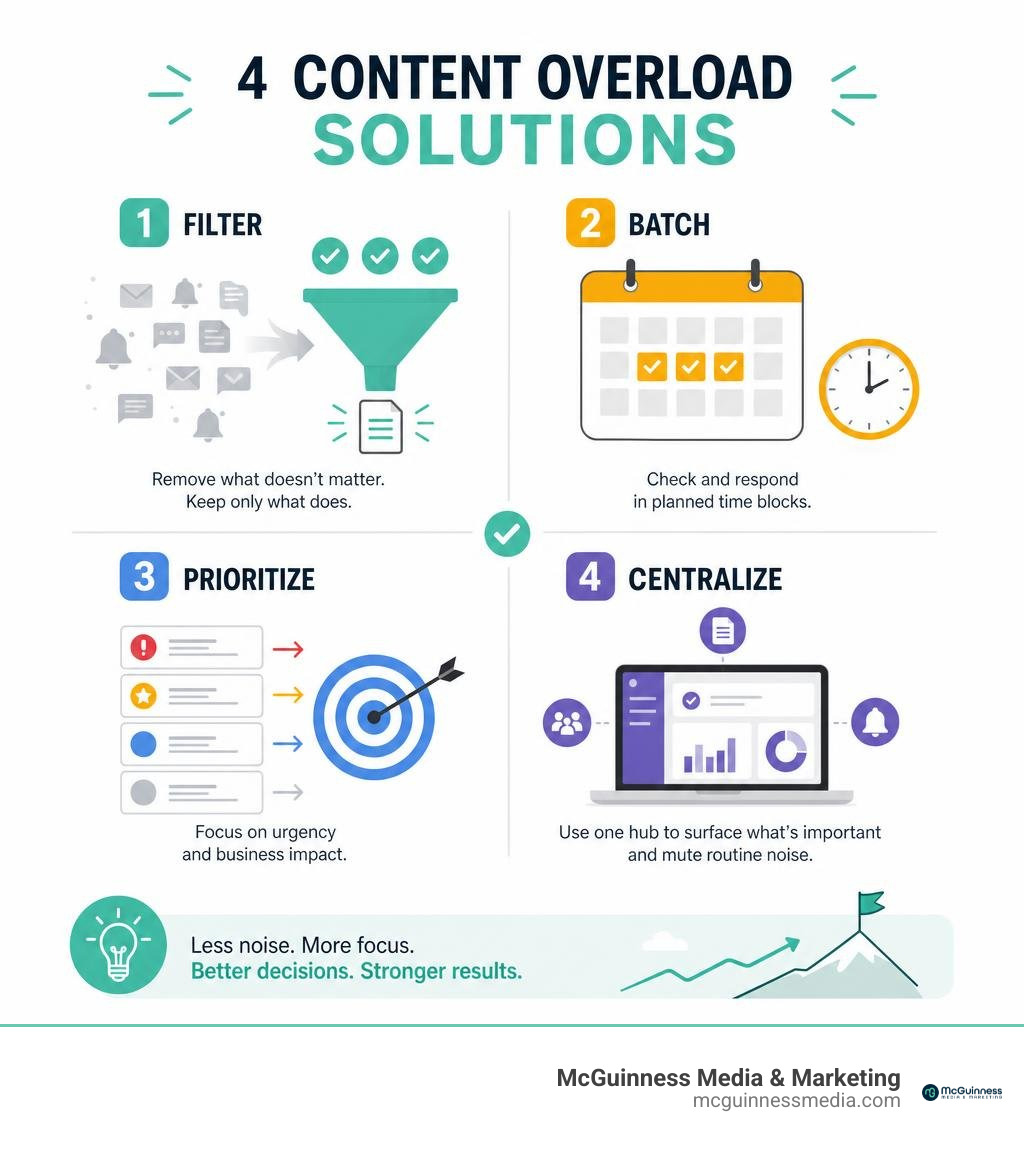
The most effective content overload solutions reduce what reaches you, clarify what deserves attention, and create limits around when you consume or respond to information. Start with these four steps:
- Turn off nonessential notifications and unsubscribe from low-value updates.
- Check email, news, and social feeds in planned time blocks instead of all day.
- Prioritize messages and tasks by urgency and business impact.
- Use a central workspace or dashboard to surface high-priority work and mute routine noise.
Information overload happens when the amount, speed, or complexity of incoming content exceeds your ability to process it well. The result is not just a crowded inbox. It can lead to distraction, slower decisions, lower-quality work, and rising stress. Research has also identified information overload as a frequent workplace stressor for 22.5% of respondents in a representative German sample.
For business leaders, the goal is not to consume every trend, alert, campaign brief, and competitor post. It is to build a reliable system that separates signal from noise, protects focused work, and helps your team act on the information that matters.
I am Megan McGuinness, owner and CMO of McGuinness Media & Marketing, with more than 20 years of experience creating marketing strategies for regional, national, and global brands. My work in strategy, media, digital marketing, and creative planning informs practical content overload solutions that help teams focus on clear messages and measurable growth.
Similar topics to content overload solutions:
The Anatomy of Digital Overload: Causes and Cognitive Costs
To fix digital overwhelm, we first have to understand the mechanics behind it. The volume of digital data generated every two days is roughly equivalent to the entire amount produced from the dawn of human civilization up through 2003. Yet, while our cloud storage is practically limitless, our biological processing power has stayed roughly the same since the Stone Age.
According to Cognitive Load Theory, human working memory can only comfortably juggle roughly seven (plus or minus two) chunks of information at any given time. When we exceed that bandwidth, cognitive friction sets in. Technostress—specifically the sub-categories of techno-overload (having too much information thrust upon you) and techno-complexity (feeling intimidated by the sheer variety of software interfaces)—creates mental gridlock (Arnold et al., 2023).
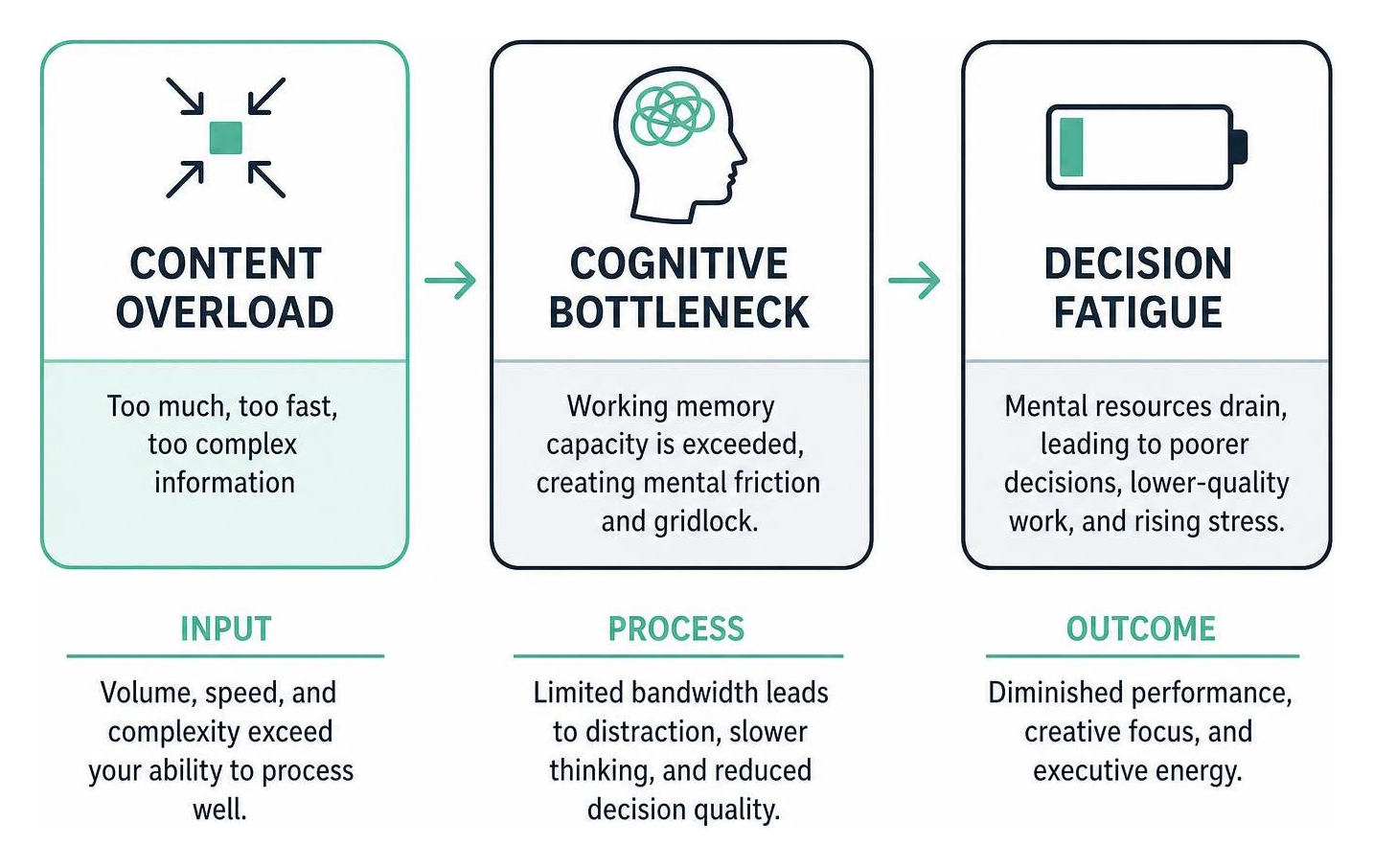
In the current digital ecosystem, this friction translates into diminished decision quality, fractured creative focus, and executive exhaustion. In creative fields, this mental drag is especially noticeable; for example, learning how to deal with content overload while designing has become essential for maintaining creative clarity and brand consistency.
Personal and Organizational Triggers of Information Overwhelm
Overload does not happen in a vacuum. It stems from a collision between personal habits and workplace communication architecture:
- Push Notifications and Alerts: The endless chime of pings creates an environment of continuous partial attention. We are never fully focused on the task at hand, nor are we fully resting.
- Asynchronous Message Bloat: The proliferation of messaging apps often leads to endless, scattered chat threads where critical decisions get buried under routine banter.
- Communication Silos: When teams lack unified documentation, employees spend hours sifting through emails, project management platforms, and drive folders just to locate a single brief.
- Hypervigilance: Fear of missing out (FOMO) on industry news, breaking events, or internal updates creates a psychological urge to check feeds compulsively.
Psychological Toll: Decision Paralysis and Burnout
The consequences of constant digital deluge extend beyond lost work hours. Around 81% of US adults identify global uncertainty as a significant source of chronic stress. When we consume high volumes of uncurated media, our brains struggle to triage what is immediately actionable and what is background noise.
Studies show that consuming as little as 2.5 hours of unfiltered media per day can elevate mild symptoms of anxiety and depression into moderate territory. Furthermore, during periods of continuous news-related strain, roughly a third of adults report struggling with basic, routine daily choices—such as deciding what to eat or wear. When your cognitive energy is depleted by thousands of micro-inputs, decision fatigue leaves little room for high-level strategic thinking.
Core Content Overload Solutions: Behavioral Habits and Daily Routines
Overcoming content overload requires intentional operational habits. Rather than letting the stream of incoming digital data dictate your day, establishing structured boundaries protects your mental bandwidth.

Implementing an Information Diet and Consumption Limits
Think of digital consumption much like your physical nutrition: you want nutrient-dense insight, not empty digital junk food.
- Practice Notification Hygiene: Disable non-urgent notifications on desktop and mobile devices. Keep alerts strictly reserved for time-sensitive, emergency items. (Research shows that using smartwatch alerts solely for critical notifications reduces response times by 3x without disrupting surrounding workflows).
- Triage Headlines Intentionally: Skimming doom-laden headlines without context spikes cortisol. If a topic matters, read one comprehensive, authoritative analysis rather than scrolling through twenty fragmented posts. For additional practical daily tactics, check out these tactics to avoid information overload.
- Task Batching and Bounded Windows: Group similar low-focus tasks together. Designate two 30-minute windows daily for email and social feed triage rather than responding to inquiries reactively throughout the afternoon.
- The Eisenhower Matrix: Categorize incoming data and tasks by urgency and importance:
- Urgent & Important: Do immediately.
- Important, Not Urgent: Schedule protected deep work time.
- Urgent, Not Important: Delegate or automate.
- Neither: Delete, unsubscribe, and ignore.
Psychological Content Overload Solutions: Mindfulness and Cognitive Reframing
Behavioral changes work best when paired with mental resilience:
- Cognitive-Behavioral Reframing: When you feel overwhelmed by industry shifts or rapid news cycles, challenge catastrophizing thoughts. Ask: “Is this development actionable for my business today, or is it external noise beyond my control?”
- Grounding and Tech-Free Zones: Create physical tech-free areas in your home or office. A 5-minute breathing exercise or a brief outdoor walk resets your autonomic nervous system after intense screen time.
- Uncertainty Tolerance: Accept that you cannot consume everything. Shifting from an “information hoarding” mindset to an “information on demand” mindset frees up vital cognitive reserves. Building intentional wellness initiatives within organizations, including supporting mental health through corporate media strategies, creates a sustainable work environment for everyone.
Enterprise and Technological Frameworks to Filter Digital Noise
Individual discipline is vital, but organizational infrastructure must reinforce it. If internal communications resemble a chaotic free-for-all, individual team members will inevitably burn out.
| Communication Vector | Traditional Unstructured Approach | Unified & Governed Framework |
|---|---|---|
| Channel Architecture | Fragmented across email, chat, texts, and notes | Centralized digital workplace with designated hubs |
| Message Prioritization | All pings treated with equal urgency | Visual dashboards highlighting high-priority tasks |
| Information Retention | Buried in individual email inboxes | Structured, searchable internal knowledge base |
| Response Expectations | Immediate response expected at all hours | Clearly defined asynchronous response windows |
Deploying AI-Powered Content Overload Solutions and Curation Engines
Modern filtering technology can serve as a protective barrier between your brain and the internet. In high-stakes environments like healthcare, staff presented with 51 admission concepts naturally prioritized and utilized only 11 critical points; intelligent systems help automate that triage.
- Zero-Noise Briefings and Automated Filters: Instead of browsing endless feeds, modern tools assess content originality and depth. Platforms like AI content quality filtering systems score incoming pieces and remove repetitive noise.
- Concept-Based Knowledge Bases: Instead of saving bookmarks into forgotten folders, tools like Noverload compile your saved resources into a searchable knowledge base that can be queried by concept or business goal.
- Intelligent Newsletter Curation: To keep track of thought leadership without inbox chaos, intelligent newsletter curation platforms and services like Sift or ContentDigest score updates based on relevance, helping you absorb industry insights in a concise weekly summary.
- Dynamic On-Site Delivery: For businesses delivering information to clients, tools like Personyze match resources directly to individual visitor profiles, preventing content saturation on your website.
Organizational Policies and Healthy Communication Norms
Tools alone cannot fix a culture of urgency. Leadership teams must establish structural norms that protect focus:
- Enforce No-Meeting Blocks: Institute dedicated no-meeting days or deep-work mornings to give team members uninterrupted focus time.
- Establish the Right to Disconnect: Clearly state that after-hours messaging does not require immediate replies. Setting clear boundaries prevents baseline stress from spilling into personal time.
- Message Triage Standards: Train team members to write clear subject lines, summarize key action items upfront, and tag colleagues only when explicit action is needed. These habits are crucial for combating social media fatigue across teams.
Strategic Content Planning: Delivering High-Signal Marketing
For business leaders and marketers, solving content overload is a two-way street. While we must protect our own attention, we must also ensure our brand is not contributing to digital clutter.

High-signal marketing cuts through the noise by delivering clear, targeted value rather than high-volume filler:
- Prioritize Audience Empathy: Every piece of content should answer a specific customer question or solve an immediate challenge.
- Quality Over Volume: Publishing two comprehensive, authoritative pieces each month provides greater ROI and brand authority than pushing daily low-effort updates.
- Unified Strategic Roadmaps: Designing an overarching plan prevents disconnected, frantic campaign execution. Take time to explore how to create a solid digital marketing strategy for your business to ground your outreach in clear objectives.
- Clarity in Presentation: Whether drafting client decks or executive summaries, distill key insights into digestible takeaways. For guidance on presenting strategic frameworks cleanly, review our guide on mastering marketing strategy presentations with winning slide decks.
For a deeper dive into crafting disciplined communication campaigns, review our guides on building a strategic content plan, strategic planning for marketers, and the complete strategic marketing planning process. You can also explore perspectives on editorial strategy in modern media for additional context.
Frequently Asked Questions About Content Overload
What is the difference between information overload and sensory overload?
Information overload refers to receiving more data, text, ideas, and decisions than your cognitive working memory can process. Sensory overload occurs when one or more of your physical senses (sight, hearing, touch) is overstimulated by physical inputs like bright flashing lights, loud alarms, or chaotic physical environments. While information overload is a cognitive capacity bottleneck, sensory overload is a neurological reception bottleneck.
How does task batching reduce digital fatigue?
Every time you switch between writing a report, replying to an email, and checking a notification, your brain suffers from “attention residue”—a lingering cognitive cost from the previous task. Task batching groups similar activities into designated time blocks, allowing your brain to maintain a single processing mode. This minimizes context switching, reduces mental friction, and preserves energy throughout the day.
What is the right to disconnect policy in modern workplaces?
The right to disconnect is a workplace policy (and in some jurisdictions, a legal standard) that protects employees from having to monitor or respond to work-related communications outside of contracted working hours. By setting clear boundaries around off-hours emails, calls, and chat pings, organizations prevent chronic hypervigilance, support recovery, and reduce employee burnout.
Conclusion: Reclaiming Focus in an Over-Communicated Era
Tackling information overload is not about running away from technology. It is about intentionally curating your digital environment, setting firm operational boundaries, and using modern tools to separate meaningful insight from endless noise.
At McGuinness Media & Marketing, based in Warwick, Rhode Island, we help brands replace marketing chaos with clear, strategic, and high-signal communication that drives real growth. Explore our latest thinking on our marketing blog, or partner with our team through our comprehensive digital marketing services to build campaigns that truly stand out.
References
Arnold M, Goldschmitt M, Rigotti T. “Dealing with information overload: a comprehensive review..” Frontiers in psychology, 2023. PMCID PMC10322198.