
Speak Their Language: How Audience Segmentation Drives Clearer Brand Messages
Why Speaking the Same Language as Your Customers Matters
Audience segmentation strategies are the practice of dividing your customer base into smaller, distinct groups based on shared characteristics—like demographics, behavior, location, or interests—so you can deliver more relevant, personalized messages to each group.
Quick Overview: Core Audience Segmentation Strategies
- Demographic Segmentation – Group by age, gender, income, education, or occupation
- Geographic Segmentation – Target based on location, climate, or region
- Psychographic Segmentation – Organize by values, lifestyle, interests, or personality
- Behavioral Segmentation – Segment by purchase history, website activity, or engagement level
- Lifecycle Stage Segmentation – Tailor messages to where customers are in their journey (awareness, consideration, decision)
- Technographic Segmentation – Differentiate by device usage or technology preferences
In today’s market, 81% of customers expect a personalized experience. Yet many businesses still broadcast the same message to everyone, hoping something will stick. This “one-size-fits-all” approach leads to what marketing expert Seth Godin calls mediocre marketing—content that’s so generic it disappoints everyone and resonates with no one.
The reality is simple: your customers are not all the same. An urban office worker and a rural farmer have vastly different needs. A first-time buyer requires different information than a loyal repeat customer. When you treat everyone identically, you waste budget, dilute your brand, and miss opportunities to build real connections.
Audience segmentation solves this problem. By organizing your contacts into meaningful groups, you can craft messages that feel personal—like they were written specifically for each recipient. This targeted approach improves focus, drives higher conversion rates, and builds the kind of customer loyalty that generates repeat purchases and referrals. In fact, 78% of consumers are more likely to make repeat purchases from brands that personalize their messages.
But segmentation isn’t just about better emails or ads. It transforms how you understand your market, develop products, allocate resources, and compete. It’s the difference between firing shots blindfolded and aiming with precision.
I’m Megan McGuinness, and over my 20+ years developing marketing strategies for regional, national, and global brands, I’ve seen how effective audience segmentation strategies turn struggling campaigns into revenue engines. At McGuinness Media & Marketing, we help businesses cut through the noise by speaking directly to the customers who matter most.
Why Audience Segmentation is the Cornerstone of Modern Marketing
In today’s busy market, making noise isn’t enough. To connect with customers, you must speak their language and engage them on their terms. This is where audience segmentation strategies become indispensable. They clarify who your audiences are and how they spend their time, allowing you to deliver a better customer experience, influence the path to purchase, and identify the most valuable groups to target.
The benefits of implementing robust audience segmentation are far-reaching:
- Improved Marketing Focus: By narrowing our target, we can concentrate our marketing efforts and resources on the specific groups most likely to convert. This means less wasted ad spend and more impactful campaigns.
- Improved Customer-Centricity: Segmentation forces us to look at our customers as individuals with unique needs and preferences, rather than a faceless mass. This customer-first approach ensures our strategies are built around what they want.
- Competitive Advantage: When we understand our audience better than our competitors, we can react faster to trends, tailor our offerings, and create a stronger bond with our customers. This agility is a powerful differentiator.
- Increased Return on Investment (ROI): Personalized messages resonate more deeply, leading to higher engagement rates, better conversion rates, and ultimately, a stronger bottom line. As a report by Mckinsey & Company found, businesses that excel at personalization often see significant improvements in revenue and customer loyalty.
Audience segmentation is a strategic imperative that allows for efficient and effective scaling. It means focusing on a subset of customers who are most similar to your best existing ones, rather than casting a wide, inefficient net.
| Feature | Market Segmentation | Audience Segmentation |
|---|---|---|
| Primary Focus | Broad market, potential customers | Existing customer base, known contacts, leads |
| Goal | Identify promising segments for growth, tailor acquisition strategies | Personalize marketing, improve service, improve retention |
| Data Basis | Demographics, geography, industry | Demographics, behavior, needs, engagement level |
| Stage of Business | Earlier stages, expanding into new markets | Later stages, optimizing engagement and loyalty |
The Dangers of a One-Size-Fits-All Approach
Imagine hosting a dinner party and serving the exact same meal to everyone, regardless of dietary restrictions or preferences. Some guests might be mildly satisfied, others disappointed, and some might not eat at all. This is precisely what happens with a “one-size-fits-all” marketing strategy. As Seth Godin wisely observed, “We worry about disappointing, missing, offending or otherwise leaving behind someone who might become our customer.” To avoid this, many businesses try to produce content that will appeal to everyone. The result, unfortunately, is often content that is flat, generic, and ultimately mediocre.
The pitfalls of generic messaging are numerous:
- Wasted Ad Spend: When we broadcast messages to people who aren’t interested, we’re essentially throwing money away. Our marketing budget could be working much harder if it were precisely targeted.
- Lower Engagement Rates: Customers today are bombarded with content. If a message doesn’t immediately resonate, they’ll scroll past it without a second thought. Low engagement means our efforts are largely ineffective.
- Brand Dilution: A brand that tries to be everything to everyone often ends up being nothing to anyone. It loses its distinct voice and fails to build a strong identity in the minds of consumers.
In the highly competitive market of Rhode Island and beyond, we simply cannot afford to be mediocre. We need to cut through the noise with clarity and relevance.
How Segmentation Drives Personalization and Customer Loyalty
Effective audience segmentation strategies are the key to avoiding mediocre marketing. Customers expect to be treated as individuals, a demand that reflects a fundamental shift in consumer behavior.
By segmenting your audience, you can:
- Meet Customer Expectations: Deliver the personalized experiences customers expect, making them feel valued and understood.
- Build Stronger Relationships: Custom messages foster a sense of connection and trust, helping build lasting customer relationships.
- Increase Repeat Purchases: Personalization makes consumers more likely to make repeat purchases, directly impacting revenue and customer lifetime value.
- Generate Referrals: Satisfied customers are also more likely to refer family and friends, driving invaluable organic growth.
The power of personalization, driven by smart segmentation, is undeniable. It transforms marketing from a guessing game into a strategic, data-driven approach that resonates.
The 4 Main Types of Audience Segmentation (And How to Use Them)
To effectively implement audience segmentation strategies, we first need to understand the fundamental ways we can group our customers. While there are many advanced approaches, most segmentation models are built upon four core types: Demographic, Geographic, Psychographic, and Behavioral. We often combine these to create more nuanced and effective segments.
Demographic Segmentation: The Who
Demographic segmentation is one of the most basic and widely used forms of segmentation. It involves dividing our audience based on quantifiable, outward-facing attributes of individuals.
- Key Factors: Age, gender, income, education level, occupation, marital status, family size, ethnicity.
- Why it’s useful: Demographics provide a foundational understanding of who our customers are. They often correlate with purchasing power, product interest, and communication preferences.
- Example: For a fitness apparel brand in Rhode Island, we might target women aged 30 to 45 with moderate to high income who are health-conscious. This demographic group might be interested in premium activewear for their active lifestyles.
Geographic Segmentation: The Where
Geographic segmentation divides our audience based on their physical location. This can range from broad categories like country or region to more specific areas like city, neighborhood, or even climate zone.
- Key Factors: Country, state, city, zip code, rural vs. urban, climate.
- Why it’s useful: Location often dictates needs, cultural nuances, and even logistical considerations. It’s particularly important for local businesses or those with region-specific offerings.
- Example: A beverage company operating in Rhode Island might promote hot coffee and tea during the colder winter months, while heavily advertising iced beverages and sparkling water during the warmer summer season, tailoring their message to the local climate.
Psychographic Segmentation: The Why
Psychographic segmentation digs into the “why” behind consumer behavior, focusing on internal characteristics that influence purchasing decisions. It’s about understanding our customers’ minds and hearts.
- Key Factors: Lifestyles, values, interests, personality traits, attitudes, opinions, beliefs.
- Why it’s useful: This type of segmentation helps us connect with customers on a deeper, emotional level, allowing for more authentic and resonant messaging.
- Example: A travel company might target “adventure enthusiasts” in Rhode Island who value unique experiences and exploration over luxury and relaxation. Our messaging would highlight thrilling activities, off-the-beaten-path destinations, and the excitement of findy.
Behavioral Segmentation: The How
Behavioral segmentation focuses on the actions our customers take, providing direct insights into their preferences, habits, and engagement with our brand.
- Key Factors: Purchase history (what, when, how often), website activity (pages visited, time on site, clicks), engagement level (email opens, social media interactions), device usage, loyalty status.
- Why it’s useful: This is often the most powerful form of segmentation because it’s based on actual actions, which are strong predictors of future behavior.
- Example: An e-commerce site might segment customers based on their purchase history: frequent buyers, one-time purchasers, or those who haven’t bought in a while. We could then send exclusive loyalty offers to frequent buyers or “win-back” promotions to inactive customers. It’s also crucial to remember that more than half of your audience will view your website on their mobile devices, so segmenting by device usage allows us to optimize content for mobile-first experiences.
A Practical Guide to Implementing Audience Segmentation Strategies
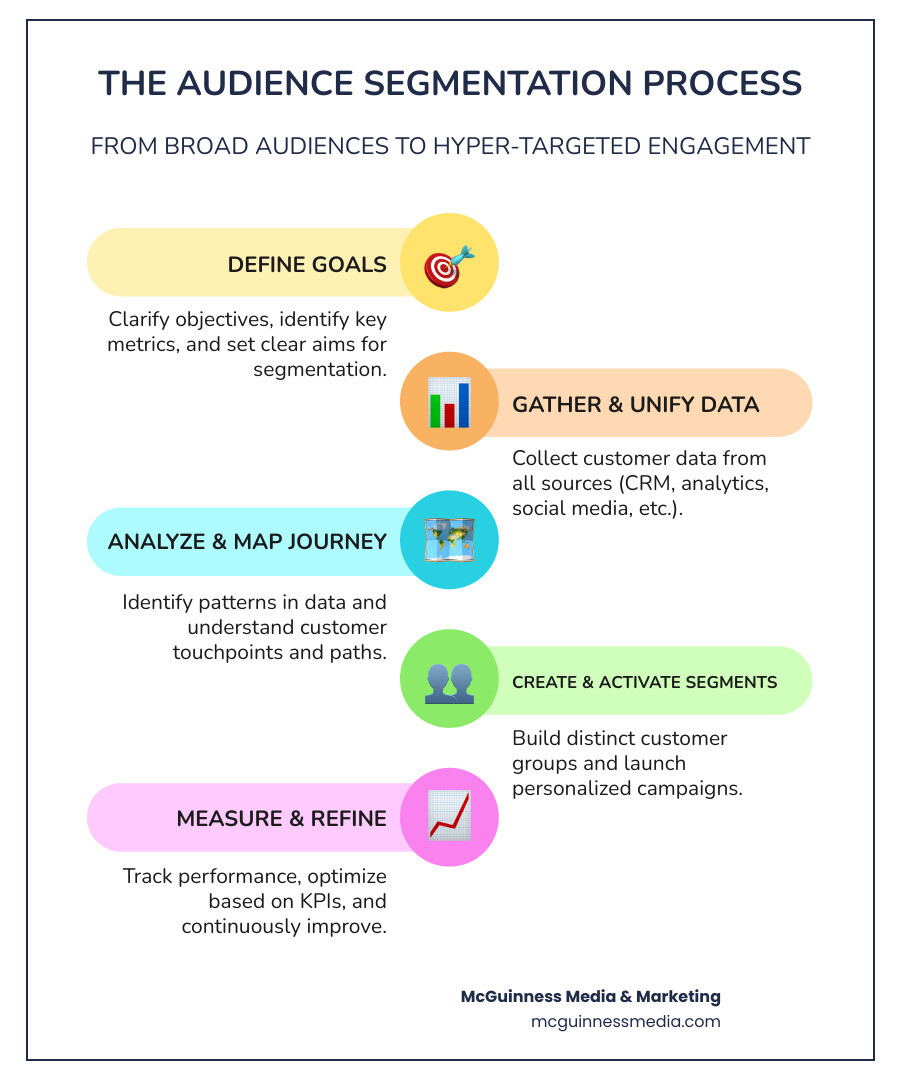
Implementing effective audience segmentation strategies requires a systematic and data-driven approach. It’s not a one-time task but an ongoing process of learning, adapting, and refining. At McGuinness Media & Marketing, we guide our clients through each step, ensuring their segmentation efforts yield tangible results. This process is deeply integrated into our Branding and Strategy Services, where we help businesses define their unique voice and connect with their ideal customers.
Step 1: Set Clear Goals and Gather Customer Data
Before we even think about dividing our audience, we need to know why we’re doing it. What specific business objectives are we trying to achieve? Are we looking to increase sales, improve customer retention, boost engagement, or launch a new product? Defining these objectives clearly will guide our entire segmentation process.
Once our goals are set, the next critical step is to gather and unify customer data. Data comes from all directions—our Customer Relationship Management (CRM) system, email marketing platforms, website analytics, social media interactions, customer service records, and more. The challenge is often getting a full picture of each customer when this data is fragmented.
Our goal is to create a “single source of truth” for customer data. This means pulling in data from various sources to create unified customer profiles. This 360-degree customer view allows us to see how a customer engages with our brand over time, identifying important patterns like their preference for discounts or the timing of big purchases.
Step 2: Analyze Data and Map the Customer Journey
With our data unified, we can now begin to analyze it for patterns and insights. This is where we start to identify the common characteristics that will form our segments. A powerful tool in this step is customer journey mapping.
Customer journey mapping helps us visualize the entire path a customer takes when interacting with our brand, from initial awareness to post-purchase support. By understanding each touchpoint and the customer’s mindset at that stage, we can align our segments with their journey. For example, a customer in the “Awareness” stage needs very different information than one in the “Decision” stage. We can then craft specific content for each point along the customer journey to guide them to the next stage effectively.
Step 3: Create, Validate, and Activate Your Segments
Based on our data analysis and journey mapping, we can now begin to build our distinct audience segments. This often involves combining different segmentation types (e.g., demographics + behavior) for more granular targeting.
A valuable practice at this stage is to create customer personas. These are semi-fictional representations of our ideal customers within each segment, complete with goals, challenges, motivations, and pain points. Personas bring our segments to life and help us empathize with our customers, guiding our creative and messaging efforts.
Before rolling out our segmented strategies widely, we always recommend testing our segments with pilot campaigns. This allows us to validate our hypotheses and make adjustments based on real-world performance. Once validated, we can activate our segments across all relevant channels, whether it’s through targeted email campaigns, personalized website content, or highly specific social media ads. Our Social Media Services are specifically designed to help clients in Rhode Island leverage these segmented approaches for maximum impact.
Step 4: Measure Success and Refine Your Segments
Audience segmentation is an iterative process. We must continuously monitor, measure, and refine our strategies to ensure ongoing success. This involves tracking key performance indicators (KPIs) for each segment.
Important metrics to track include:
- Conversion Rate per Segment: How effectively is each segment converting?
- Customer Lifetime Value (CLV) by Segment: Which segments are generating the most long-term value?
- Engagement Rates: Are our emails being opened, and our social media posts clicked within each segment?
- Return on Ad Spend (ROAS): How efficient are our segmented advertising campaigns?
Using control groups can also help us isolate the true impact of our segmentation efforts. By comparing the performance of a segmented group against a non-segmented control group, we can objectively assess the effectiveness of our strategies. We continuously analyze and optimize our audience segmentation strategies, ensuring they remain relevant and effective, which is a core part of our approach to Maximizing ROI: Media Planning Tips for Small Businesses.
Advanced Segmentation: The Role of AI, Ethics, and Channel Activation
As marketing continues to evolve, so too do the capabilities of audience segmentation strategies. We’re moving beyond basic demographic splits into a world where artificial intelligence (AI) and predictive analytics can open up unprecedented levels of personalization.

How AI and Predictive Analytics Improve Segmentation
AI and predictive analytics are changing how we approach audience segmentation. They allow us to move from reacting to past customer behavior to anticipating future actions.
- Automated Segment Finding: AI can analyze vast datasets to automatically suggest high-value segments and uncover hidden patterns that human analysts might miss. Imagine AI detecting subtle engagement shifts—like fewer logins or shorter session times—and automatically moving a customer into a “re-engagement” segment.
- Predicting Future Behavior: AI, when powered by robust data, can significantly improve segmentation by predicting metrics like a customer’s next order date or their predicted Customer Lifetime Value (CLV). This enables us to deliver highly personalized experiences and build smarter segments faster.
- Real-Time Segment Updates: Advanced platforms can offer dynamic audiences that adapt in real-time based on customer interactions and changes in behavior. This means our segments are always current, ensuring we’re messaging the right audience at the right time.
However, it’s worth noting that this advanced level of integration is still developing. Research on AI-powered segmentation indicates that only 20% of companies have currently integrated real-time, AI-powered segmentation into their strategies. This presents a significant opportunity for businesses to gain a competitive edge. For small businesses in Rhode Island and beyond, understanding The Rise of AI in Marketing: What It Means for Small Businesses is crucial for staying ahead.
Overcoming Common Challenges in Audience Segmentation Strategies
While the benefits of segmentation are clear, implementing these strategies is not without its problems. We frequently encounter several common challenges:
- Data Silos: Information scattered across various systems (CRM, marketing automation, sales, customer service) makes it difficult to get a unified view of the customer.
- Maintaining Data Quality: Inconsistent, outdated, or duplicate data can lead to irrelevant messaging and flawed segmentation.
- Segment Management: As the number of segments grows, managing them can become overwhelming, especially for businesses with limited resources.
- Behavior Shifts: Customer behaviors and market trends are constantly evolving, meaning segments that worked in the past can quickly become outdated.
To overcome these challenges, we recommend:
- Data Unification Platforms: Investing in a Customer Data Platform (CDP) or similar solution to integrate multiple data sources into a single, comprehensive customer profile.
- Regular Data Audits and Cleansing: Implementing processes to regularly audit data sources for accuracy and completeness, removing duplicates and correcting errors.
- Automation Tools: Utilizing automated tools and analytics platforms to simplify segment management and ensure segments update in real-time.
- Continuous Monitoring: Regularly monitoring market trends and adjusting segmentation strategies accordingly. Segmentation should never be static; flexibility is key.
Ethical Considerations and Data Privacy
As we leverage more sophisticated audience segmentation strategies and use customer data, ethical considerations and data privacy become paramount. Ignoring privacy rules can lead to hefty fines and significantly harm a brand’s reputation.
- GDPR & CCPA Compliance: We must ensure our data collection and segmentation practices adhere to regulations like GDPR (General Data Protection Regulation) and CCPA (California Consumer Privacy Act), even for businesses in Rhode Island serving customers across different regions.
- Transparency in Data Collection: It’s crucial to be transparent with customers about what data we collect and how we use it. Providing clear data policies and easy opt-out options builds trust.
- Focusing on First-Party Data: Prioritizing the use of first-party data—information customers willingly share with us—is a best practice. This behavioral and transactional data, rather than personal details, often provides the most actionable insights for segmentation.
- Balancing Personalization with Privacy: The goal is to create personalized experiences without being intrusive. We focus on behavioral patterns and consented data, allowing customers to control their preferences.
Combining Audience Segmentation Strategies for Granular Targeting
The true power of segmentation often lies in combining different types to create highly granular and effective segments. This layering allows us to move beyond broad categories to hyper-targeted micro-segments.
For example, instead of just targeting “millennials,” we could combine:
- Demographic: High-income urban millennials (age, income, location)
- Behavioral: Who recently purchased running shoes (purchase history)
- Psychographic: And frequently engage with fitness content on social media (interests, engagement level)
This combined segment—”high-income urban millennials who recently purchased running shoes and frequently engage with fitness content on social media”—is incredibly specific. We can now craft marketing messages that speak directly to their immediate needs (e.g., promoting performance apparel, recovery tools, or local running events in Rhode Island) with a precision that generic messaging could never achieve. This level of detail ensures our messages resonate deeply and drive stronger results.
Frequently Asked Questions about Audience Segmentation
What is the difference between audience segmentation and buyer personas?
This is a common question, and the distinction is important.
- Audience Segmentation is the process of dividing your entire customer base or market into groups based on shared characteristics. These segments are broad categories of real people who exhibit similar traits or behaviors. For example, “first-time buyers,” “high-value customers,” or “customers in Warwick, RI interested in home improvement.”
- Buyer Personas, on the other hand, are fictional, archetypal representations of your ideal customers within a specific segment. They add qualitative details to your segments, such as names, job titles, goals, challenges, motivations, and even personal interests. A buyer persona might be “Savvy Sarah,” a 38-year-old marketing manager in Providence, RI, who is tech-savvy, values efficiency, and is looking for solutions to streamline her team’s workflow.
Think of it this way: segmentation provides the framework, and personas fill in the rich, human details.
How often should I update my audience segments?
The frequency of updating your audience segments depends on the type of segmentation and the dynamism of your market.
- Static Segments: Demographically or geographically based segments (e.g., “women aged 25-34 in Rhode Island”) tend to be more stable. These can often be reviewed quarterly or annually to ensure they still accurately represent your target groups.
- Dynamic Segments: Behavioral or lifecycle-based segments (e.g., “cart abandoners,” “active users,” “customers who haven’t purchased in 90 days”) are much more fluid. These segments should ideally update in real-time or be reviewed at least monthly to adapt to changing customer behavior and market conditions. High-growth companies or those in rapidly evolving industries might even need to review them more frequently.
Continuous monitoring of performance metrics is always advised, even for static segments, to ensure their ongoing relevance.
What metrics should I track to measure segmentation success?
Measuring the success of your audience segmentation strategies is crucial for proving ROI and continuous improvement. We recommend tracking a combination of metrics, typically compared against a baseline before segmentation or against a non-segmented control group:
- Conversion Rate per Segment: This is perhaps the most direct measure. Are segmented campaigns leading to higher conversion rates (e.g., purchases, sign-ups, downloads) compared to generic campaigns or other segments?
- Customer Lifetime Value (CLV) by Segment: Are certain segments, targeted with specific messages, generating a higher long-term value for your business? This helps us identify and nurture our most profitable customer groups.
- Engagement Rates: For email campaigns, track open rates and click-through rates. For social media, monitor likes, shares, comments, and clicks. Higher engagement within a segment indicates that our messages are resonating.
- Return on Ad Spend (ROAS) per Campaign: For paid advertising, evaluate how much revenue is generated for every dollar spent on campaigns targeted at specific segments.
By tracking these metrics, we can gain a clear understanding of what’s working, what’s not, and where to further refine our segmentation efforts.
Conclusion: From Broad Strokes to Fine Details
In an age where customers expect personalized experiences and generic marketing falls flat, effective audience segmentation strategies are no longer optional—they are essential. We’ve seen how moving from a volume game to a relevance game transforms marketing results, drives customer loyalty, and ultimately fuels business growth.
From understanding the fundamental types of segmentation like demographic, geographic, psychographic, and behavioral, to implementing a practical step-by-step process of data gathering, analysis, and activation, segmentation empowers us to speak directly to the customers who matter most. As we look to the future, AI and predictive analytics will only further refine our ability to anticipate needs and deliver hyper-personalized experiences, all while navigating the critical ethical considerations of data privacy.
At McGuinness Media & Marketing, based right here in Warwick, Rhode Island, we believe in the power of a clear message custom to the right audience. Our expertise in strategic planning, creative services, and media buying means we’re uniquely positioned to help businesses like yours leverage these advanced segmentation techniques to cut through the noise and build lasting connections. Let us help you transform your marketing efforts from broad strokes to fine, impactful details.