
From Lab to Launch: A Commercialisation Strategy Example That Works
A Commercialisation Strategy Example: From Lab to Market
Here is a commercialisation strategy example: A startup develops a new lithium-ion battery separator. Before launch, it asks battery makers what performance they need, checks whether the market is large enough, protects its intellectual property, and tests production with a manufacturing partner. It then sets a price, chooses a sales route, and ties revenue targets to the number of customers it can realistically win.
That is the point of a commercialisation strategy: to turn a promising idea into a product customers can buy and the business can deliver. The battery separator case below shows how those choices fit together, without assuming that a large market guarantees sales.
I’m Megan McGuinness, owner and chief marketing officer of McGuinness Media & Marketing. I bring more than 20 years of marketing strategy experience to this commercialisation strategy example, with a focus on reaching the right audience and building a clear launch plan.
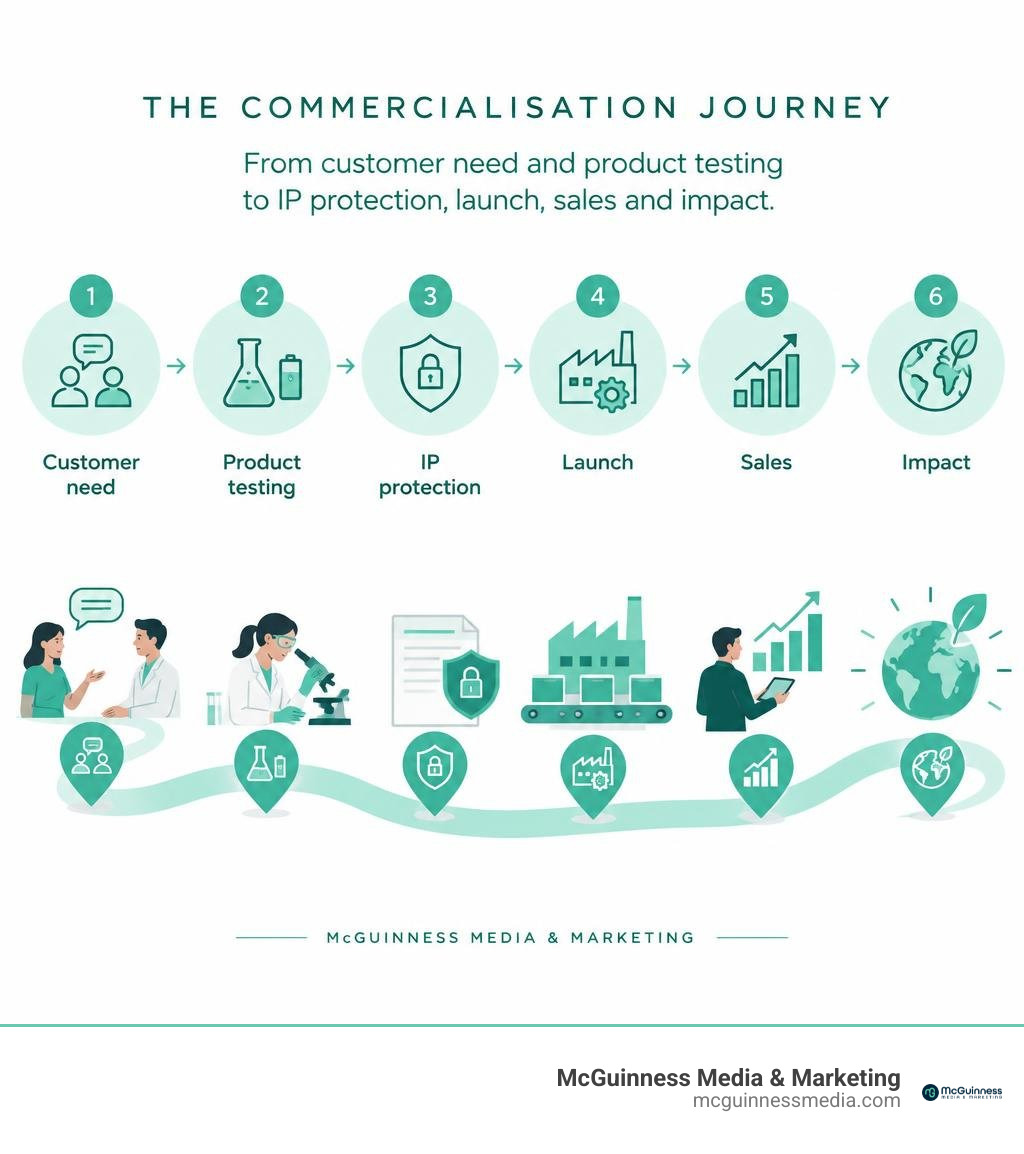
Know your commercialisation strategy example terms:
What a Commercialisation Strategy Is—and Why It Matters
A commercialisation strategy is the practical plan for turning an idea, invention, or service into something a market can adopt and a business can sustain. It coordinates product development, production, pricing, distribution, promotion, sales, and customer support.
Without that coordination, a technically impressive product can still fail: it may not solve a pressing customer problem, cost too much to produce, lack a route to buyers, or arrive before the company is ready to deliver it. A strategy helps a team test these assumptions, make choices about investment, and connect launch decisions to business goals.
The marketing mix, often called the four Ps, is one useful part of the plan: product, price, place (distribution), and promotion. Commercialisation covers more than marketing, though. It also includes feasibility, operations, intellectual property, funding, and stakeholder relationships. The commercialisation cycle offers a useful reminder that development, market learning, and post-deal management may overlap rather than follow a perfectly straight line. We can connect these decisions to broader strategic marketing planning.
The Three Stages: Ideation, Business Process, and Stakeholder Engagement
A simple way to organise the work is in three stages:
- Ideation: Generate possible solutions, then filter them against customer needs and the company’s strengths. Think of this as a funnel: many ideas enter, but only those with evidence of value and feasibility should advance.
- Business process: Test whether the product can be developed, made, priced, supported, and delivered. This includes R&D, cost estimates, production decisions, funding, IP, and launch planning.
- Stakeholder engagement: Involve the people who can influence adoption, including customers, suppliers, channel partners, investors, regulators, and internal teams. Their feedback can reveal requirements the original concept missed.
These stages are connected. Customer conversations can reshape a prototype, a manufacturing constraint can change the product design, and new evidence can lead the team to revisit its market assumptions.
How Commercialisation Supports Long-Term Business Goals
A commercialisation plan should support more than a launch date. It should explain how the product contributes to goals such as revenue growth, a stronger market position, customer impact, or expansion into a new segment.
That also means checking operational readiness. Before widening distribution, a company needs enough production capacity, trained staff, reliable suppliers, customer support, and working capital. A launch that outpaces delivery can damage trust before the business has a chance to grow.
Commercial strategy brings the organisation’s resources and customer opportunity together. Marketing helps define and communicate value; commercialisation also considers whether the company can produce, sell, and support that value consistently.
A Commercialisation Strategy Example: Taking a Battery Separator from Lab to Launch

Imagine a startup has developed a lithium-ion battery separator using a different manufacturing method. A separator is a component inside a battery cell, so the product must meet demanding performance and safety requirements before a manufacturer will adopt it. The team’s task is not simply to announce an invention. It must prove that the product solves a relevant problem, can be made consistently, and is worth the cost and effort of qualification.
The U.S. Department of Energy’s Phase I SBIR/STTR commercialization plan example shows how a research-stage company can organise its market, team, IP, and revenue thinking around a new separator technology.
Define the Market in This Commercialisation Strategy Example
Start with the need, not the biggest market statistic you can find. The team should identify which battery applications and manufacturers might benefit, what performance or cost problems they face, and what specifications a separator must meet to be considered.
Then size the opportunity from the bottom up. Estimate the number of potential customers or production lines, likely annual demand per customer, and a realistic price per unit. Separate the total market from the portion the product can serve and the share the team might reasonably win. A broad market report can provide context, but it is not a sales forecast.
Map the buying process, too. Battery manufacturers may be direct customers, while cell suppliers, material converters, and vehicle or equipment makers may influence adoption. End users experience the final product’s benefits, but procurement, engineering, safety, and quality teams may help decide whether it is approved. Customer discovery should include these perspectives.
Finally, assess alternatives. Competitors include established separators, other emerging materials, and the status quo. The startup needs a clear advantage, such as a measurable performance improvement, lower production cost, or a benefit that simplifies manufacturing. It must also identify where it sits in the supply chain and who needs to validate the product.
Build the Commercialisation Strategy Example Around a Credible Opportunity
The research cites an estimated $500 million market opportunity over 10 years for battery separators and an industry estimate of $350 million in annual cost savings from adopting a new manufacturing method. These figures may signal potential, but they are not guaranteed revenue. The company should verify their scope, source, assumptions, and relevance to its specific product.
Customer validation turns market estimates into better decisions. The team can interview potential buyers, request feedback on product specifications, and explore whether a manufacturer will test a sample or discuss a pilot. A letter expressing interest is more informative when it describes a concrete next step, such as evaluation criteria, a pilot, or data sharing.
The plan should also account for adoption barriers. Battery makers may need extensive safety and performance testing, which takes time and resources. A manufacturing partner could help produce test quantities or scale output, but the startup still needs to agree on responsibilities, quality standards, costs, and IP protections.
For a practical guide to defining market opportunity, team capability, IP, revenue, and risk in a funding application, see Writing a Good Commercialization Plan: Suggestions for SBIR/STTR Applicants.
Map the Opportunity from Prototype to Mainstream Adoption
A commercial path might begin with proof of concept, then move to prototype testing, pilot production, customer qualification, and larger-scale manufacturing. Each step should have an owner, budget, evidence requirement, and decision point. If the separator fails a test or costs too much to make, the team needs a defined way to revise the product or pause investment.
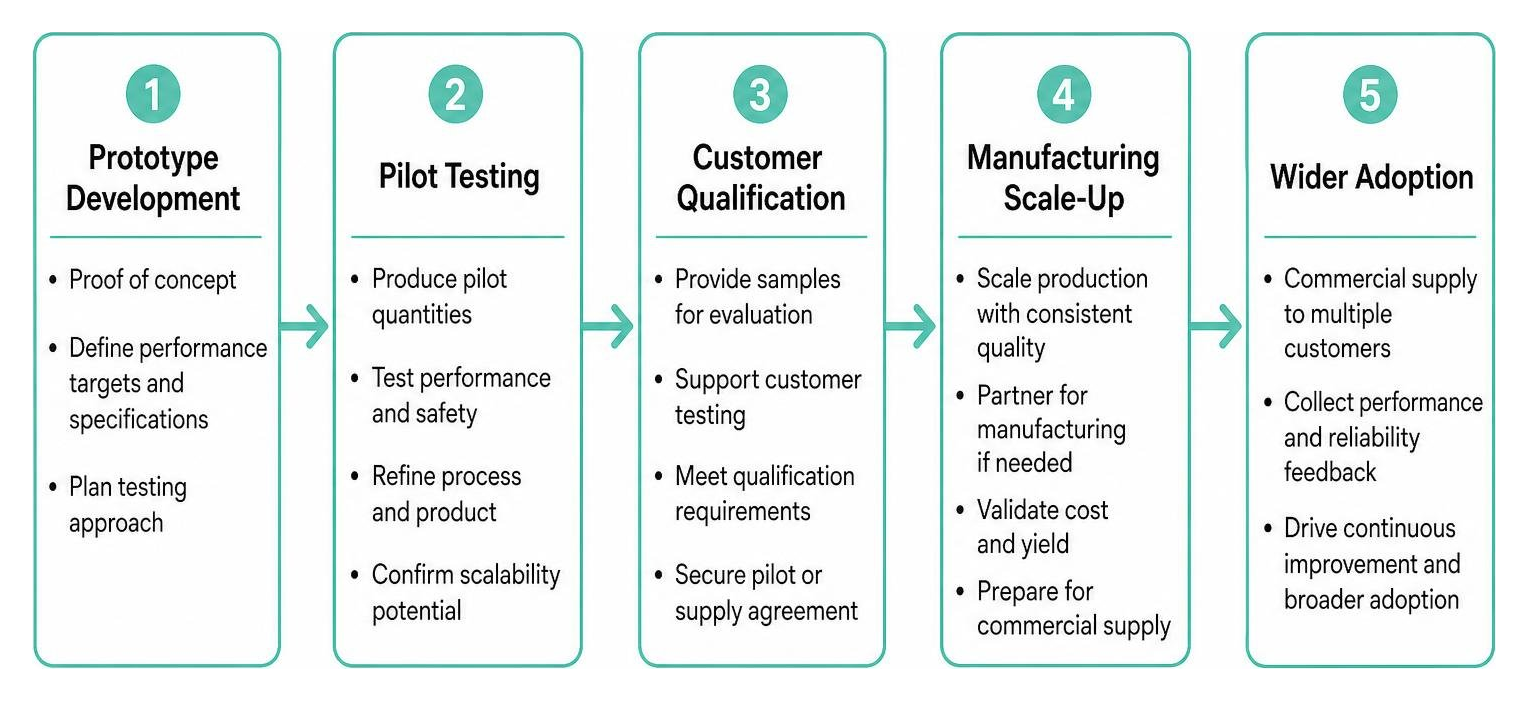
After early adoption, distribution and customer support become part of the product experience. The company should collect feedback on performance, reliability, and production consistency, then use it to improve the offer. Commercialisation continues after launch: customer learning can influence the next product version, pricing, and expansion plans.
Turn the Opportunity into a Launch-Ready Commercialisation Plan
A useful plan connects market evidence to action. Set out launch milestones, accountable owners, budget needs, dependencies, and measures of progress. Depending on the product, measures might include customer interviews completed, pilot agreements secured, product qualification achieved, production yield, sales conversion, or repeat orders.
The marketing and sales work should be tied to the product’s actual readiness. Our step-by-step strategic marketing plan can help organise audience, messaging, channels, and timing, but the commercialisation plan also needs to address the operational work behind the launch.
Protect the Innovation and Assess Team Readiness
Choose IP protection based on what the innovation is and how it could be copied:
- Patents may protect qualifying inventions, subject to legal requirements and filing strategy.
- Trademarks protect brand identifiers such as names and logos.
- Copyright can protect original works, including software code and written materials.
- Trade secrets can protect valuable confidential processes or know-how if the company takes reasonable steps to keep them secret.
Before public disclosure, the team should ask an IP professional about ownership, filing timing, licensing rights, and freedom to operate. A patent application does not automatically establish that a product can be made or sold without infringing someone else’s rights. Teams should also state IP status accurately and avoid claiming protection that has not been secured.
Next, assess whether the team can execute. List the experience and capabilities required across product development, sales, manufacturing, regulation, finance, and customer support. Identify gaps and decide whether to hire, train, partner, or bring in advisers. A strong technical team may still need commercial leadership, customer access, or production expertise.
The DARPA transition and commercialization guide also stresses early stakeholder engagement and ongoing adjustment as technology and market needs change.
Choose a Revenue Model and Route to Market
The best route depends on the product, customer, sales cycle, required investment, and capabilities the company wants to retain. Common options include direct sales, licensing, distributors, value-added resellers, partnerships, and joint ventures. Manufacturing can be in-house or handled by a contract manufacturer.
| Route | Investment | Control | Market access |
|---|---|---|---|
| Direct sales | Higher, because the company builds sales and support capacity | Higher control over customer relationships and pricing | Depends on the company’s ability to reach and serve buyers |
| Licensing | Often lower production and sales investment; terms vary | Less control over how the licensee develops and sells the product | Can use a licensee’s established capabilities and relationships |
| Partnership | Shared investment and responsibilities depend on the agreement | Shared control; roles need to be clearly defined | Can combine complementary expertise, production, or customer access |
Direct sales may suit a company that can manage production and customer relationships. Licensing can make sense when another organisation has the resources, manufacturing capacity, or distribution reach the innovator lacks. A partnership can fill specific gaps, but responsibilities, decision rights, costs, and IP use should be settled early.
For the separator startup, working with an experienced converter or manufacturing partner could reduce the need to build a facility before demand is proven. The right choice is the route the company can execute while meeting customer requirements and protecting its long-term interests.
Set Financial Targets and Mitigate Commercialisation Risks
Build projections from operating assumptions rather than a hoped-for percentage of a large market. Estimate price per unit, expected order size, production costs, sales cycle, customer acquisition costs, and the time needed for qualification. Then calculate revenue from the number of customers or units the company could realistically serve.
Prepare conservative, base, and growth scenarios. In each, explain what must be true: the number of customers won, how quickly they adopt, production capacity, and expected pricing. Track cash needs and runway alongside revenue, because development and qualification costs may arrive well before meaningful sales. Identify the funding gap between the end of a grant or investment period and commercial revenue.
Common risks include slow customer adoption, technical performance shortfalls, regulatory or qualification delays, IP disputes, supply interruptions, and production costs that exceed estimates. For each risk, assign an owner, an early warning sign, and a response. For example, a second qualified supplier could reduce exposure to a single-source disruption, while staged pilot commitments could limit spending before customer demand is clearer.
A cohesive marketing strategy helps keep promotion connected to the product, audience, and available resources. It cannot replace sound financial assumptions, but it can help ensure the company’s launch activity supports the commercial plan.
Adapt the Plan for Startups, Established Companies, and SBIR/STTR Funding
Startups often have limited staff, production capacity, customer history, and cash. Their plans should focus on a specific initial customer group, evidence of demand, key capability gaps, and milestones that reduce uncertainty without overcommitting resources.
Established companies may already have manufacturing, sales channels, customer relationships, and funding. Their challenge is often fitting the new product into existing operations without distracting from other priorities. They should clarify which teams own development, launch, and ongoing support.
For SBIR/STTR funding, the plan must follow the specific agency’s current instructions. Phase I generally focuses on technical feasibility and early commercial de-risking; Phase II typically requires stronger evidence of customers, IP, financing, production, and a route to market. Phase III refers to follow-on work supported by non-SBIR/STTR funding. Requirements differ by agency and solicitation, so applicants should check the applicable funding announcement rather than assume one format fits all.
Frequently Asked Questions About Commercialisation Strategies
What Is the Difference Between a Commercialisation Strategy and a Marketing Strategy?
A marketing strategy focuses on understanding an audience, positioning an offer, and communicating its value through appropriate channels. A commercialisation strategy is broader. It includes product readiness, production, IP, pricing, sales, distribution, funding, customer support, and marketing. Marketing is one part of the route from idea to sustainable adoption.
Which IP Protection and Revenue Pathway Should a Business Choose?
Choose IP protection based on the nature of the innovation, how easily it can be copied, ownership, cost, and the intended route to market. Patents may suit protectable inventions; trademarks protect brand identifiers; copyright covers original creative work; and trade secrets may suit confidential know-how. Seek qualified legal advice before making filing or disclosure decisions.
Choose a revenue pathway based on the company’s resources and the customer’s buying process. Direct sales offer closer customer relationships but require sales and delivery capacity. Licensing can provide access to another organisation’s capabilities, while partnerships can combine resources and expertise. Compare costs, control, timing, and access before committing.
How Should a Startup Set Revenue Targets and Reduce Commercialisation Risk?
Start with customer evidence and unit-level assumptions: who will buy, how many units they may need, what they may pay, and how long adoption could take. Build conservative, base, and growth scenarios, and state the assumptions behind each. Then review cash needs, sales-cycle timing, and the funding required before revenue becomes reliable.
Reduce risk through customer interviews, pilot testing, staged spending, supplier planning, and clear milestones. Treat projections as hypotheses to update when new evidence arrives, not promises that the market will behave exactly as forecast.
Conclusion
A successful lab-to-launch plan links a validated market need with protected innovation, a capable team, a realistic revenue model, and a route to customers the company can support. For the battery separator startup, progress depends on proving the product’s value, confirming that buyers will test and adopt it, and scaling production in step with demand.
At McGuinness Media & Marketing, we help brands connect business goals with clear positioning and coordinated marketing. Explore our branding and strategy services to see how we can support a focused growth plan.