
A Practical Guide to Analyzing Your Current Marketing Situation with Examples
What Does a Current Marketing Situation Look Like in a Marketing Plan?
An example of the current marketing situation in a marketing plan might read: “Repeat customers drive most sales, but their purchases are slowing. Our website is our strongest sales channel, while lower-priced alternatives put pressure on our pricing.” This is an illustrative example, not a finding about a real business.
To write your own, gather evidence on your products, market size, customers, competitors, distribution, and sales history. Summarize what the evidence says, then use the biggest gaps and strengths to set your marketing goals.
I’m Megan McGuinness, owner and chief marketing officer of McGuinness Media & Marketing, with more than 20 years of experience building marketing strategies for brands. If you came looking for a current marketing situation in marketing plan example, this guide will show you how to build one from facts you can use.
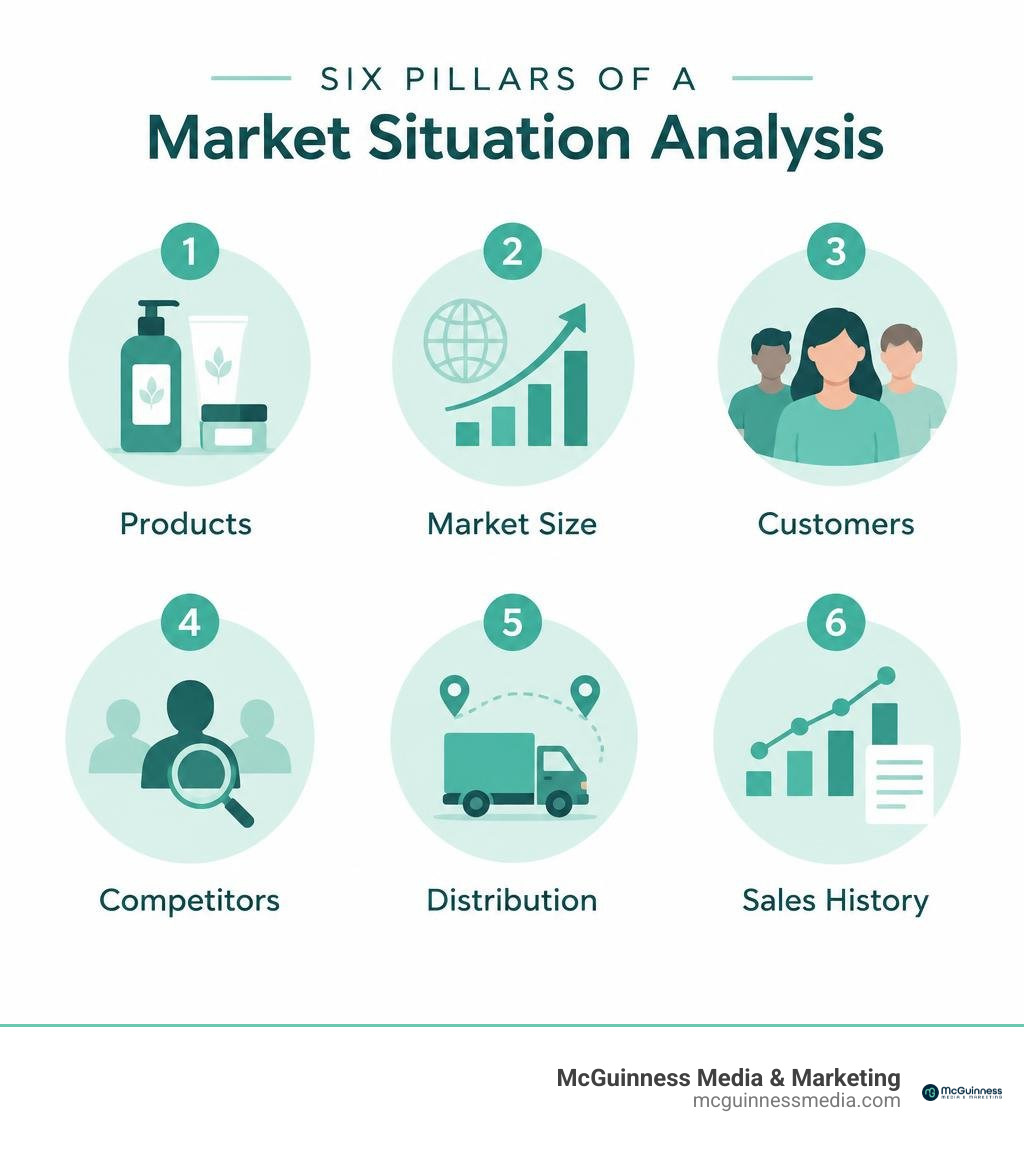
Easy current marketing situation in marketing plan example glossary:
What Is a Market Situation Analysis and Why Is It Essential?
A market situation analysis is the factual baseline of your entire marketing plan. It defines where your brand currently stands in the commercial landscape, detailing your operational environment, market demand, customer sentiment, and competitive pressures. Rather than relying on guesswork, intuition, or wishful thinking, this diagnostic stage grounds your strategy in objective reality.
When you master the strategic marketing planning process, the situation analysis serves as your navigational anchor. It clarifies revenue predictability, illuminates operational bottlenecks, and significantly reduces commercial risk. According to the FDIC Small Business Marketing Guide, evaluating your current business context and operational scope is a non-negotiable prerequisite for sustainable financial management and capital allocation.
Key Questions Every Situation Analysis Must Answer
To create an airtight situation analysis, you must interrogate your commercial ecosystem across several specific dimensions:
- Product and Service Portfolio: What specific offerings generate your revenue, and what distinguishing features or proprietary advantages separate them from alternatives?
- Total Addressable Market Opportunity: What is the overall dollar value and unit volume of your addressable market, and at what rate is this category expanding or contracting?
- Sales and Revenue History: Historically, how well have your products sold across seasonal cycles, economic shifts, and channel variations?
- Distribution Channels and Logistics: What direct, wholesale, retail, or digital pathways deliver your product to end users, and where do margin leaks occur?
- Geographic Footprint: Which specific regions, metros, or territories drive your primary sales volume, and where do untapped expansion pockets exist?
- Target Audience Demographics: Who are your primary buyers regarding age, household income, decision-making authority, and lifestyle attributes?
- Competitive Landscape: Which direct and indirect competitors hold dominant market shares, and what core strengths protect their positions?
The Business Cost of Skipping Market Context
Skipping this foundational diagnostic is one of the most expensive mistakes a business can make. Without an objective market assessment, leadership teams routinely misallocate capital into channels that do not reach active buyers.
When you bypass market realities, several severe operational penalties occur:
- Misallocated Media Spend: Investing heavily in high-cost traditional or digital channels when your target audience frequents alternative discovery platforms.
- Channel Mismatch: Distributing products through intermediaries that dilute margins rather than leveraging high-efficiency direct paths.
- Customer Churn: Failing to identify shifts in buyer sentiment, resulting in silent defection to modern alternatives.
- Pricing Resistance: Setting product price points without understanding category price elasticity or competitor positioning.
- Brand Irrelevance: Communicating value propositions that resonate with past consumer priorities rather than immediate market demands.
Core Analytical Frameworks to Audit Your Market Environment
Structured analytical frameworks prevent situation analyses from becoming unmanageable collections of unstructured data. By applying established strategic models, you transform disparate market metrics into actionable intelligence.
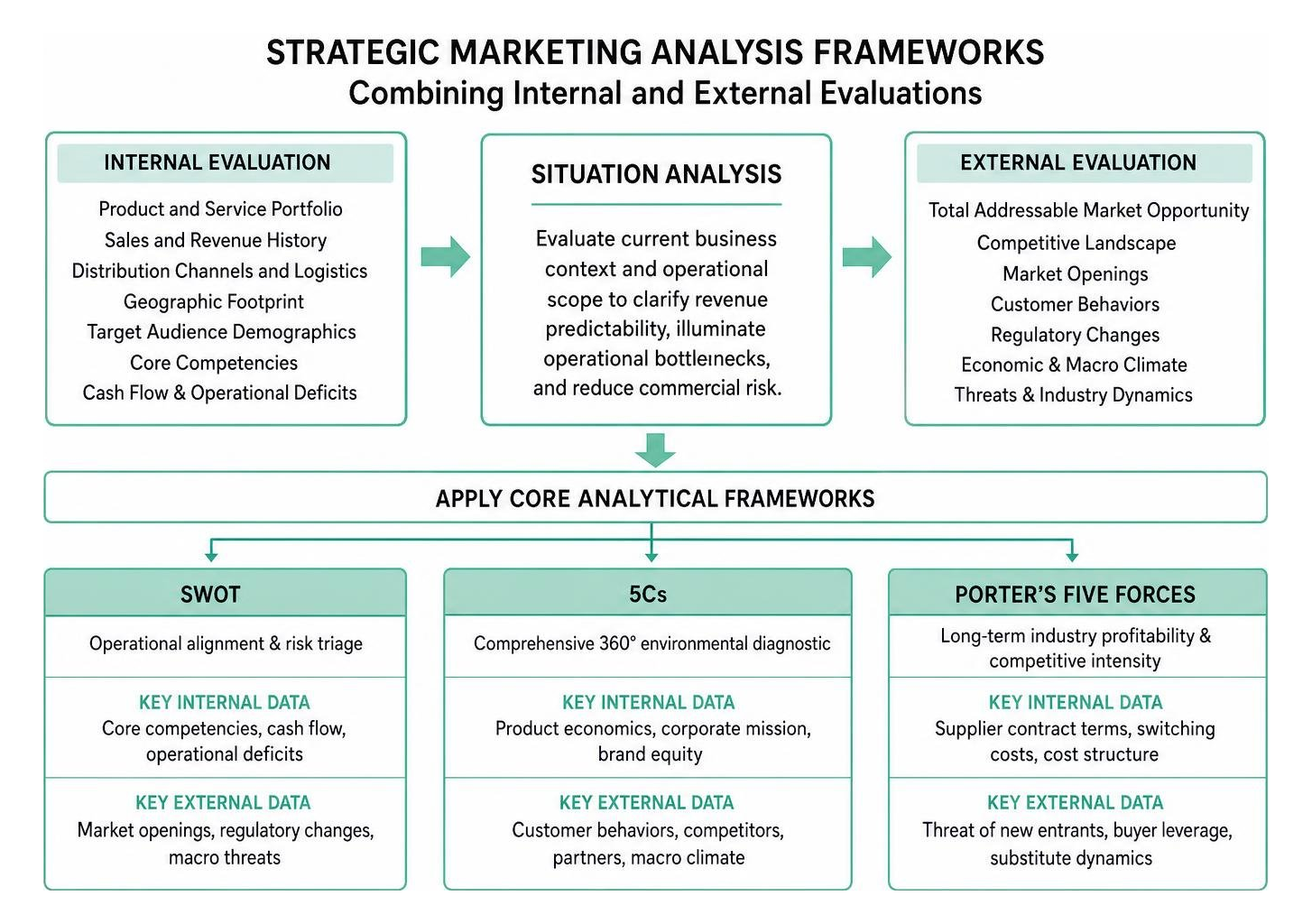
| Framework | Primary Strategic Focus | Key Internal Data Required | Key External Data Required |
|---|---|---|---|
| SWOT | Operational alignment & risk triage | Core competencies, cash flow, operational deficits | Market openings, regulatory changes, macro threats |
| 5Cs | Comprehensive 360° environmental diagnostic | Product economics, corporate mission, brand equity | Customer behaviors, competitors, partners, macro climate |
| Porter’s Five Forces | Long-term industry profitability & competitive intensity | Supplier contract terms, switching costs, cost structure | Threat of new entrants, buyer leverage, substitute dynamics |
Evaluating Company, Customers, Competitors, Collaborators, and Climate (5Cs)
The 5Cs framework provides an exhaustive environmental scan across five interconnected pillars:
- Company: An inward evaluation of your organizational capabilities, operational limits, core competencies, and financial runway.
- Customers: A behavioral examination of consumer segments, including purchasing triggers, lifetime value expectations, and emerging values (such as sustainability and social responsibility).
- Competitors: A direct comparison of rival market shares, product features, pricing models, and advertising voice-share.
- Collaborators: An audit of key external entities that enable your business model, including logistics carriers, supply chain vendors, and agency partners.
- Climate: An assessment of macro-environmental forces, encompassing regulatory policies, economic headwinds (such as inflation or interest rates), and technological disruptions.
Assessing Internal Strengths and External Market Realities (SWOT)
A SWOT analysis synthesizes internal capabilities with external market dynamics. When creating a strategic marketing plan from scratch, the SWOT matrix ensures your growth initiatives lean directly on distinct competitive strengths while establishing defensive moats around known vulnerabilities.
Strengths and weaknesses represent internal, controllable factors—such as proprietary software, seasoned sales teams, or constrained warehouse capacity. Opportunities and threats represent uncontrollable external dynamics—such as shifting demographic preferences, supply chain raw material costs, or new legislative requirements.
Step-by-Step Guide to Evaluating Internal and External Factors

Building a rigorous situation analysis requires a structured, multi-step data collection process. Rather than relying solely on internal assumptions, you must triangulate information from multiple internal and external sources.
Defining Target Audience and Customer Segments
Audience definition requires moving beyond high-level demographic brackets into precise behavioral segmentation. We categorize customers using four critical dimensions:
- Demographics: Quantifiable traits including age, household income, education level, and geographic concentration.
- Psychographics: Qualitative drivers including personal values, lifestyle preferences, risk tolerance, and brand affiliations.
- Behavioral Triggers: Category purchase frequency, brand loyalty indices, sensitivity to price adjustments, and typical purchase occasions.
- Economic Value: Grouping customers using the classic Pareto principle, identifying the key 20% of customer accounts that generate 80% of top-line revenue.
Conducting Direct and Indirect Competitor Benchmarking
To benchmark competitors effectively, assemble a structured competitor profile matrix. Evaluate both direct competitors (companies offering similar products to the same audience) and indirect competitors (companies solving the same underlying problem through alternative means).
Examine each rival’s:
- Estimated Market Share: Revenue volume and customer volume relative to industry totals.
- Core Value Proposition: The primary claim anchoring their promotional strategy and brand identity.
- Pricing Strategy: Premium, parity, penetration, or discount pricing structures.
- Distribution Footprint: Channel partnerships, digital presence, and geographic footprint.
- Known Deficiencies: Customer reviews detailing product failure rates, poor service quality, or fulfillment delays.
Overcoming Data Gaps and Common Analytical Challenges
Smaller organizations and growing enterprises often face data scarcity when compiling market analysis. When comprehensive industry reports are cost-prohibitive, you can bridge analytical gaps by:
- Conducting qualitative interviews with top customer accounts and front-line sales personnel.
- Utilizing desktop research from trade associations, chamber of commerce publications, and regional economic development centers.
- Analyzing social listening trends and search engine intent data to measure shifting consumer demand in real time.
- Reviewing internal CRM and point-of-sale logs through a disciplined system for marketing plan control and analysis.
Breakdown of a Real-World Current Marketing Situation in Marketing Plan Example
To see how these concepts translate onto paper, let us examine two practical reference models representing distinct commercial environments.
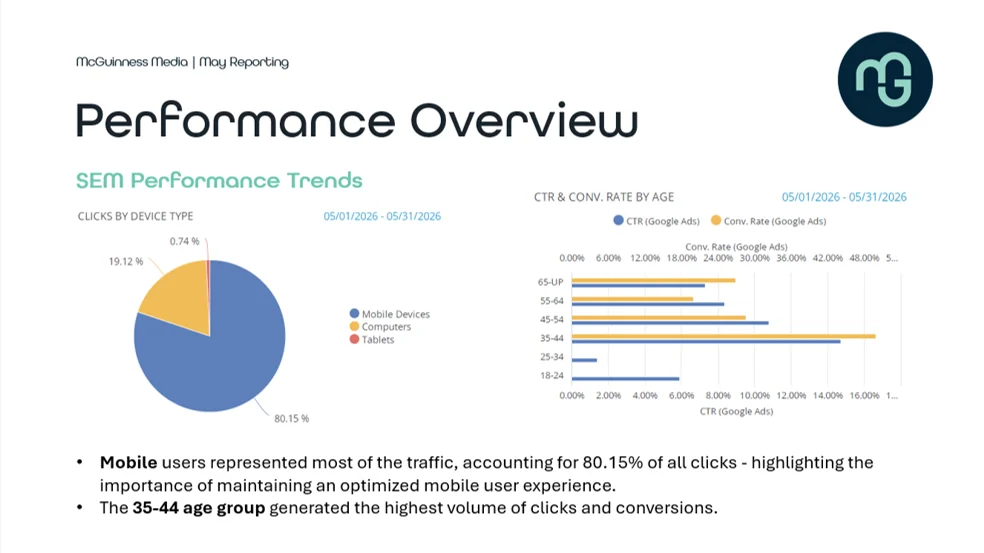
Deconstructing a Consumer Goods Current Marketing Situation in Marketing Plan Example
A canonical illustration of consumer product market diagnostics comes from the classic Spree fashion watch strategic plan documented in the University of Baltimore Marketing Plan Repository.
In this scenario, the market situation analysis uncovered several critical empirical benchmarks:
- Category Valuation: The branded fashion watch sector represented a $524 million retail industry projected to expand beyond $721 million over four years, demonstrating an annual growth rate exceeding 6%.
- Market Concentration: Four legacy market leaders (Swatch, Fossil, Guess?, and Anne Klein) controlled 70% of total category sales, establishing a consolidated retail landscape.
- Demographic Purchasing Patterns: Demographic analysis revealed that 50% of category buyers were between 18 and 34 years old. The 25–34 age segment exhibited a purchase index of 1.74, indicating they purchased 74% more fashion watches per capita than the average consumer.
- Strategic Implications: Because category purchases were heavily driven by design variety and impulse buying, the diagnostic dictated a penetration pricing strategy ($45 retail point), high point-of-purchase display investment, and distinct styling collections targeting young professionals.
Key Takeaways from a B2B Current Marketing Situation in Marketing Plan Example
In high-volume B2B distribution, market situation analyses frequently reveal systemic channel shifts. A notable example is captured in the Strategic Marketing Plan Case Study for Despensa Peruana, a major mass-consumption product distributor.
The situation analysis highlighted critical shifts in customer behavior and macro-environmental realities:
- Client Base Contraction: The distributor’s active customer base at its primary operational hub contracted from 32.52% in 2020 down to 11.44% by 2023, driven by inflationary pressures where 267 out of 586 basic basket goods suffered price escalations.
- Channel Dynamics: Field data showed that local small grocery stores accounted for 44% of household consumer spending, yet buying behaviors evolved as consumers increased their visited shopping channels from 6 to 8.
- Own-Brand Opportunity: Despite broad client attrition, the company’s proprietary brand portfolio participation surged from 4% of total sales in 2019 to 25% in 2023.
- Strategic Outcome: The diagnostic proved that long-term survival required immediate digital transformation via a B2B e-commerce platform combined with rapid expansion of high-margin proprietary brands.
How to Connect Market Situation Insights to Strategy and Execution
An analytical audit is only as valuable as the strategic actions it informs. Once you finalize your diagnostic findings, you must translate data points directly into commercial execution through a structured practical guide to brand growth.

Aligning the Marketing Mix (4Ps/7Ps) with Diagnostic Findings
Your tactical marketing mix must respond directly to the empirical realities identified during your situation audit:
- Product: Modify features, packaging sizes, or service tiers to address specific customer complaints and competitor blind spots.
- Price: Align pricing strategies with customer price elasticity and competitive alternatives, selecting value-based, premium, or penetration models accordingly.
- Place (Distribution): Secure retail shelf space, optimize e-commerce logistics, or form wholesale distribution partnerships based on where your target segment actively buys.
- Promotion: Direct advertising investments into the specific media channels, creative messaging angles, and promotional calendars preferred by your core demographic.
- People, Process, and Physical Evidence (7Ps): Refine service delivery standards, onboarding experiences, and visible brand touchpoints to reinforce market differentiation.
Translating Market Gaps into Revenue Growth Objectives
Every marketing objective must stem directly from an identified market diagnostic gap. Ensure all strategic targets follow the SMART framework (Specific, Measurable, Achievable, Relevant, and Time-bound):
- Diagnostic Finding: High brand awareness among 25–34-year-olds, but a low conversion rate on digital landing pages due to checkout friction.
- SMART Marketing Objective: Increase mobile website checkout conversion from 1.3% to 3.5% over the next two quarters by deploying one-click purchasing options and streamlined navigation.
- Diagnostic Finding: Heavy market concentration by legacy competitors who under-index on digital communication channels.
- SMART Marketing Objective: Capture a 3% category market share within 12 months by dominating regional paid search voice-share and localized social media acquisition campaigns.
Frequently Asked Questions About Marketing Situation Analysis
What are the main components of a current marketing situation section?
A complete current marketing situation section consists of five core elements:
- Industry and Market Overview: Category size, historical growth trajectories, and macroeconomic factors.
- Target Market Profile: Buyer personas, demographic characteristics, and customer purchasing behaviors.
- Competitive Landscape: Market share concentration, competitor value propositions, and pricing structures.
- Product Line Performance: Historical sales figures, channel margins, and product life-cycle stages.
- Distribution Infrastructure: Logistics pathways, partner networks, and direct-to-consumer pipelines.
How often should a business update its marketing situation analysis?
Organizations should conduct an exhaustive situation analysis annually as part of their comprehensive strategic planning cycle. However, market-facing leadership teams should review core competitive metrics, media performance indices, and customer acquisition costs quarterly. Significant external triggers—such as sudden economic disruptions, new aggressive market entrants, or major regulatory overhauls—warrant an immediate situational audit.
What is the difference between a situation analysis and a SWOT analysis?
A situation analysis is the comprehensive diagnostic process that investigates your entire business environment, including industry economics, buyer psychographics, supply chain stability, and competitive shares. A SWOT analysis is a specific strategic synthesis tool used within the broader situation analysis to categorize and prioritize internal strengths and weaknesses against external opportunities and threats.
Conclusion
A disciplined, evidence-based market situation analysis transforms strategic planning from speculative guesswork into predictable business growth. By rigorously analyzing your product performance, audience demographics, distribution networks, and competitive landscape, you provide your leadership team with the strategic clarity needed to allocate budgets effectively and win lasting market share.
At McGuinness Media & Marketing, we help growing brands navigate complex market environments through data-backed creative strategies, precision media planning, and full-funnel execution. Explore our comprehensive branding and strategy services to turn your market diagnostic into measurable revenue growth.