
Print Media Buying: Types, Costs, and How It Works
How Print Media Buying Works
Print media buying is the process of choosing and purchasing ad space in newspapers, magazines, and other printed publications. To do it well, start with the people you want to reach. Compare publications by their readers and distribution, confirm the ad size, price, placement, and deadlines, then track responses with a code, QR code, or dedicated phone number.
Print can still earn a place in a digital-first plan when a local paper or specialist title reaches people your brand needs to reach. The key is to buy for audience fit, not just the biggest circulation number.
I’m Megan McGuinness, owner and chief marketing officer of McGuinness Media & Marketing. I’ve spent more than 20 years developing marketing strategies for brands, and I bring that experience to print media buying as part of a broader media plan.
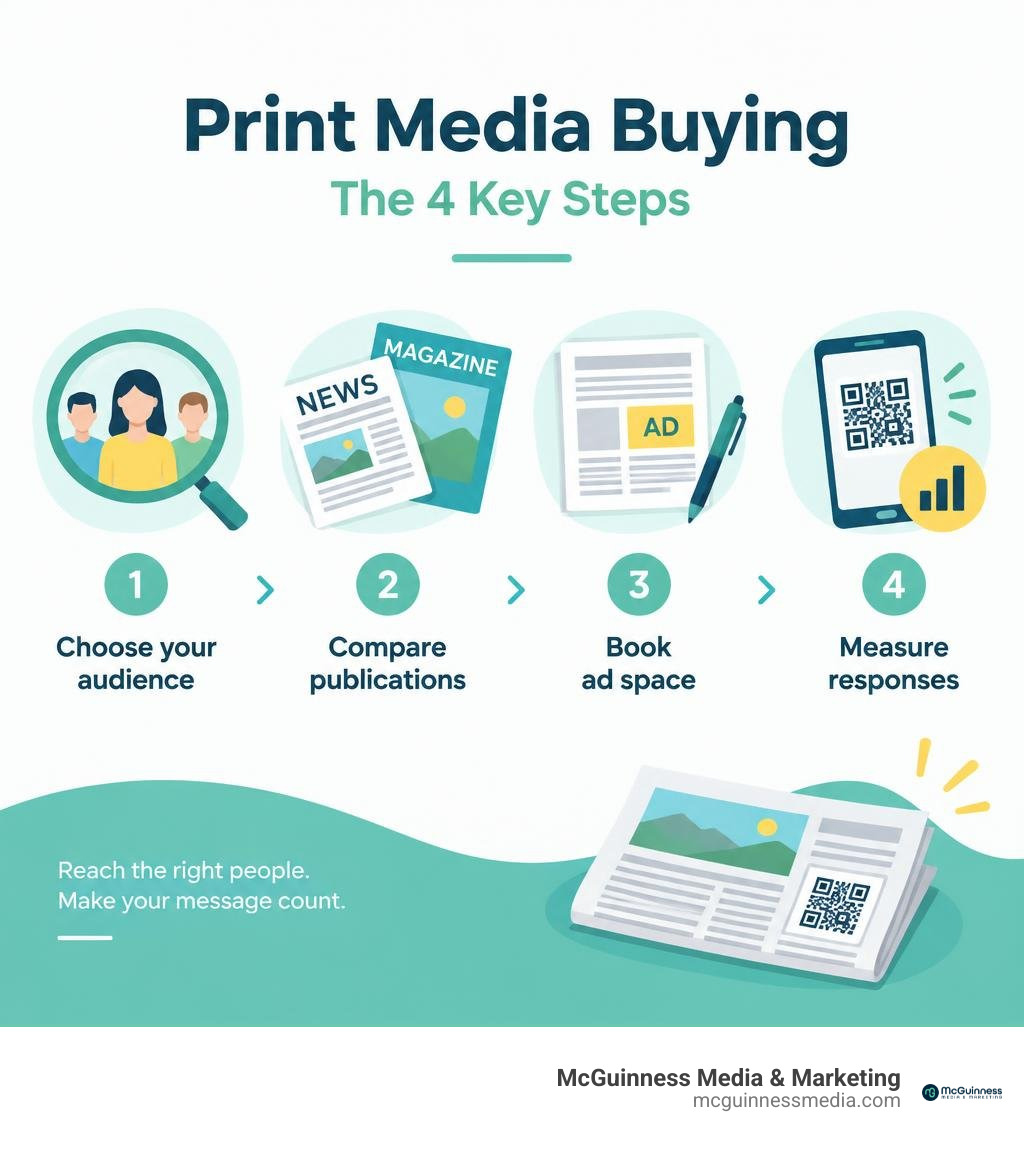
Basic print media buying terms:
What Is Print Media Buying? Types, Benefits, and How It Works
Media buying means procuring advertising across channels such as TV, radio, websites, and out-of-home. Print is the slice that covers paper: you buy space by the page, or part of a page, in each issue. The price is set against audited circulation or a readership estimate, and you deliver finished artwork to the publisher’s specification before a deadline.
Common print types include:
- Newspapers, national and local, which suit timely offers and community news.
- Magazines, consumer and niche, which suit longer-lived, visual messages.
- Trade and professional publications, which reach people in a specific industry.
- Inserts and special formats, such as loose flyers or sponsored sections.
- Direct mail, which sits next to print and gets delivered to chosen households.
The big benefit is what we call chosen attention. Readers pick up a title on purpose, read at their own pace, and often keep it to reread or tear out. That shelf life, plus pass-on readership, gives each ad more chances to be seen. Print also carries detailed information well, and a respected title lends your brand some of its credibility. Add geographic reach, such as a paper that covers the towns you serve, and print becomes a very focused tool.
It has limits too. Reach is fixed by the title, it moves slower than digital, and exposure evidence is softer. That is why we like to mix print with digital rather than treat it as either/or.
How print media buying works from brief to insertion
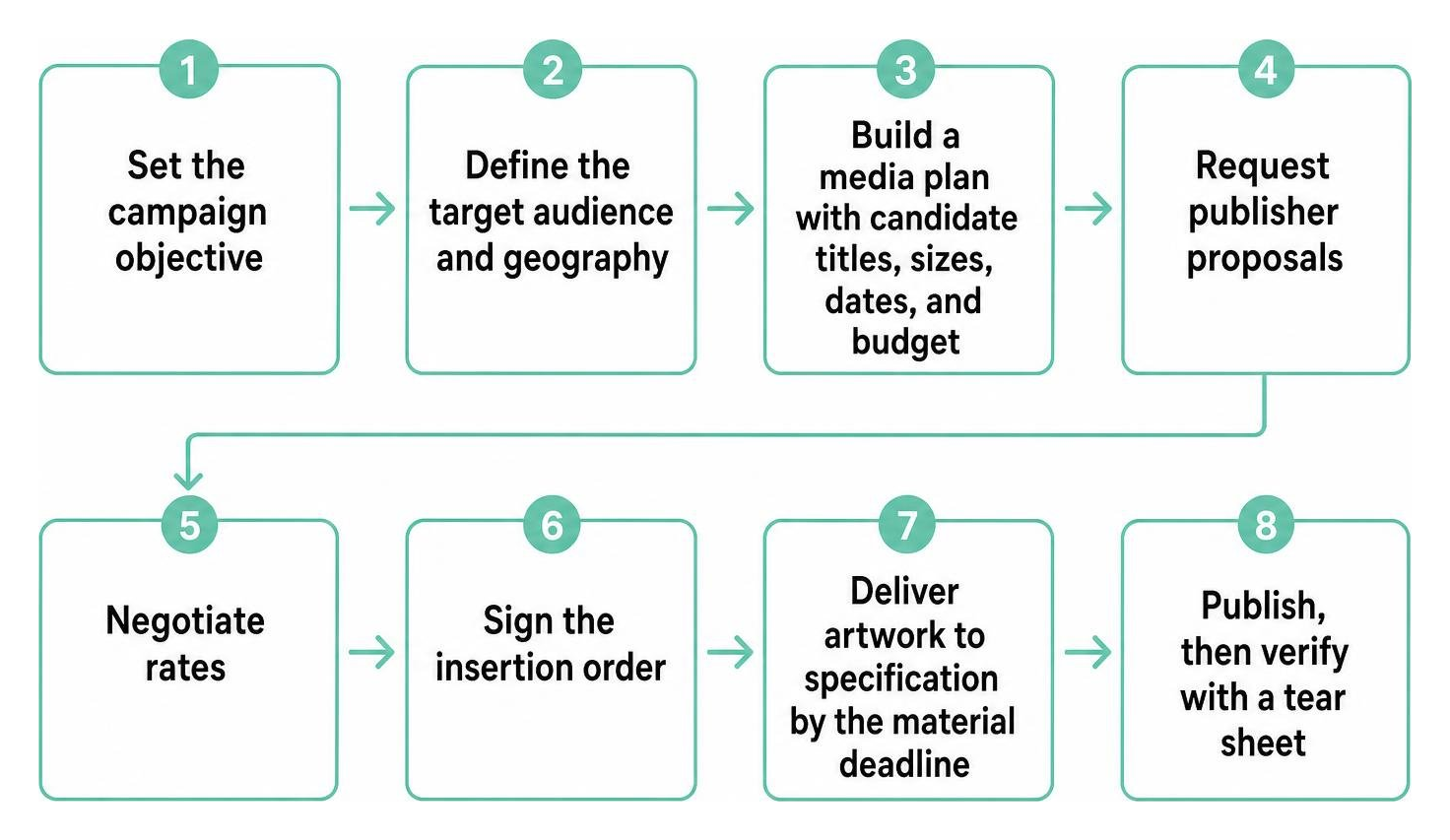
Here is the usual flow:
- Set the campaign objective. Awareness, consideration, or direct response each call for different choices.
- Define the target audience and geography.
- Build a media plan with candidate titles, sizes, dates, and budget.
- Request publisher proposals. Give each one the same brief so the replies are comparable.
- Negotiate rates. Rate cards are an opening position, not the final price.
- Sign the insertion order, which records title, edition, date, size, position, and price.
- Deliver artwork to specification by the material deadline.
- Publish, then verify with a tear sheet.
When print makes sense in a digital-first media plan
Print works best when:
- You serve a local area and a community paper reaches it.
- Your buyers read a specialist title, such as a trade journal or a magazine for a particular age group.
- You need brand credibility from an established publication.
- Your goal is consideration, where readers need room to absorb detail.
- You want awareness in a defined place, or a measurable response through codes.
Print is a weaker fit when you need instant changes or very narrow digital targeting. Whatever the answer, decide it inside a strategic media buying plan so print is judged on the same basis as every other line.
How to Choose Print Publications by Audience, Circulation, and Readership
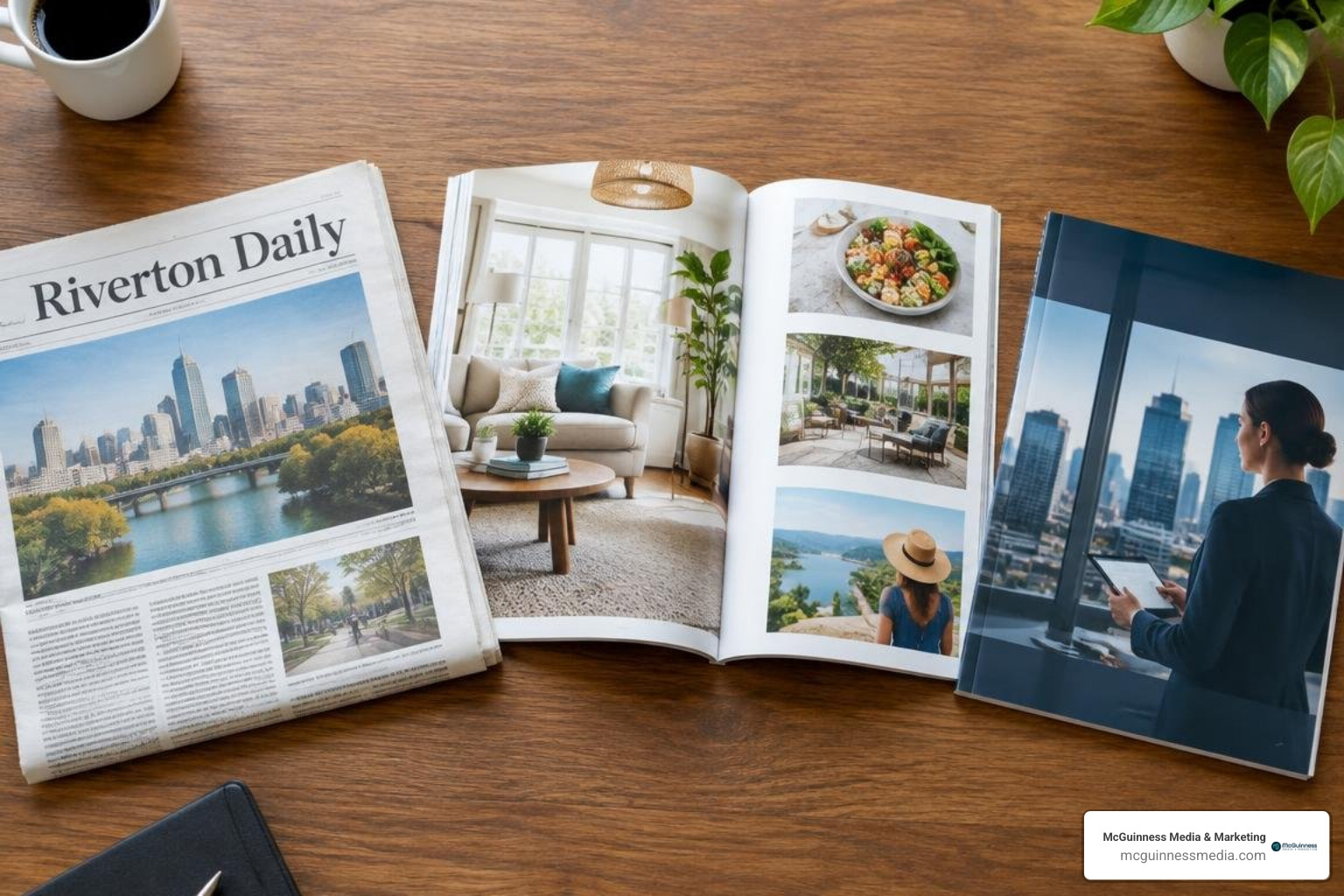
Start from the audience, not from a list of titles. A title chosen because “we’ve always advertised there” or because a sales rep called has not yet earned its place. Ask each publisher for the reader profile, geography, publishing frequency, and how long issues stay around. A weekly sits on the coffee table longer than a daily, and a monthly magazine can linger for weeks.
A small specialist title can deliver more of your target audience than a large general one, so the share of target readers matters more than total copies. Pass-on readership and shelf life add extra chances to be seen, though those rest on readership estimates rather than circulation counts. A clear brief helps here, and a guide to how to plan print advertising covers what to include: audience, geography, preferred titles, insertion dates, sizes, color, and budget.
Circulation vs. readership: what each figure tells you
These two numbers get mixed up constantly.
- Circulation counts copies distributed, paid or free, usually under independent audit.
- Readership estimates how many people read an average issue, usually from a survey. It is normally larger because copies get shared.
Never compare one title’s circulation with another’s readership. Ask each publisher:
- Which figure is this, and who produced it?
- Is it audited or accredited? In the United States, the Media Rating Council accredits measurement services against published standards.
- Does it cover the print edition, the digital replica, or both?
- Does it describe your target audience or all readers?
- How recent is the estimate?
Put every quote on the same basis before you decide.
Compare publications on reach and audience quality
Convert each quote to a cost per thousand target readers, including color, position premiums, and production. Here is an illustration with invented numbers. A local weekly quotes $3,600 for six half-page color ads and reaches an estimated 48,000 target readers per issue. A second weekly quotes $2,700 for six quarter pages and reaches 22,000. A specialist magazine quotes $4,200 for three full pages and reaches 70,000. The first works out to about $12.50 per thousand target readers, the second about $20.45, and the magazine about $20.00. The cheapest quote is not always the best value, and the biggest title is not always the best audience. Match the comparison to your goal, then check local coverage and reader demographics.
Print Media Buying Costs, Ad Bookings, Deadlines, and Proofs
Costs come from a few building blocks: the rate card, the size, the position, color, the number of insertions, and any production work. Publisher prices usually exclude agency commission, so allow for agency or client fees separately. For a deeper walkthrough of print booking, deadlines, and proofs, that guide is a useful companion.
| Pricing model | What you pay | Best for | Watch out for |
|---|---|---|---|
| Flat rate | A listed price per ad, whatever the audience size | Most newspaper and magazine buys | Comparing titles without knowing circulation |
| CPM (cost per thousand) | Price relative to every thousand copies or readers | Comparing titles of different sizes | Mixing circulation with readership |

How print media buying rates and discounts work
Print is sold by the page or fraction of a page, per insertion. Almost all media companies offer flat rates for printed content: the listed price is what you pay for one ad, delivered to everyone. CPM means cost per thousand, and it is a handy yardstick. In plain terms, divide the price by circulation, then multiply by 1,000.
Ask for the rate card, a price sheet for every size, and note the frequency discounts. Some papers take up to 50 percent off if you run more than three ads in a week or six in a month. Other levers to ask about:
- Annual commitments, which often bring lower rates and free “value-add” advertising.
- Remnant or cost-per-lead programs, where unsold space may run with revenue sharing. These are usually reserved for strong client relationships.
- Free resizing of your design for different sizes.
Asking whether a price is flat or CPM, and requesting circulation figures, shows a rep you know the game. Good relationships with reps also open doors, and reps will often mock up layouts for you. Finally, compare titles on cost per response alongside cost per thousand.
Choose ad size, position, color, and series
Define every booking by size, position, color or format, and series.
- Size: Full page, half page, quarter page, or smaller. In a typical newspaper, a full page is six columns wide by 20 inches deep, and six columns equal about 10 inches. One-eighth page is traditionally the smallest. Dimensions vary by publication, so confirm them. The right size is the smallest that does the creative job.
- Position: Premium spots such as section fronts cost more. Confirm whether position is guaranteed or merely requested.
- Color and special formats: Color, inserts, and a double truck (two full pages side by side) all change the price.
- Series: Repeat insertions raise frequency and usually unlock discounts.
Confirm copy deadlines, ad specs, and proofing requirements
Missed deadlines can sink a campaign, so write them into the order. Confirm:
- Booking and material deadlines, plus cancellation terms.
- Size, bleed, and safe area. Bleed is artwork extending past the trim edge, and the safe area keeps key text away from it.
- File format, color requirements, and delivery route.
- Proof review. Ask for confirmation of receipt, and approve proofs where offered.
Check the copy itself too. Claims should be substantiated, offer terms clear, the response mechanism working, and the ad identifiable as advertising. If it looks like an article, label it. Our media buying services and campaign coordination cover this paperwork so nothing slips.
Measure Print Campaign Results, Improve Performance, and Avoid Common Mistakes
Print can be measured when you plan for it. The trick is giving readers an easy way to respond and giving each title its own trail. Strong measurement also benefits from media buying analytics that weigh numbers against negotiation.
How to measure print media buying performance
Use response mechanisms such as:
- Title-specific promo codes.
- Dedicated web addresses or QR codes that land on a page built for the ad.
- Dedicated phone numbers with call tracking.
- Customer questions at checkout or booking: “How did you hear about us?”
- Area comparisons, looking at sales where the ad ran versus where it did not.
Then compare titles on cost per lead, cost per acquisition, or cost per appointment. In our invented opticians example, 186 coded appointments came from three titles: 92, 31, and 63. At the quoted prices, that is roughly $39, $87, and $67 per appointment. The first title wins, but a title that reaches lots of target readers with few codes may be doing awareness work. Codes give you a floor, not the whole effect, because some readers will search or visit without using one.
Verify placement with tear sheets and post-campaign checks
A tear sheet is proof your ad ran, either the actual page or a digital screenshot of it. After publication, check it against the insertion order: ad size, publication date, position, and reproduction quality. Do this before approving the invoice, which usually arrives after the ad runs. If something is off, such as an ad squeezed next to an unrelated ad block, ask for a make-good, like a free extra insertion.
Pair print with digital, direct mail, broadcast, and outdoor media
Print gets stronger in company:
- Digital display and retargeting in the same community.
- QR landing pages and email follow-up to capture interest.
- Direct mail or inserts arriving the same day.
- Broadcast and out-of-home to dominate a market.
Keep creative consistent across channels. For more ideas, see these integrated media buying strategies. Broadcast buyers may also like our guide to infomercial media buying.
Avoid common print advertising buying mistakes
- Choosing titles out of habit.
- Comparing circulation with readership.
- Trusting unverified circulation figures.
- Assuming you will get the position you asked for.
- Missing copy deadlines.
- Running unlabeled editorial-style ads.
- Skipping response tracking.
- Not checking tear sheets.
- Buying bigger space than the creative needs.
Frequently Asked Questions About Print Media Buying
Is print advertising still effective, and when is it worth the cost?
For some jobs, yes. A local paper in the area you serve, or a specialist magazine your buyers read, reaches a defined group while they are paying attention. It is worth it when the cost per thousand target readers and the cost per response compare well with your other channels.
What should I ask a publisher before booking a print ad?
Ask about availability for your dates, flat rate or CPM, and circulation or readership for those dates. Request the rate card and discounts, reader profile, ad specs, deadlines, cancellation terms, whether production is included, whether position is guaranteed, and how you will get a tear sheet.
What is a tear sheet, and how does it confirm placement?
A tear sheet is a copy of the page where your ad ran. Compare it with your order for date, size, position, and print quality before paying. If it falls short, you can raise it and ask for a make-good.
Conclusion
Good print buying comes down to audience-first planning, comparable quotes, clear booking terms, and response tracking. Do those four things and print stops being a gamble and becomes a measurable part of your mix.
At McGuinness Media & Marketing, we help Rhode Island brands plan and buy media with that discipline. If you want a hand building a print-ready plan, explore our media planning services and let’s talk.