
Innovative Media Buying Strategies That Actually Scale Your Brand
Innovative Media Buying Starts with Better Decisions
Innovative media buying means choosing placements based on who you need to reach, where they pay attention, and what each ad needs to achieve. Start with a clear goal. Then use AI-assisted planning and live performance data to adjust your media mix, while people stay in charge of budget, brand fit, and creative choices.
That approach can help you move beyond buying the cheapest reach. A placement is worth more when it puts the right message in an environment your audience will engage with.
I’m Megan McGuinness, owner and chief marketing officer of McGuinness Media & Marketing. For over 20 years, I’ve developed strategies for regional, national, and global brands, and I bring that experience to innovative media buying built around clear goals and measurable results.

Basic innovative media buying glossary:
The Core Pillars of Innovative Media Buying in 2026
The advertising ecosystem has moved past manual bidding setups and rigid schedules. In 2026, media buyers are no longer stuck adjusting line items manually inside complicated demand-side platforms (DSPs) all afternoon. Instead, autonomous systems evaluate real-time market dynamics and execute transactions at lightning speed.
Deploying high-impact campaigns starts with crafting a winning media buying strategy that integrates dynamic optimization with clear human direction. When intelligent algorithms operate within strict guardrails, brands get lower transaction friction, sharper placement quality, and more value from every marketing dollar.
Recent breakthroughs—such as an industry-first agentic streaming audio media campaign—showcase this evolution. AI agents now evaluate opportunities on the fly and buy audio or video inventory based on real-time parameters set by human planners.
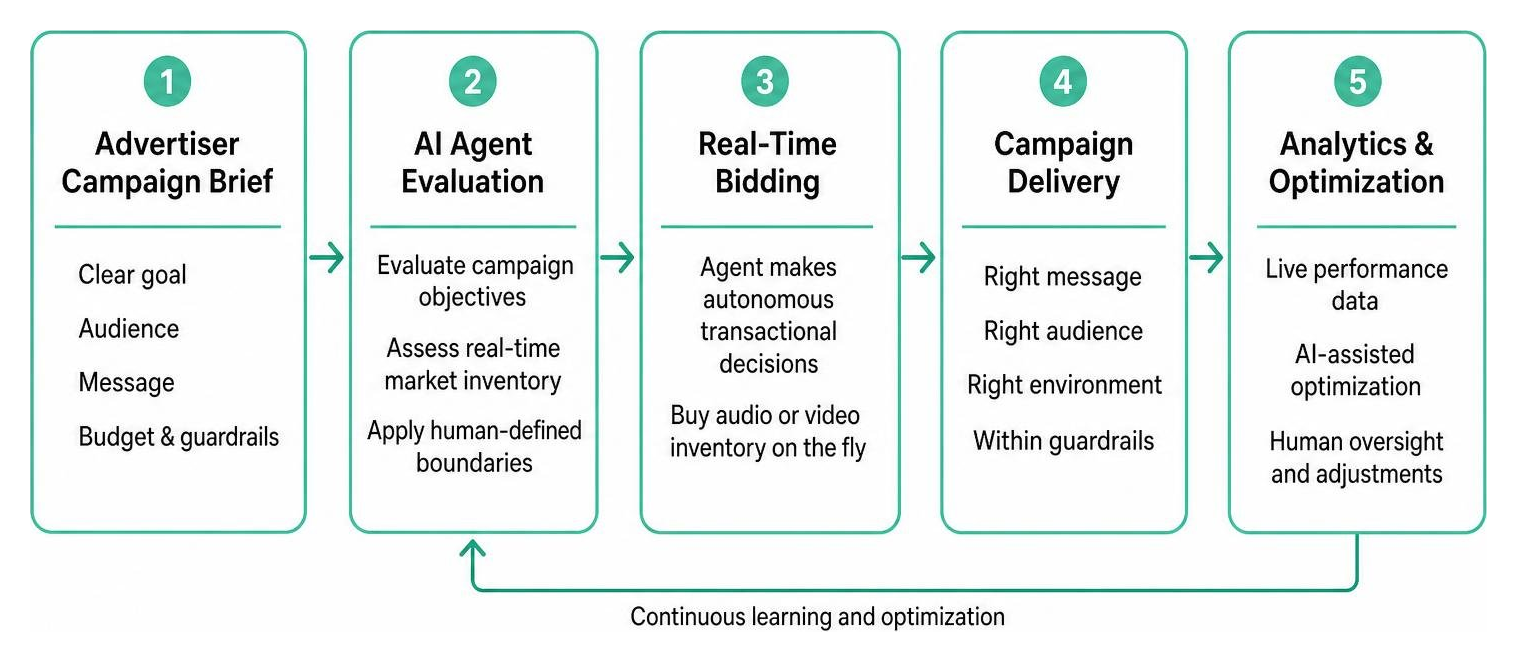
Autonomous Execution vs. Static Programmatic
Traditional programmatic advertising relied on static, rule-based logic: bid up to X amount if a user matches demographic Y during hour Z. While automated, those workflows remain reactive. If publisher inventory quality drops or consumer engagement shifts unexpectedly, traditional setups continue spending until a human pulls the emergency brake.
Agentic media buying represents a true paradigm shift. Rather than adhering to inflexible scripts, AI agents analyze campaign objectives, assess real-time market inventory, and make autonomous transactional decisions within human-defined boundaries. According to industry projections from Gartner, AI-influenced self-serve platforms will handle more than 80% of US ad spend by 2028. This rapid shift frees marketing teams from repetitive manual operations, letting them focus on high-level growth strategy.
Total Video Convergence Across Linear and CTV
The historic wall between broadcast television and digital connected TV (CTV) is officially disappearing. Modern media buyers no longer treat linear broadcast, broadcaster video-on-demand (BVOD), and addressable TV as separate silos. Instead, they activate them under unified “Total Video” models.
A prime example is the Total Video planning layer developed for major television networks. Broadcasters are connecting API data feeds across linear ratings, addressable programmatic streams, and digital servers. AI engines instantly analyze available inventory to build balanced video schedules across every screen.
Crucially, modern systems also calculate cross-channel reach curves alongside environmental metrics like campaign carbon footprints. This gives brands broad exposure without over-saturating individual households or generating unnecessary digital waste.
Beyond Whitelists: Redefining Quality with Containerized RTB and Granular Metrics
For years, digital media buyers used static publisher whitelists as a safety blanket. If a website had a recognizable domain name, it was deemed safe. Unfortunately, bad ad experiences happen even on reputable domains—think pages overloaded with five autoplay videos, hidden banner stacks, and aggressive autorefresh scripts.
Brands are now piloting containerized RTB to solve this problem. Containerized real-time bidding embeds DSP decision intelligence directly inside the supply-side platform (SSP) or publisher environment, giving buyers immediate visibility into page quality before they bid.
| Capability / Metric | Traditional Open RTB | Containerized RTB |
|---|---|---|
| Bidding Location | Centralized DSP server | DSP logic running inside the SSP container |
| Bid Stream Data Access | Standard bid stream metadata only | Direct publisher-level DOM and render data |
| Ad Clutter & Density Visibility | Blind to actual page layout | Measures live ad-to-content ratio |
| Video Playback Quality | Unknown audio status | Real-time audio unmuted vs. muted verification |
| User Attention Signals | Basic viewability percentages | Scroll depth, dwell time, and interaction rates |
| Inventory Curation | Static, manually updated whitelists | Dynamic, AI-curated inclusion lists |
Unlocking Publisher-Level Signals with Containerized RTB
Traditional bid requests send basic information: a browser cookie or device ID, an ad slot size, and a general domain name. Containerized RTB uncovers the actual user experience on the page.
By evaluating publisher-side signals, buyers can evaluate:
- Ad Ratio: The proportion of page real estate occupied by ads compared to editorial content.
- Video Sound State: Direct verification of whether an ad played with the sound unmuted or was hidden in a muted corner player.
- Scroll Velocity & Dwell Time: Whether a visitor is genuinely reading content or skimming past placements.
- Page Refresh Rates: How frequently ads refresh automatically without new user interactions.
Bidding specifically on high-engagement environments helps brands stop paying for “viewable” impressions that no human actually looks at.
Replacing Static Whitelists with Dynamic AI Inclusion Lists
Static whitelists decay quickly. A publisher running clean layouts today might introduce aggressive ad refresh scripts next month to boost yield. Conversely, emerging niche publishers with deeply engaged readers are often left off static lists entirely.
To maintain real-time quality control, modern teams turn to our practical field guide to media buying analytics. AI models continually scan the open web, evaluate real-time layout signals, and generate dynamic inclusion lists. Brands can safely discover high-performing, niche publishers while filtering out low-quality ad farms.
Real-World Case Studies: How Modern Brands Scale with Next-Gen Tactics

Innovative buying tactics are delivering real, measurable wins across audio, video, and digital channels. Brands looking at scaling ecommerce brands are moving away from brute-force spending in favor of intelligent, automated execution.
Innovative Media Buying in Streaming Audio and Podcasting
Streaming audio and podcasting have historically been fragmented and time-consuming to buy. Media planners spent hours manually negotiating rates, coordinating insertion orders, and managing podcast host-read schedules.
In a recent pilot using an autonomous AI agent, a national brand tested dynamic execution across streaming audio and podcast networks. The results were clear:
- The agentic buy delivered streaming audio 42% more efficiently than the advertiser’s traditional direct buying benchmark.
- In podcasting, 48% of impressions were delivered in high-value, non-skippable mid-roll placements, compared with only 33% allocated to mid-rolls in the traditional static plan.
The AI agent secured premium, high-converting placements at a lower effective cost by dynamically evaluating available podcast episodes against strict audience and context rules.
AI-Driven Broadcaster Planning: Inside FranceTV Publicité
European broadcast networks are leading the charge in convergent planning. FranceTV Publicité deployed its ADspace platform to unify cross-video buying across broadcast and digital channels.
The platform’s AI planning layer was trained on a robust dataset of approximately 8,700 linear campaigns and 300 CTV/BVOD/addressable TV campaigns. Today, the system delivers real-time, inventory-aware media schedules tailored to target demographics, flight dates, and creative formats (including 15, 20, and 30-second spots).
The impact on daily operations has been significant:
- Over 45 advertising agencies and nearly 200 daily buyers actively plan through the platform.
- Around 60% of FranceTV Publicité’s total revenue passes directly through the ADspace platform.
- Campaign plans balance gross rating points (GRP) and cost per thousand (CPM) against verified attention scores and carbon footprint metrics.
The Evolving Role of Media Buyers and Agencies
With algorithms and autonomous agents handling real-time bids and line-item setups, the role of human media buyers is evolving, not disappearing. Media professionals are shifting away from repetitive spreadsheet work to focus on strategic planning, governance, creative direction, and audience research.

When evaluating partners, many businesses discover that working with a local media buying agency provides hands-on accountability. Local teams keep a close eye on AI tools, ensuring campaign automation aligns with real-world business objectives.
Shifting from Manual Execution to Strategic Oversight
In an automated media landscape, human expertise serves as the essential steering wheel:
- Rule Governance: Humans define the guardrails—such as maximum bid ceilings, audience exclusions, brand-safety tolerances, and budget splits.
- Creative Storytelling: AI can optimize delivery, but compelling creative concepts, clear messaging, and emotional resonance still come from human insights.
- Cross-Channel Alignment: Strategic planners ensure digital programmatic efforts reinforce out-of-home, local broadcast, and event sponsorships.
How to Implement Innovative Media Buying in Your Organization
Transitioning your marketing department or growing brand to modern media buying practices requires a clear, step-by-step roadmap:
- Clarify Business Objectives and KPIs: Determine whether your primary goal is lower acquisition costs, verified reach, or higher attention share. Review our step-by-step guide to media buying services to align internal KPIs with current buying tactics.
- Audit Current Ad Environments: Look closely at where your programmatic ads actually run. Identify low-quality placements, hidden video players, or ad-stuffed pages that inflate impression counts without driving real engagement.
- Start with Channel-Specific Pilots: Launch controlled tests using agentic audio buys or containerized video networks. Compare these modern placements against your historical direct-buy benchmarks.
- Incorporate Attention and Quality Metrics: Shift campaign optimization goals away from cheap CPMs toward verified unmuted views, high dwell time, and clean ad-to-content ratios. If you run a smaller enterprise, practical media planning tips for small businesses can help you test these metrics without stretching your budget.
- Establish Continuous Human Governance: Schedule regular reviews to inspect AI-generated inclusion lists, audit placements, and refine campaign decision logic.
Frequently Asked Questions About Modern Media Buying
How does agentic media buying differ from standard programmatic buying?
Standard programmatic media buying relies on rigid, static rules configured manually within a DSP. Once launched, it runs automatically, but cannot adapt on its own if marketplace conditions change. Agentic media buying uses autonomous AI agents operating within human-defined rules. These agents continuously evaluate opportunities, assess live inventory quality, negotiate real-time transactions, and reallocate budgets dynamically across channels.
What metrics matter most when assessing ad placement quality?
While CPM and basic viewability offer a high-level snapshot, modern quality assessment focuses on granular user experience signals:
- Ad Density: The ratio of advertisements relative to core editorial content on a webpage.
- Audio and Player Status: Whether video ads render with sound unmuted in main content containers or run muted in background slots.
- Scroll Depth and Dwell Time: How long users remain on a screen while an ad is visible.
- Refresh Frequency: The presence of aggressive auto-refresh scripts that artificially inflate publisher impression counts.
How does AI-driven media planning account for sustainability?
Modern media planning platforms, such as broadcaster total-video engines, now integrate carbon footprint calculation APIs directly into the schedule-building workflow. The algorithms optimize delivery routes by prioritizing energy-efficient streaming paths, cutting down on redundant ad calls, and eliminating bloated supply paths. This reduces the carbon emissions of digital delivery while improving campaign efficiency.
Conclusion
The future of advertising belongs to brands that trade outdated manual setups for intelligent, data-rich buying systems. By embracing agentic workflows, dynamic publisher-level verification, and unified video models, your business can eliminate wasted spend and secure high-value placements that genuinely engage your target audience.
At McGuinness Media & Marketing, our team pairs deep strategic planning with cutting-edge media execution to help brands stand out and scale sustainably. Whether you want to modernize your programmatic stack, launch connected TV campaigns, or refine cross-channel creative, our expert media planning services give you the strategic edge needed to lead your market.