
How to Manage and Scale Your Brand Reputation Without Losing Identity
Brand management strategies that help you grow without losing your identity
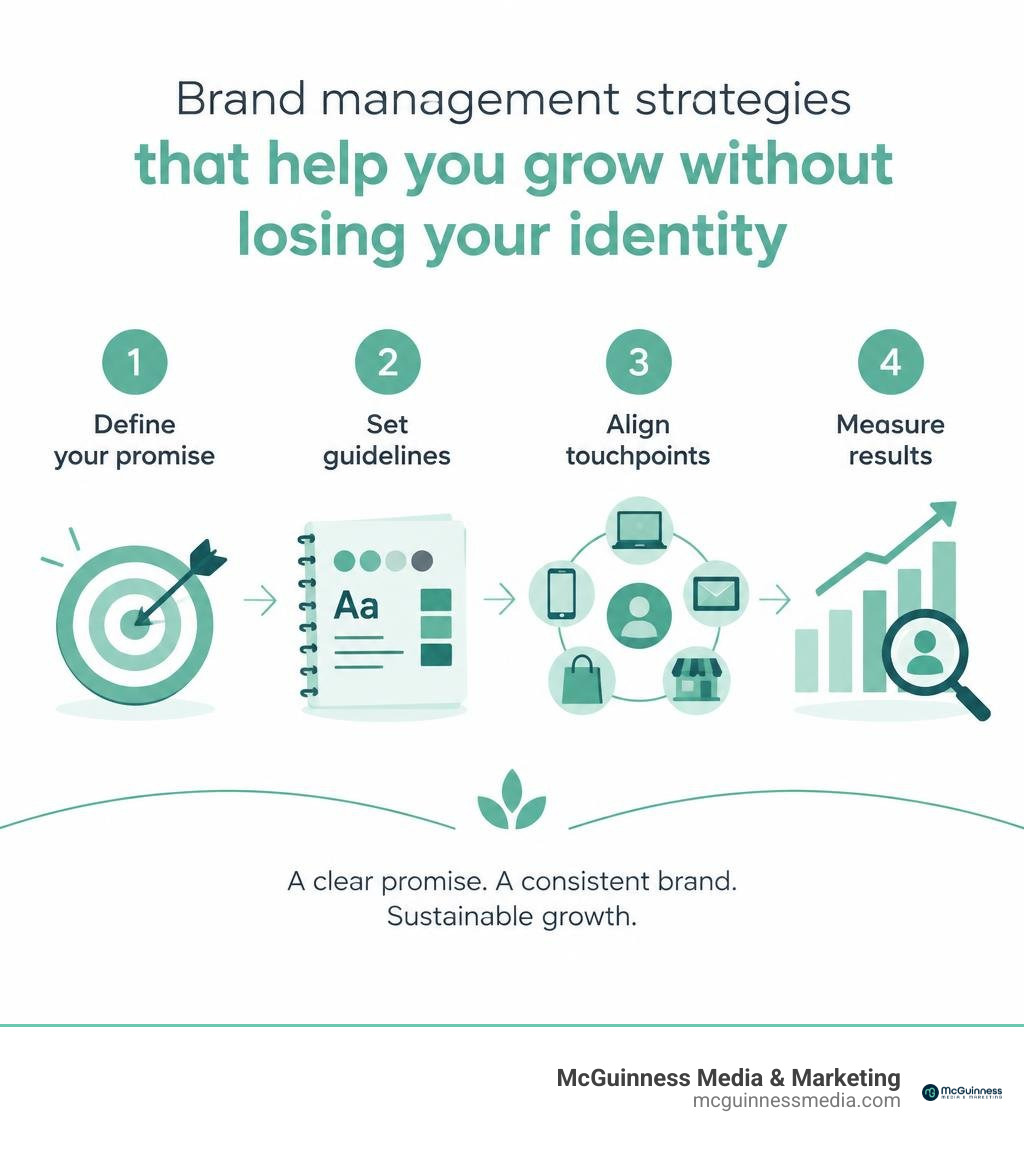
Start with a clear promise to your customers. Then use these brand management strategies to protect it as you grow: define what makes you different, set guidelines for how your brand looks and sounds, use them across every customer touchpoint, and track awareness, customer feedback, and repeat purchases. Adjust what is not working without changing the promise people trust.
That matters when new products, channels, or teams put more people in charge of your brand. Growth should make your identity easier to recognize, not harder.
I’m Megan McGuinness, owner and chief marketing officer of McGuinness Media & Marketing. For more than 20 years, I’ve developed brand management strategies and marketing plans for regional, national, and global brands; this guide shows how to put those principles to work as you scale.
Brand management strategies glossary:
Fundamentals of Strategic Brand Management and Brand Equity
A brand is not just a logo, a catchy tagline, or a color palette. At its core, a brand is an intangible asset that represents the sum total of every perception, emotion, and experience a customer associates with your company. While products have finite lifecycles, strong brands can outlive individual product lines, making brand equity one of the most valuable resources on any corporate balance sheet.
Consider corporate acquisition history. When Kraft Foods purchased Cadbury for $19.5 billion, it did not merely invest in chocolate factories and manufacturing equipment. Kraft paid a premium for Cadbury’s storied heritage, widespread goodwill, and consumer devotion. Similarly, when Tata Motors acquired Jaguar and Land Rover for $2.6 billion, the physical infrastructure represented only a fraction of the transaction value. The substantial balance reflected the intrinsic value of the brand names themselves.
As outlined in academic frameworks like Core Reading: Brands and Brand Equity, brand equity provides tangible financial advantages:
- Pricing power: Businesses with high equity command premium rates without losing market share.
- Customer acquisition resilience: Consumers gravitate toward familiar, trusted names when navigating crowded markets.
- Accelerated growth: High brand equity acts as an economic moat, facilitating category expansion and sustained profitability.
To capture these benefits, organizations must build an operational brand strategy and planning blueprint that balances identity protection with business growth.
Core Principles: Awareness, Consistency, and Loyalty
Managing brand equity requires mastering four foundational principles:
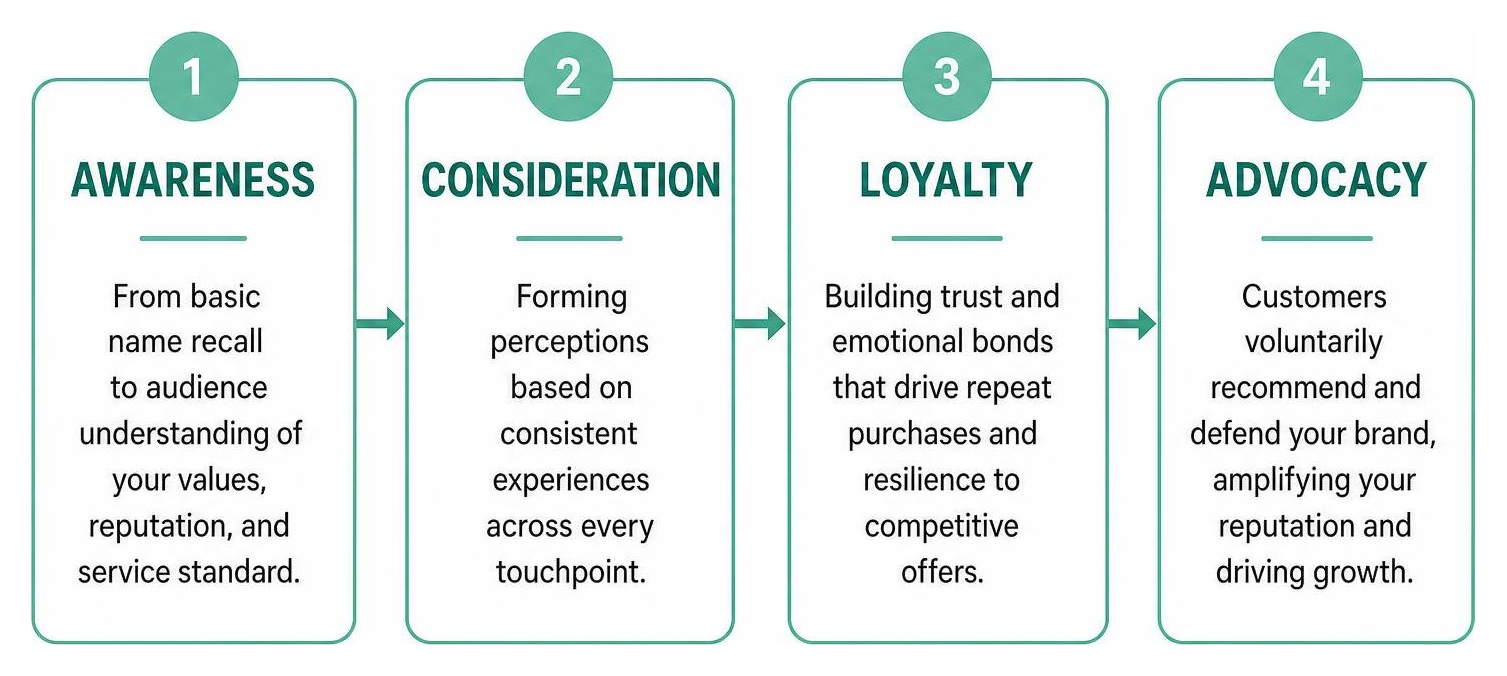
- Brand Awareness Across the Spectrum: Brand awareness is not a binary metric. It moves across a continuum—from basic name recall to deep audience understanding of your values, reputation, and service standard.
- Visual and Verbal Consistency: Every customer touchpoint must speak the same visual and narrative language. Whether a buyer interacts with an advertisement, a customer support representative, or physical packaging, the identity must remain unmistakably yours.
- Perceived Quality: Strong brand perception relies on consistently meeting or exceeding customer expectations across all deliverables.
- Brand Loyalty and Emotional Bonding: When consumers form an authentic emotional attachment to your brand, they purchase repeatedly regardless of minor price differentials or competitor promotions.
Establishing Mission, Vision, and Core Brand Values
Sustainable scaling starts from within. Before launching outward-facing campaigns, an organization must clearly define its internal compass:
- Mission: What your business does today, whom it serves, and how it delivers value.
- Vision: Where your brand intends to go and the broader impact it plans to make in the long term.
- Core Values: The operational principles that guide your decisions, hiring, and customer relationships.
- Unique Value Proposition (UVP): The distinct reason customers should choose you over alternative solutions.
Aligning these elements creates a shared culture where employees become active brand ambassadors. When your organizational values are clear, expanding into new markets or launching new products reinforces your core promise rather than diluting it. Understanding these nuances is precisely why every growing business needs brand positioning experts today to safeguard identity across multi-channel initiatives.
Core Types of Brand Management Strategies for Scaling Businesses

As organizations scale, managing a growing lineup of services or products requires structured brand architecture. Choosing the right architectural approach reduces operational friction and protects your core reputation.
Proven Brand Management Strategies: Extensions, Individual, and Attitude Branding
Different commercial scenarios demand specific brand management methodologies. The following model highlights the primary approaches used across diverse market environments, supported by insights from A Conceptual Framework for Creating Brand Management Strategies:
| Brand Strategy Type | Primary Objective | Risk Profile | Equity Impact | Typical Use Case |
|---|---|---|---|---|
| Brand Extension | Leverage existing parent brand equity to enter new categories | Moderate (risk of parent brand dilution) | Directly enhances or impacts parent brand | Dyson expanding from vacuums into haircare and lighting |
| Individual Branding | Create standalone identities for distinct product lines | Low for parent brand; higher upfront marketing costs | Isolates parent company reputation from product failure | Procter & Gamble marketing Tide, Pampers, and Gillette independently |
| Attitude Branding | Link the brand to a specific lifestyle, mindset, or feeling | Low to Moderate (relies heavily on cultural resonance) | Creates deep emotional loyalty and cultural relevance | Nike focusing on athletic determination; Apple focusing on creative expression |
| Private Labels | Deliver cost-effective, high-margin alternatives within retail | Low financial risk; dependent on retailer distribution | Builds store-level loyalty rather than global brand equity | Retail grocery brands competing against national product lines |
| Crowdsourced Branding | Involve consumers directly in brand creation and co-design | Variable (requires careful community moderation) | Fosters high brand engagement and organic advocacy | Brands using public community votes for new product variants |
By selecting the right structural model, businesses can diversify their revenue streams without exposing their primary brand identity to undue risk.
Tailoring Brand Management Strategies Across Luxury vs. Mass Markets
Brand execution differs significantly depending on whether a company operates in the luxury sphere or mass market:
- Luxury Brand Management: Anchored in exclusivity, heritage, and scarcity. Luxury brands do not focus on universal appeal; they maintain premium pricing power by deliberately limiting accessibility and emphasizing craftsmanship and status.
- Mass Market Brand Management: Anchored in accessibility, utility, and scale. Success depends on broad availability, competitive pricing, high distribution volume, and messaging that resonates with a wide demographic.
Scaling companies often attempt to bridge this divide by introducing premium tiers. When moving across this spectrum, governance is vital to ensure that mass accessibility does not undermine premium prestige.
A 7-Step Framework for Building an Enduring Brand Strategy
Scaling a brand while protecting its reputation requires a disciplined, repeatable operational framework.
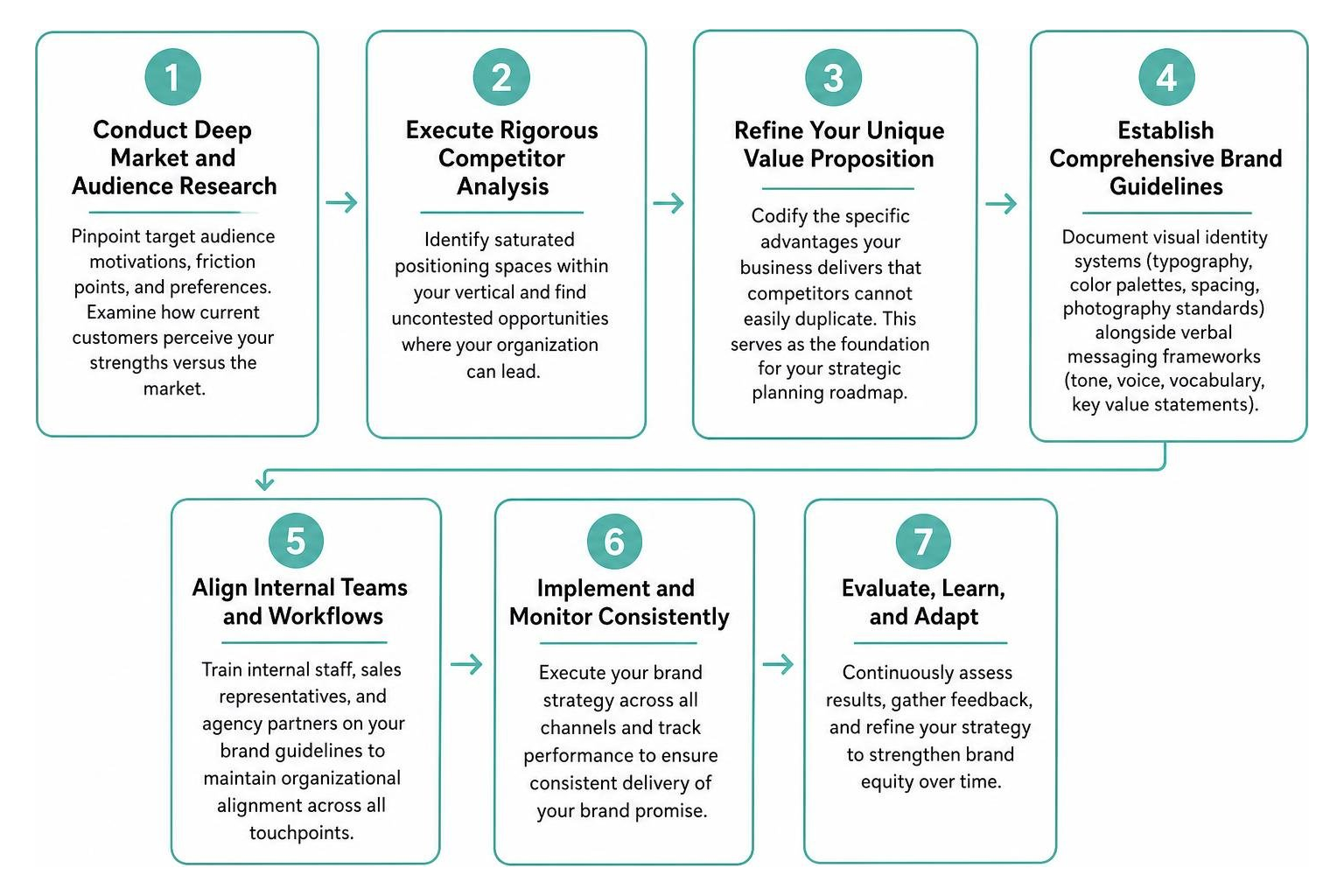
- Conduct Deep Market and Audience Research: Pinpoint target audience motivations, friction points, and preferences. Examine how current customers perceive your strengths versus the market.
- Execute Rigorous Competitor Analysis: Identify saturated positioning spaces within your vertical and find uncontested opportunities where your organization can lead.
- Refine Your Unique Value Proposition: Codify the specific advantages your business delivers that competitors cannot easily duplicate. This serves as the foundation for your strategic planning for marketers roadmap.
- Establish Comprehensive Brand Guidelines: Document visual identity systems (typography, color palettes, spacing, photography standards) alongside verbal messaging frameworks (tone, voice, vocabulary, key value statements).
- Align Internal Teams and Workflows: Train internal staff, sales representatives, and agency partners on your brand guidelines to maintain organizational alignment across all touchpoints.
- Deploy Integrated Multi-Channel Marketing: Launch coordinated promotional campaigns across web, social media, video, and physical collateral using your unified positioning.
- Monitor, Measure, and Iterate: Continuously measure brand health metrics, evaluate market feedback, and refine execution without deviating from your core organizational values.
Designing Guidelines and Unified Communications
Brand guidelines serve as your operational rulebook. Without documented standards, fragmented messaging across sales, social media, and client services will inevitably erode audience trust.
Your guidelines should encompass:
- Visual Standards: Logo lockups, clear space requirements, approved typography, digital color codes (HEX/RGB), print color profiles (CMYK/Pantone), and photographic styling.
- Verbal Identity: Brand personality traits, mission-driven vocabulary, boilerplate company descriptions, and explicit “we say / we do not say” parameters.
- Channel Execution Rules: Specific conventions for digital advertising, organic social content, email newsletters, and long-form publications.
Maintaining these rules creates a reliable experience across all channels, forming the cornerstone of a cohesive brand communications strategy.
Execution, Governance, and Technology Infrastructure

In modern marketing environments, manual asset management is inefficient and prone to error. Modern organizations rely on structured governance systems and marketing technology:
- Digital Asset Management (DAM): Centralized cloud repositories ensure that internal teams and external creative partners only access approved, current assets with appropriate usage rights and versioning.
- Approval Workflows: Multi-stage review protocols prevent unauthorized or off-brand creative from reaching public distribution.
- AI-Powered Brand Governance: Machine learning tools assist in monitoring real-time brand compliance across digital touchpoints, flagging logo misuse, color drift, or unauthorized messaging variations before campaigns go live.
Measuring, Monitoring, and Protecting Brand Equity
Brand health cannot be assessed solely through short-term sales transactions. Sustained brand equity demands comprehensive measurement across qualitative and quantitative vectors, as explored in The Sage Handbook of Brand Management.
Brand Tracking Metrics and Methodologies
- Brand Recall and Recognition: Tracking unaided and aided awareness through targeted market surveys to measure visibility within your industry.
- Net Promoter Score (NPS) and Customer Sentiment: Assessing customer satisfaction, retention likelihood, and direct user sentiment across review platforms.
- Social Listening and Sentiment Analysis: Utilizing automated monitoring tools to evaluate public conversations, sentiment trends, and emerging brand issues across digital platforms.
- The BrandDynamics and Resonance Pyramids: Measuring how successfully your audience progresses from basic product awareness to functional relevance, perceived superiority, and emotional attachment.
- Share of Voice (SOV): Measuring your brand’s media presence and conversation volume relative to direct competitors.
Real-World Lessons: How Apple, Nike, and Coca-Cola Maintain Identity
The world’s most resilient brands demonstrate how disciplined brand management preserves identity while scaling globally:
- Apple: Maintains strict minimalism across industrial design, operating software, marketing campaigns, and retail architecture. Every product packaging unboxing reinforces their core promise of elegant, intuitive innovation.
- Nike: Centers its communication on personal athletic achievement and emotional storytelling. By championing the consumer’s journey under the timeless “Just Do It” ethos, Nike transcends athletic apparel to embody determination.
- Coca-Cola: Protects its heritage while adapting to local markets worldwide. Through iconic visual consistency, nostalgic holiday campaigns, and unified packaging, Coca-Cola evokes feelings of community and refreshment across cultures.
- Patagonia: Demonstrates the power of purpose-driven brand management. By aligning operational decisions directly with environmental activism—such as their well-known “Don’t Buy This Jacket” initiative—they foster intense customer loyalty and trust.
Frequently Asked Questions About Brand Management Strategies
What is the difference between brand strategy and brand management?
Brand strategy is the foundational blueprint that defines who your brand is, your unique positioning, audience segments, and long-term objectives. Brand management is the ongoing operational process of executing, measuring, governing, and evolving that strategy across daily marketing touchpoints, product releases, and customer interactions throughout the brand lifecycle.
How do modern tools like DAM and AI improve brand consistency?
Digital Asset Management (DAM) platforms provide a single source of truth for all approved visual and verbal collateral, eliminating outdated assets and unauthorized variations. AI tools complement DAM by automating compliance checks, auditing multi-channel content for style guide adherence, and analyzing audience sentiment in real time.
When should a company consider rebranding versus a brand extension?
A company should consider rebranding when its current identity no longer reflects its strategic direction, when market positioning has become obsolete, or when overcoming persistent negative public associations. A brand extension is appropriate when existing parent brand equity is exceptionally strong, and the company seeks to enter a related or complementary product category without abandoning its established identity.
Conclusion
Scaling a business without losing your identity requires a delicate balance of disciplined governance and strategic adaptability. By building a clear value proposition, establishing comprehensive guidelines, implementing modern asset management infrastructure, and continuously monitoring market sentiment, your brand can expand into new markets while maintaining the reputation and trust that drove your early success.
At McGuinness Media & Marketing, we serve as the creative services and strategic planning partner for ambitious businesses. Our team builds integrated strategies that protect your voice, unify your market presence, and scale your audience impact across every channel.
Ready to scale your brand with clarity and purpose? Discover our comprehensive branding and strategy services to build a resilient foundation for long-term growth.