
Why Integrated Media Solutions Are the Backbone of Modern Smart Spaces
How Integrated Media Solutions Make Smart Spaces Work
Integrated media solutions connect a space’s network, displays, audio, and controls so they work as one system. If you’re evaluating a provider, ask who will plan the wiring and power, test the equipment together, and support it after installation. A simple control screen matters less if the system behind it is unreliable.
That same joined-up thinking applies to what people see and hear in the space: the content should fit the audience and the setting. For brands, that means the technology infrastructure and the marketing content running through it need to be planned together, not treated as separate projects.
I’m Megan McGuinness, owner and chief marketing officer of McGuinness Media & Marketing. For more than 20 years, I’ve developed integrated media solutions through marketing strategy, creative work, and media planning; this guide will help you judge the technology that brings content into a smart space.
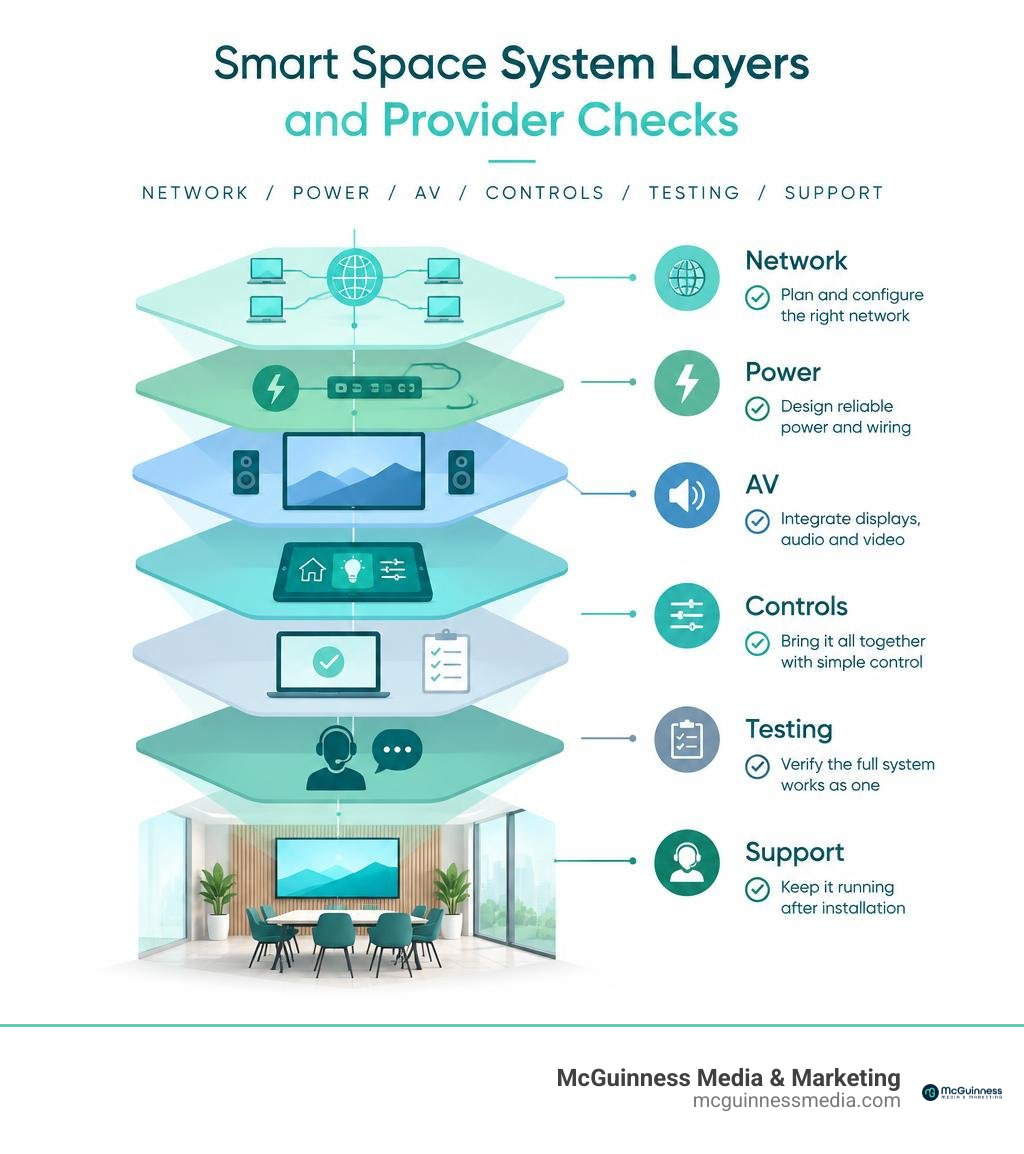
Integrated media solutions terminology:
Defining Integrated Media Solutions Across Modern Environments
At its core, true integration represents the elimination of friction between physical hardware, structured network backbones, and human operation. In modern commercial facilities and smart environments, technology can no longer exist in isolated silos. When an organization attempts to patch together standalone displays, separate audio amplifiers, fragmented environmental controls, and mismatched conferencing tools, the result is operational paralysis.
Modern facilities demand a unified infrastructure where audiovisual engineering, broadcast systems, environmental controls, and digital communication networks operate as a single cohesive organism. As organizations face adapting to modern media landscape shifts, physical environments must intuitively support hybrid collaboration, high-fidelity media delivery, and centralized management. Industry organizations note that modern automated architectures rely on the convergence of building automation, IT networking, and media distribution to create responsive physical spaces.
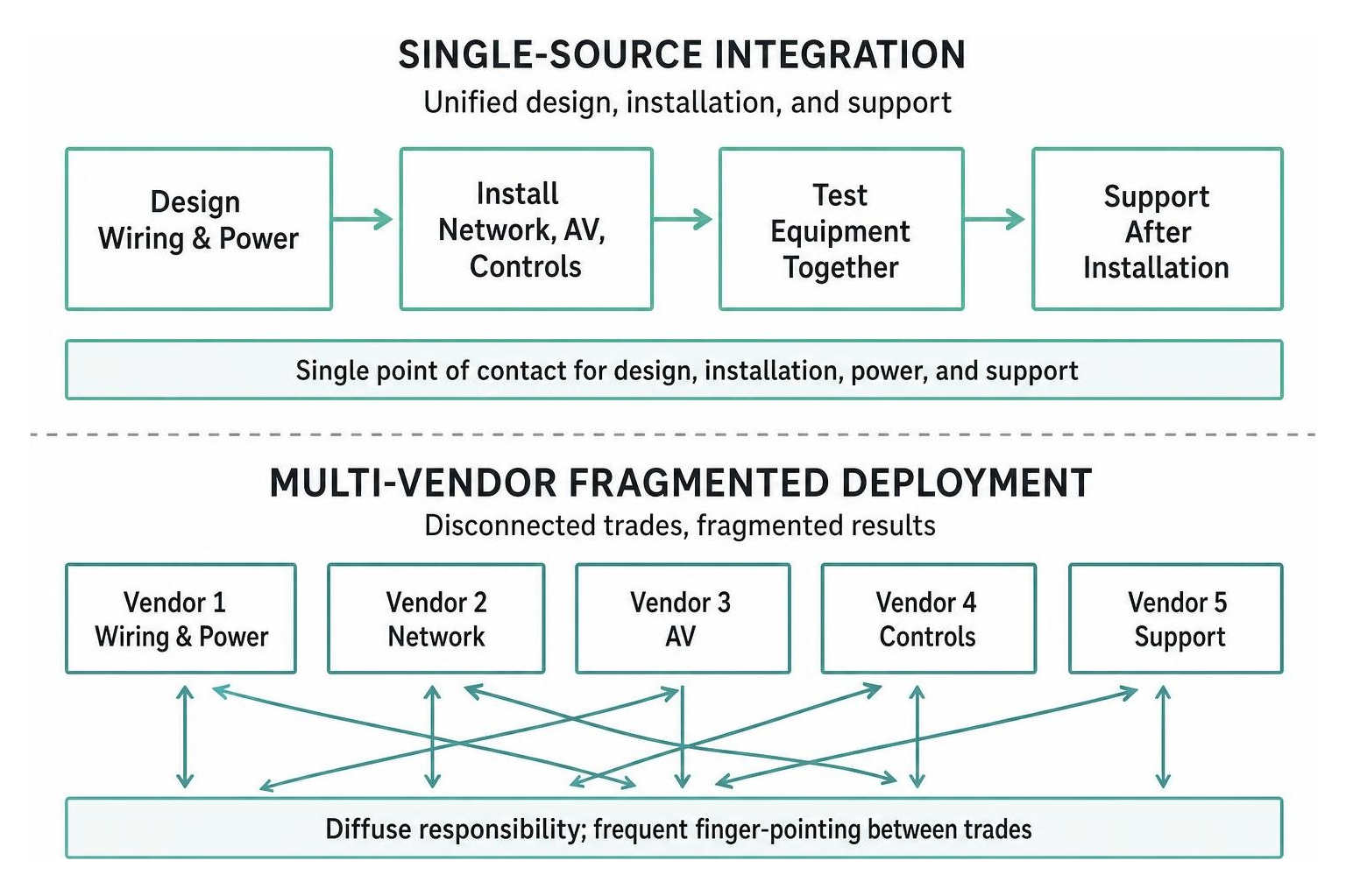
The difference between hiring a single-source turnkey integration partner versus managing multiple independent vendors across trades is substantial:
| Feature / Consideration | Single-Source Turnkey Integration | Multi-Vendor Fragmented Deployment |
|---|---|---|
| Accountability | Single point of contact for design, installation, power, and support | Diffuse responsibility; frequent finger-pointing between trades |
| System Reliability | Pre-tested interoperability and unified network architecture | High risk of protocol mismatch and unexpected hardware dropouts |
| Electrical Coordination | Integrated power, dedicated circuits, and built-in surge protection | Disconnect between electrical contractors and AV hardware specs |
| Deployment Timeline | Accelerated via off-site staging and pre-configured equipment racks | Delayed due to sequential handoffs, site re-work, and conflicts |
| Lifecycle Support | Comprehensive service level agreements (SLAs) and centralized updates | Disjointed warranty claims across hardware manufacturers and installers |
Core Components of Integrated Media Solutions in Enterprise Architecture
A robust smart media architecture is built on structured physical and logical layers. The foundation begins with enterprise-grade structured cabling (such as Cat6A shielded and fiber optics) alongside high-throughput IP networking gear configured specifically for low-latency audiovisual transport protocols (such as Dante for audio and AV-over-IP for video).
Beyond the physical cables, the system integrates:
- Centralized Processing and Amplification: Unified digital signal processors (DSPs) that balance audio across multiple discrete zones.
- High-Definition Visual Arrays: Commercial-grade LED video walls, interactive flat panels, and ultra-short-throw laser projection systems.
- Media Asset Architecture: Integration with cloud and on-premise repositories to feed video and photography production assets directly to digital displays and conferencing endpoints.
- Environmental Sensors: Automated daylight harvesting, occupancy sensors, and climate monitors tied into the overarching media controller.
Bridging Physical AV Hardware and Digital Content Workflows
High-end physical hardware is only as good as the content pipeline running through it. The true test of modern media integration is how easily teams can manage, route, and broadcast assets across spaces without requiring a dedicated engineering staff on site.
Centralized control systems route audio, video, and environmental scenes through intuitive touchscreen interfaces. In media production and broadcast environments, this includes RF signal distribution, broadcast transmission uplinks, and hybrid cloud rendering pipelines. Integrating media asset management (MAM) platforms directly into physical display arrays cuts down search times and allows organizations to deploy data driven content workflows in real time. Rather than treating hardware as static boxes, integrated systems turn physical facilities into active distribution platforms.
Evaluating Technical Integrators for Commercial and Residential Facilities

Selecting an integration provider requires looking far beyond a list of hardware brands on a line-item estimate. Successful smart spaces rely on engineering precision, proper licensing, and rigorous pre-installation testing protocols.
When evaluating technical integrators, consider whether the provider maintains master electrical capabilities alongside networking expertise. When a single engineering team coordinates conduit placement, dedicated electrical circuits, surge suppression, and structured data lines, you eliminate handoff friction with general contractors. Furthermore, assess their operational culture and stability; independent studies, such as workplace culture benchmarking data, demonstrate that high-trust organizations with transparent leadership retain skilled technical talent over 50% longer than industry averages. A stable, experienced engineering team directly translates to consistent dedicated client service management throughout the decades-long lifespan of your facility.
Key Criteria for Evaluating Integrated Media Solutions Providers
Before signing a contract or committing to a major capital expenditure, use the following evaluation framework:
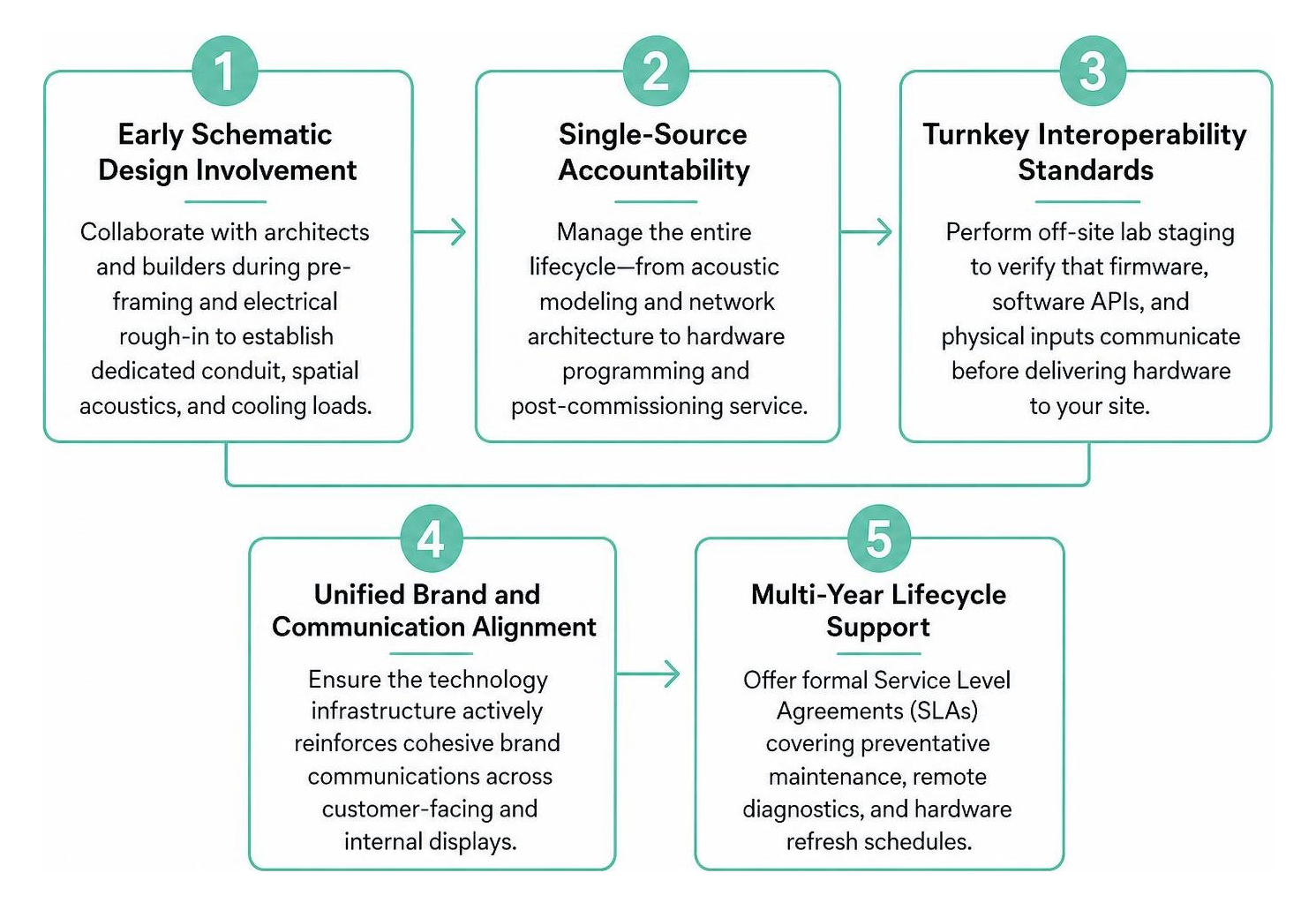
- Early Schematic Design Involvement: Does the integrator collaborate with architects and builders during the pre-framing and electrical rough-in phases to establish dedicated conduit, spatial acoustics, and cooling loads?
- Single-Source Accountability: Can the provider manage the entire lifecycle—from acoustic modeling and network architecture to hardware programming and post-commissioning service?
- Turnkey Interoperability Standards: Does the integrator perform off-site lab staging to verify that firmware, software APIs, and physical inputs communicate before delivering hardware to your site?
- Unified Brand and Communication Alignment: Does the technology infrastructure actively reinforce cohesive brand communications across customer-facing and internal displays?
- Multi-Year Lifecycle Support: Does the partner offer formal Service Level Agreements (SLAs) covering preventative maintenance, remote diagnostics, and hardware refresh schedules?
Scalability, Cybersecurity, and Network Reliability
Modern smart systems reside directly on local area networks, making network segmentation and cybersecurity critical priorities. An improperly configured smart controller or unpatched media streamer can expose an enterprise to severe vulnerabilities.
Professional integrators build media environments around hardened enterprise network architectures:
- VLAN Segmentation: Isolating media traffic (AV-over-IP, Dante audio, control signals) from corporate business data to optimize bandwidth and prevent unauthorized access.
- Endpoint Protection and Encryption: Implementing 802.1X network authentication, robust user permissions, and encrypted control protocols across every wall plate and touch panel.
- Hybrid Cloud and Storage Strategy: Balancing high-speed on-premise cache servers with scalable cloud repositories to ensure media playback never stutters during network outages.
- Scalable Code Frameworks: Structuring control system software on modular, standard web development architectures, much like how modern enterprise web development architecture allows digital platforms to scale without rewriting baseline code.
Best Practices for Deploying Unified Media and Smart Technology Systems

Deploying a complex media environment requires methodical planning to prevent expensive retrofits and project delays. Whether modernizing a corporate boardroom, establishing an institutional auditorium, or engineering an advanced commercial space, following structured best practices ensures long-term operational success.
A successful rollout balances technical engineering with user experience. If a user needs a training manual just to turn on the displays and start a video call, the integration has failed. The goal is to tame complex technology in the background while presenting a clean, self-explanatory control interface. This philosophy mirrors the precision required in advertising, where complex behind-the-scenes data powers focused campaigns through structured media buying services.
Off-Site Pre-Configuration and Rigorous Interoperability Testing
One of the most effective practices in commercial AV deployment is off-site interoperability lab staging. Rather than unboxing dozens of hardware components on an active construction site, experienced integrators assemble, wire, program, and test entire equipment racks within a controlled staging facility.
During off-site staging, engineers:
- Flash and standardize firmware across all endpoints to prevent communication mismatches.
- Stress-test network switches under full 4K video-over-IP and uncompressed multichannel audio loads.
- Debug control scripts, custom user interface graphics, and automation macros.
- Dress and label all internal rack cabling to commercial telecommunication standards.
This controlled pre-configuration eliminates site bottlenecks, accelerates field deployment velocity by days or weeks, and ensures that hardware performs reliably the moment it arrives on site. This methodical staging ensures your physical infrastructure seamlessly supports integrated digital marketing activations and digital signage campaigns without unexpected technical dropouts.
Centralizing Environmental Controls, Audio, and Visual Distribution
True smart spaces integrate media distribution with environmental engineering. By tying lighting, motorized window treatments, climate regulation, and audiovisual switching into single-touch macros, spaces dynamically adapt to their intended use.
For instance, pressing a “Presentation” scene can automatically lower motorized solar shades, dim architectural lighting to 30% along perimeter walls, power on the primary visual display, route the presenter’s video feed, and adjust climate controls for room occupancy.
In public commercial spaces, this unified control allows businesses to run synchronized audiovisual experiences during corporate gatherings, brand activations, and events and experiential promotions with push-button simplicity.
Frequently Asked Questions About Smart Space Media Integration
When should technology integrators be involved in a new facility build?
Technology integrators should be engaged during the schematic design phase, well before framing, dry-walling, and electrical rough-in begin. Early involvement allows engineers to coordinate conduit pathways, assess structural support for heavy video walls, calculate dedicated electrical load requirements, and design acoustic isolation. Involving an integrator early prevents costly structural rework and wall remediation later in the construction process.
How do unified smart building systems improve commercial energy efficiency?
Unified systems optimize power consumption by linking environmental hardware to scheduling routines and occupancy sensors. Motorized solar shades lower automatically during peak sunlight hours to reduce solar heat gain and lower HVAC cooling loads. Simultaneously, automated lighting systems adjust intensity based on ambient daylight harvesting, and idle media hardware powers down automatically outside business hours. These synchronized automations can yield significant reductions in annual commercial utility costs.
What is the advantage of pre-testing systems in an interoperability lab before deployment?
Pre-testing systems off-site in a controlled laboratory environment ensures that all hardware components, control processors, third-party APIs, and firmware versions communicate reliably before field installation. This process identifies defective hardware, resolves software bugs, and standardizes cabling off-site, reducing on-site deployment time and eliminating operational disruptions during commissioning.
Conclusion
Modern smart spaces are defined by the invisible harmony between physical architecture, high-performance networking, and intuitive media systems. When built on an engineered foundation of structured cabling, enterprise-grade IP security, centralized environmental management, and off-site pre-commissioning, integrated media technology elevates how organizations collaborate, communicate, and present their message to the world.
Just as a physical space requires a unified technical infrastructure to operate reliably, your brand’s voice requires a unified strategy across all creative and communication channels. At McGuinness Media & Marketing, we bring strategic discipline and creative excellence to every campaign, helping organizations amplify their presence through tailored media planning strategies. By aligning reliable infrastructure with compelling, high-impact storytelling, your organization can build spaces and campaigns engineered for long-term growth and measurable success.