
Turn Remnant Broadcast Airtime into Direct Response Profit
How DRTV Media Buying Turns Airtime Into Measurable Results
DRTV media buying means purchasing TV airtime for ads that ask viewers to act, then measuring the response. To use remnant airtime well, start with a clear offer and a way to track calls or site visits. Test a small set of spots, compare the cost of each lead or sale, and buy more of the airtime that performs.
A TV spot is only the start. Viewers may search for your brand on their phones before they buy, so your search results, landing page, and checkout need to be ready when the ad runs. For broader context on how direct response advertising fits into the media landscape, the Direct response television entry on Wikipedia provides a useful overview of the format and its history.
I’m Megan McGuinness, owner and chief marketing officer of McGuinness Media & Marketing. My 20-plus years in media planning, buying, and marketing strategy inform this guide to drtv media buying, from the first test to the next decision.
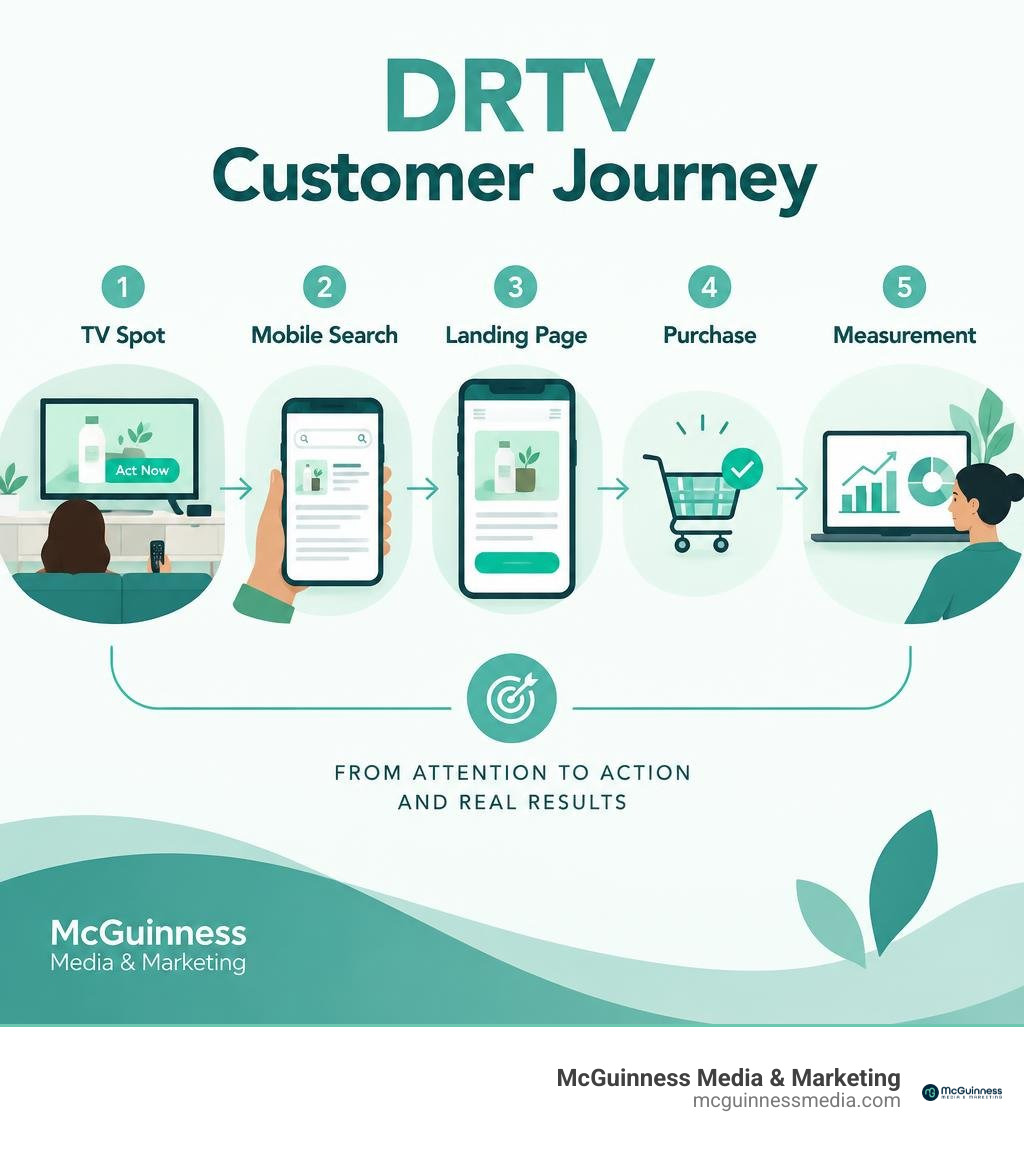
Know your drtv media buying terms:
Understanding DRTV Media Buying in Modern Advertising
Direct response television (DRTV) is fundamentally built around accountability. Unlike institutional campaigns designed purely to maintain top-of-mind awareness over quarters or years, direct response advertising asks for an immediate, trackable consumer action. Every dollar spent on airtime is expected to generate a measurable return, whether that arrives as a phone call, a direct web checkout, or a qualified lead.
Modern DRTV functions across a dynamic spectrum of linear broadcast, cable, and digital channels. Media buyers secure unsold or remnant commercial inventory at deeply discounted rates, allowing advertisers to run high-frequency campaigns without standard upfront price tags. Because the spots carry direct response calls to action (CTAs), performance data flows back to the media desk within hours rather than months.
| Dimension | Traditional Brand TV | Direct Response Television (DRTV) |
|---|---|---|
| Primary Objective | Long-term brand equity & recall | Immediate consumer response & conversion |
| Inventory Source | Fixed upfronts & premium scatter | Remnant, opportunistic, & direct-response rates |
| Cost Basis | Higher CPMs with guaranteed dayparts | Deeply discounted rates with preemption flexibility |
| Measurement Speed | Post-campaign brand lift studies (weeks/months) | Real-time spike tracking & daily response models |
| Call to Action | Subtle, thematic, or absent | Explicit, urgent, and multi-channel (URL/Phone/QR) |
| Targeting Criteria | Broad demographic ratings points (GRPs) | Cost-per-acquisition (CPA) & clearing efficiency |
Brand TV vs. Direct Response Television
The structural divide between traditional brand campaigns and DRTV centers on performance measurement and financial exposure. Traditional broadcast campaigns reserve fixed slots months in advance to guarantee specific dayparts, protecting their placement at a premium cost. When evaluating broadcast, cable, and streaming inventory, direct response buyers approach rate cards with an entirely different mandate: secure the lowest feasible cost per spot to make unit economics work.
DRTV creative relies on dedicated, trackable mechanisms:
- Unique, vanity toll-free numbers mapped to specific network feeds
- Custom promotional URLs and specific landing page subdomains
- Dynamic QR codes on screen that bridge linear viewers straight to checkout funnels
- SMS text-in keywords dedicated to isolated flight windows
This clear attribution allows media buyers to evaluate CPMs and spot clearings against direct inbound transactions. If a specific station or daypart fails to hit its target cost-per-acquisition (CPA), that placement is cut or renegotiated immediately.
Core Steps in the DRTV Media Buying Campaign Lifecycle
Executing a profitable direct response campaign requires tight coordination across production, procurement, and backend operations. A breakdown at any point in this pipeline compromises campaign attribution and wastes media spend.
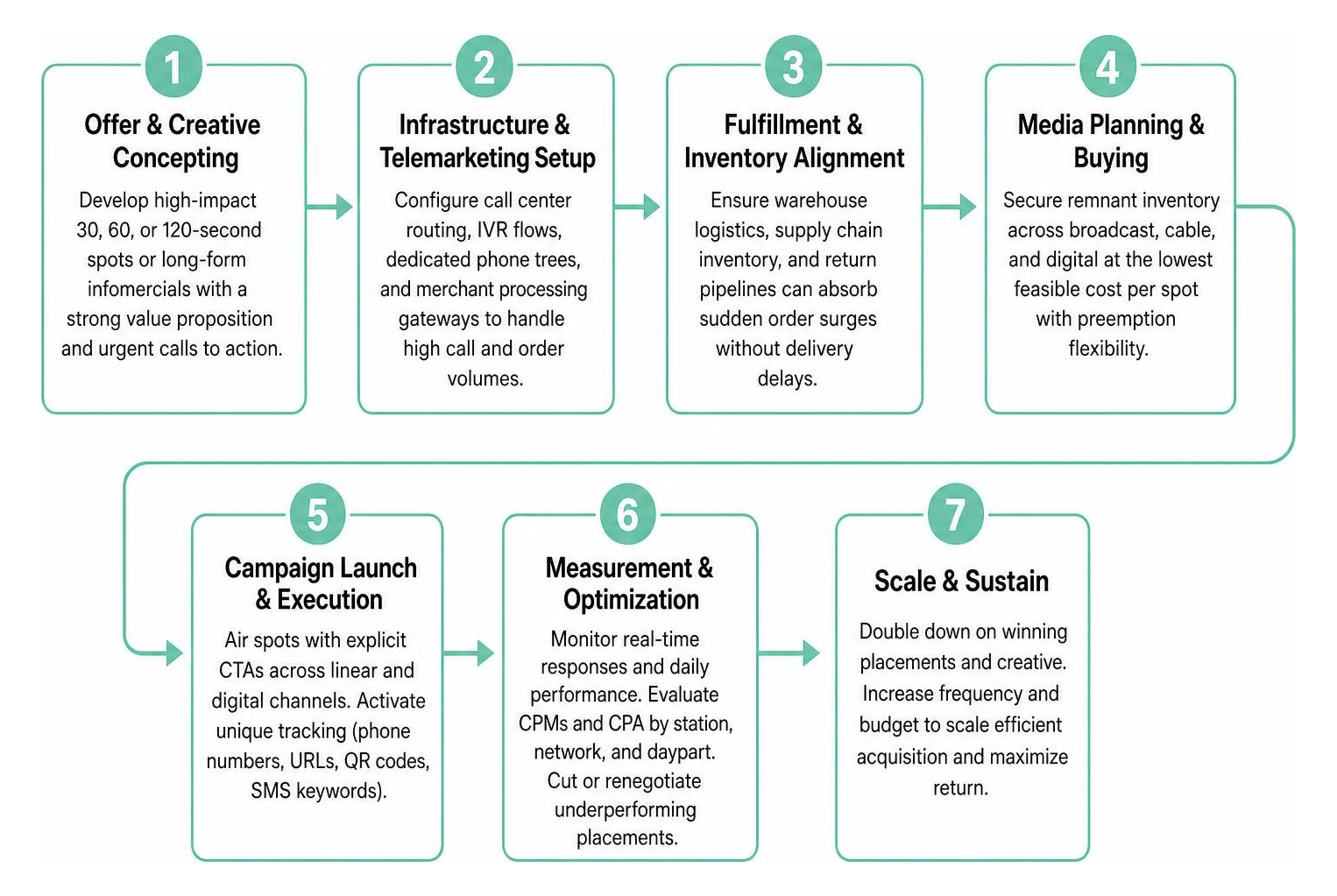
A comprehensive campaign lifecycle spans seven core phases:
- Offer and Creative Concepting: Developing high-impact 30-, 60-, or 120-second spots (or long-form infomercials) featuring a strong value proposition, demonstrable problem-solving, and urgent calls to action.
- Infrastructure and Telemarketing Setup: Configuring call center routing, interactive voice response (IVR) flows, dedicated phone trees, and merchant processing gateways capable of handling massive concurrency.
- Fulfillment and Inventory Alignment: Ensuring warehouse logistics, supply chain inventory, and return pipelines can absorb sudden order surges without delivery delays.
- Media Procurement: Executing streamlined media buying services across broadcast networks, regional cable interconnects, and syndication to acquire remnant inventory.
- Supplier and System Integration Testing: Conducting end-to-end test transactions across phone lines, web servers, and merchant accounts before live spots air.
- Isolated Market Testing: Running low-budget test flights across selected networks and stations to validate baseline conversion rates.
- Post-Campaign Tabulation and Optimization: Merging broadcast airing logs (as-run logs) with telemarketing records and web analytics to optimize the schedule for full-scale rollout.
Why Direct Response Television Spend Is Surging
Direct response advertising continues to capture market share because modern finance and marketing leaders demand provable returns on ad spend. Marketers are moving away from opaque broadcast metrics toward media channels where every placement answers directly to the balance sheet.

Industry spend data highlights this shift:
- DRTV ad spend expanded by 25% through the first five months of the year, reaching $1.2 billion.
- Traditional cable advertising grew by roughly 13% over the first half of the year—about half the growth rate seen in direct response placements.
- Network broadcast spend has flattened as advertisers reallocate capital toward measurable performance media.
- While national TV advertising represents a massive $54 billion market, the rapid migration toward DRTV showcases a structural pivot toward accountable performance marketing.
Shifting Economics of Network and Cable Airtime
The growth of streaming platforms and cord-cutting has altered linear television economics. With live network viewership concentrating heavily around major events and news, standard daytime, fringe, and late-night dayparts frequently hold unsold commercial inventory.
Networks cannot easily lower their published rate cards without devaluing their upfront commitments to legacy brand advertisers. Instead, stations release this surplus as remnant direct-response airtime. These slots carry direct response rates at discounts ranging from 50% to 80% below standard fixed rates.
In exchange for these steep discounts, DRTV media buyers accept preemption risk. If a traditional advertiser pays full rate card price at the last minute, the DRTV spot may be bumped. Using comprehensive media planning strategies, experienced media planners manage this trade-off by negotiating clearance minimums, monitoring as-run logs daily, and distributing buys across complementary stations.
Lowering Acquisition Costs Through Discounted Spots
Buying discounted airtime changes customer acquisition economics. When airtime costs decrease, the conversion hurdle required to achieve profitability drops accordingly.
Consider how buying remnant inventory lowers acquisition costs across different dayparts:
- Early Morning & Daytime (9:00 AM – 4:00 PM): Captures retirees, remote professionals, and stay-at-home parents at accessible rates, delivering reliable lead generation for home services, insurance, and medical devices.
- Early & Late Fringe (4:00 PM – 7:30 PM & 11:00 PM – 1:00 AM): Reaches broader working audiences winding down their day, yielding immediate spikes in digital search and app downloads.
- Overnight Dayparts (1:00 AM – 6:00 AM): Delivers deeply discounted rates ideal for complex, high-ticket consumer products, long-form infomercials, and educational offers that require thorough explanation.
Media planners balance these dayparts against audience profiles, capturing impressions when viewers are relaxed, attentive, and holding connected devices.
Cross-Channel Strategies: Connecting TV to Mobile and Paid Search
Direct response TV no longer operates in a broadcast-only silo. Today, viewing habits are thoroughly cross-platform, making television one of the most reliable top-of-funnel drivers for digital search and web conversions.

When an engaging direct response spot airs, thousands of viewers reach for their mobile devices. If an advertiser treats TV as a standalone channel without coordinating its digital counterpart, a substantial portion of that traffic leaks away to competitors. Applying efficient media buying house tactics ensures broadcast exposure connects directly to an optimized digital capture funnel.
Capturing Dual-Screen Viewers with Mobile-Optimized Funnels
Dual-screening is the standard way audiences watch television today. Viewers keep smartphones in hand, scrolling social feeds or checking messages during commercial breaks. A well-crafted DRTV call to action prompts immediate online searches and visits.
However, capturing that demand requires a landing page built specifically for mobile devices:
- 60% of visitors using mobile devices who encounter a non-mobile-optimized site will never return.
- 40% of mobile visitors report they will immediately navigate to a competitor’s site if their initial mobile experience is slow, clunky, or difficult to navigate.
- Modern search engines reward mobile-optimized experiences with higher quality scores, lowering the cost to capture traffic generated by television ads.
To prevent friction, landing pages must load in under two seconds, feature visible CTAs matching the on-screen TV offer, support one-touch payment options (such as Apple Pay and Google Pay), and remove unnecessary form fields.
Protecting Search Real Estate to Maximize DRTV Media Buying ROI
One of the most predictable downstream effects of DRTV is a dramatic surge in branded search queries. As spots air, consumers frequently bypass typed URLs and search the brand name, product name, or featured tagline directly into Google.
Without an active paid search strategy, competitors can bid on your brand name, capturing the demand your broadcast ad generated.
Implementing a synchronized paid search capture strategy provides clear advantages:
- Defending Brand Terms: Bidding aggressively on branded search terms ensures your company occupies the top ad positions when broadcast spots air.
- Lowering Overall CPA: Branded search traffic yields high click-through rates (CTR) and strong conversion rates, lowering your blended cost-per-click (CPC) and overall cost-per-acquisition.
- Ad Copy Synergy: Aligning paid search ad copy, headlines, and promotional codes with on-air messaging reinforces trust and streamlines the purchase decision.
Testing, Analytics, and Scaling Remnant Airtime
The foundation of successful DRTV media buying is disciplined, data-driven optimization. Direct response buyers do not rely on broad assumptions; they manage airtime allocations based on measurable response data. Using rigorous media buying analytics and response modeling, media planners track every dollar from broadcast delivery to final sale.
Setting Up Response Modeling and Attribution
Attributing a digital conversion to a broadcast airing requires clear modeling techniques. Unlike digital clicks that carry tracking parameters, linear television attribution uses probabilistic matching models:
- Attribution Windows: Defining isolated response windows (typically 5 to 15 minutes post-airing) to capture the initial surge of direct traffic, branded search, and phone calls.
- Baseline Traffic Modeling: Establishing historical baseline web traffic for specific days and hours to isolate the true incremental lift produced by each commercial airing.
- Spot Matching Analysis: Reconciling network as-run logs (which confirm the exact minute a commercial aired) with server traffic spikes, call logs, and merchant transaction records.
- Control Market Isolation: Running spots in select geographic Designated Market Areas (DMAs) while holding other regions dark to measure lift against a clear control group.
This data allows media buyers to calculate the exact return on investment for each network, daypart, creative version, and program type, guiding smarter budget allocation for smaller businesses maximizing media ROI on tighter budgets.
Iterative Testing and Full Campaign Rollout
Scaling a DRTV campaign is an iterative process. Successful advertisers follow a structured rollout framework:
- Phase 1: Controlled Testing: Deploying an initial media test budget across a diversified mix of 5 to 10 cable networks or regional broadcast stations over a 2- to 4-week window.
- Phase 2: Creative Variant Optimization: Testing multiple creative cuts (e.g., 30s vs. 60s, alternate hooks, distinct pricing structures, or varying CTAs) to identify the top-performing creative assets.
- Phase 3: Schedule Pruning: Eliminating underperforming dayparts and networks while securing additional remnant inventory on stations that hit target CPAs.
- Phase 4: Aggressive Scaling: Expanding media spend across national cable syndication, broadcast networks, and programmatic connected TV (CTV) environments, locking in long-term clearance agreements.
Frequently Asked Questions About DRTV Media Buying
What is the difference between short-form and long-form DRTV?
Short-form DRTV consists of 30-, 60-, or 120-second commercials designed to drive fast, focused consumer action for straightforward products, retail offers, or lead-generation funnels. Long-form DRTV (typically 28.5-minute infomercials) is utilized for complex products, specialized fitness systems, educational programs, or high-ticket items requiring in-depth demonstrations, customer testimonials, and extended storytelling to overcome purchase objections.
How do dual-screening habits impact TV response rates?
Dual-screening has shifted consumer response habits. While historic direct response campaigns relied primarily on 1-800 phone numbers, the majority of modern DRTV responses happen digitally via mobile browsers, search engines, and QR code scans. This shift reduces telemarketing overhead but requires advertisers to maintain fast, mobile-optimized landing pages and active paid search campaigns to capture web traffic immediately after spots air.
How do advertisers prevent fulfillment collapse during high-response campaigns?
Preventing fulfillment collapse requires close operational alignment across media planners, warehouses, and customer support desks before spots go live. Successful brands implement scalable cloud-based order management systems, maintain safety stock buffers, establish overflow customer support protocols, and configure automated merchant processing gateways that can handle sudden transaction volume without latency or checkout errors.
Conclusion
Remnant broadcast airtime remains one of the most powerful, cost-effective growth levers available to performance-focused brands. By securing discounted television inventory, integrating paid search defenses, optimizing mobile landing pages, and applying strict attribution modeling, advertisers can transform surplus broadcast slots into predictable, profitable revenue streams.
At McGuinness Media & Marketing, our Rhode Island-based team blends creative strategy with analytical media buying to deliver measurable client growth across broadcast, cable, and digital channels. If you are ready to scale your customer acquisition through data-driven campaigns, explore partnering with a dedicated media planning team to launch your next high-performance broadcast initiative.