
Beyond the Jingle: Crafting Radio Campaigns That Resonate and Deliver Results
Why a Radio Advertising Campaign Still Delivers Results
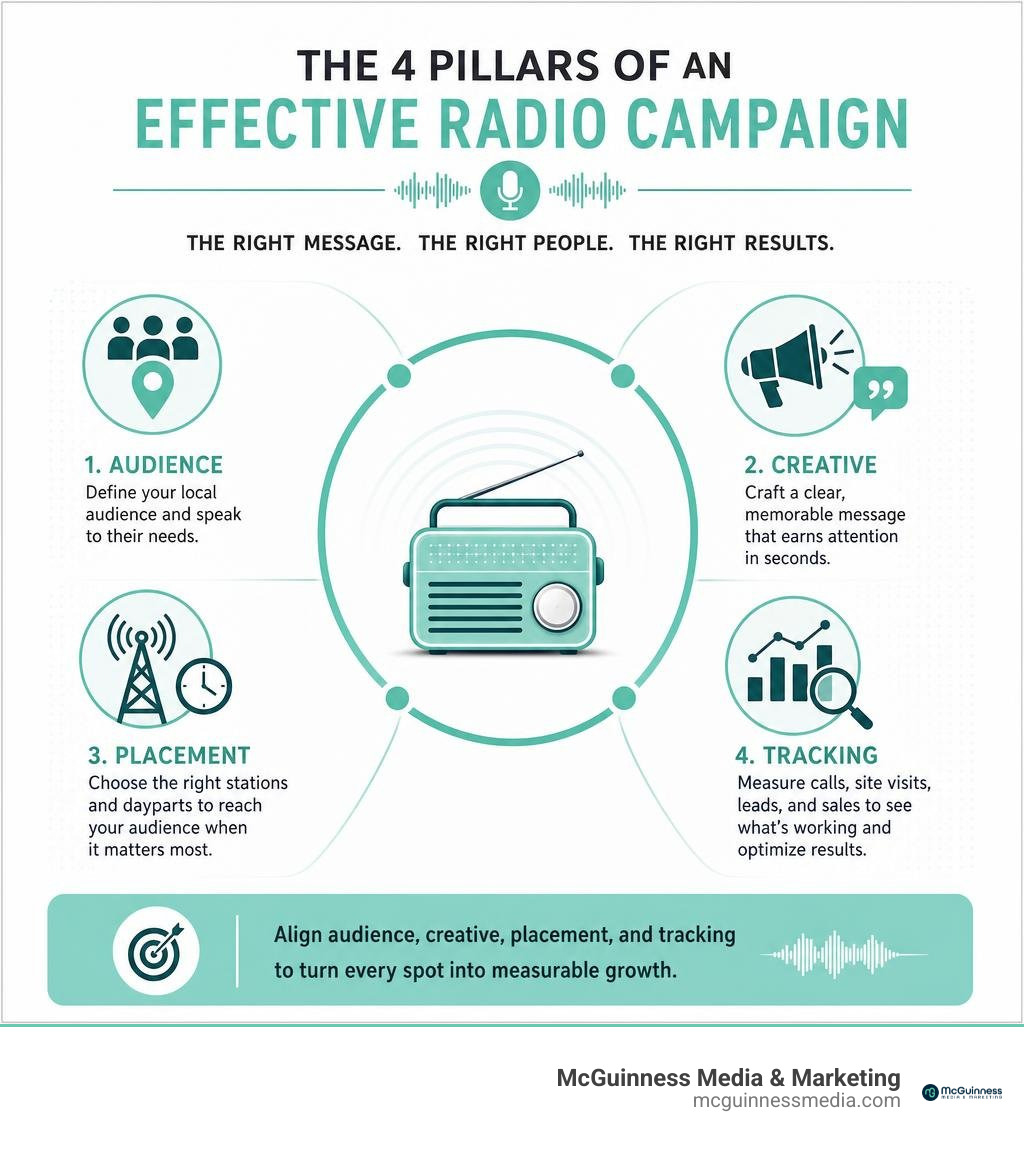
A radio advertising campaign helps a business reach local audiences at scale, build trust through familiar voices, and prompt action when people are close to making a purchase. The strongest campaigns pair a clear audience and offer with memorable audio creative, smart station and daypart placement, and a way to measure calls, site visits, leads, and sales.
| What makes a radio campaign effective | Why it matters |
|---|---|
| A defined local audience | Places messages in front of people most likely to buy |
| A simple, memorable message | Makes the brand easier to recall later |
| Consistent frequency | Gives listeners enough exposure to remember the offer |
| Trusted hosts and relevant stations | Adds local credibility and context |
| Connected digital channels | Captures the searches, clicks, and social engagement radio can spark |
| Clear tracking | Shows which placements and creative versions drive results |
Radio remains a powerful part of the local media mix. It reaches 91% of U.S. adults each month, and 79% of consumers say they trust radio – far above the 28% who say the same about social media. It also meets people during real life: on the commute, at work, in the kitchen, and often just before a shopping trip.
That does not mean any spot on any station will work. A campaign has to earn attention in seconds, sound like it belongs in the listener’s world, and give people a clear next step. Done well, audio can make a small business feel familiar before a customer ever walks through the door or visits its website.
I am Megan McGuinness, owner and chief marketing officer of McGuinness Media & Marketing, with more than 20 years of experience building media strategies for regional, national, and global brands. My work on radio advertising campaign planning connects audience insight, compelling creative, media placement, and measurable growth.
Radio advertising campaign word list:
- advertise company
- advertise radio
The Evolution and Modern Power of Audio Advertising
The historical origins of commercial audio trace back to the early 1920s. Commercial broadcast advertising officially began in August 1922 when AT&T introduced toll broadcasting, allowing companies to purchase airtime to talk directly to listeners. Early radio was primarily financed by department stores and radio equipment manufacturers looking to sell receiver sets. Over time, sponsored radio shows gave way to commercial spot loads, establishing audio as a primary commercial engine across America.
Today, modern audio media demonstrates remarkable endurance. Modern broadcast radio reaches 95% of Americans weekly and commands 64% of ad-enabled audio listening—nearly four times that of streaming platforms. Furthermore, over 80% of Americans consider commercials a fair exchange for free radio, and 92% of listeners remain tuned in during commercial breaks rather than changing the station. When we incorporate targeted Radio Advertising into a client’s growth strategy, we harness a medium that yields a +69% increase in consumer action, a +38% rise in message awareness, and a +13% increase in purchase intent.
The Strategic Benefits of Radio for Local Businesses
For local and small businesses across Rhode Island and regional markets, executing a targeted audio strategy delivers distinct structural benefits:
- High Audience Reach and Frequency: Reaching over 80% of regional populations weekly allows businesses to stay top-of-mind.
- Drive-Time Engagement: Commuters stuck in morning and evening traffic form a captive, highly receptive audience.
- Point-of-Purchase Influence: Radio is the last medium heard by 85% of consumers right before they shop, making it uniquely influential at driving immediate foot traffic.
- Cost-Efficient Local Scale: Compared to broad video budgets, audio delivers high frequency at a lower Cost Per Thousand (CPM), preserving budget while maintaining dominant market reach.
To maximize these strategic advantages, review our guide on Maximizing ROI Media Planning Tips for Small Businesses to discover how local ad dollars can yield exponential returns.
Designing a High-Impact Radio Advertising Campaign
Launching an effective radio advertising campaign requires matching the right ad unit format with specific business objectives.
| Ad Format Unit | Structure & Style | Ideal Primary Objective |
|---|---|---|
| Live Read / Host Endorsement | Delivered live on-air by a trusted DJ using personal commentary or scripts | Driving immediate trust, high credibility, and direct response |
| Produced Commercial Spot | Pre-recorded 15-, 30-, or 60-second ad with professional voice talent, music, and sound effects | Creative storytelling, emotional connection, and sustained brand identity |
| Sponsorship Billboard | Short 10-second tag attached to traffic, weather, or news segments | Continuous high-frequency brand exposure and recall |
Navigating media scheduling demands a thorough understanding of station formats and Nielsen ratings demographics. Radio stations divide broadcast days into specific dayparts, with morning drive (6:00 AM – 10:00 AM) and evening drive (3:00 PM – 7:00 PM) commanding peak rates due to commuter concentration.
Regulatory compliance is equally essential. Federal Communications Commission (FCC) Section 317 requires clear sponsorship disclosures whenever money or value is exchanged for airtime. Additionally, Federal Trade Commission (FTC) endorsement guidelines dictate that host endorsements reflect honest opinions and disclose material connections. For actionable tips on managing budget allocations, explore our insights on Lessons in Managing Local Ad Spend.
Leveraging Personality Endorsements and Local DJs
Local radio personalities hold substantial influence in their regional markets. Studies show that 26% of listeners report increased interest in a product or business when endorsed by their favorite DJ, while 25% report greater interest after hearing a standard spot on their preferred station. Furthermore, 90% of listeners say their favorite station improves their mood, and 79% feel less alone while listening.
This built-in rapport transfers directly to endorsed brands. As highlighted in a notable Liberty Mutual Audio Case Study, consistent audio presence and memorable sonic assets build deep emotional connections that turn simple brand messages into enduring cultural touchpoints.
Optimizing Media Placement for a Radio Advertising Campaign
Optimizing media placement requires balancing reach and frequency. Rather than spreading spots thinly across weeks, we employ strategic flighting—concentrating ads during key buying windows to reach target Gross Rating Points (GRPs). By analyzing Scarborough audience research, we align ad schedules with specific listener lifestyles.
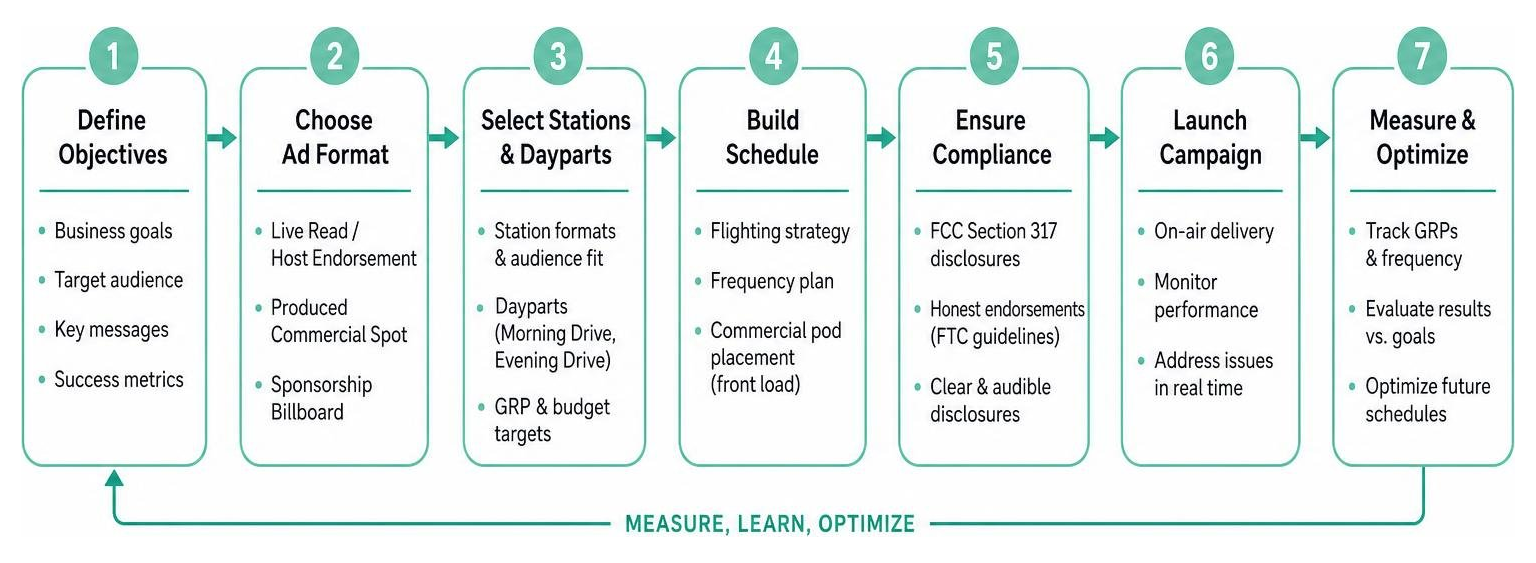
Because 92% of listeners stay tuned during commercial breaks, placing spots near the front of a commercial pod maximizes impact. Learn more about media execution in our Step by Step Guide to Media Buying Services.
Creative Storytelling and Cross-Channel Amplification
Audio advertising creates vivid visual imagery in the listener’s mind—a concept famous voice actor Stan Freberg demonstrated when he used elaborate radio sound effects to depict a 10-ton cherry dropped into a mountain of whipped cream.

Establishing dynamic audio branding—including jingles, distinct voice tones, and crossmodal soundscapes—evokes immediate mood improvement and personal connection. Read our analysis on The Power of Radio in 2025 to see how sonic identities elevate brand positioning.
Creative Storytelling Strategies for a Radio Advertising Campaign
Effective audio creative avoids dry product features, focusing instead on compelling narrative storytelling, humor, and emotional relevance.
- Unorthodox Ad Copy & Narrative Humor: Unconventional, humorous scripts disrupt standard listening patterns and build memorable brand recall.
- Ad Unit Length Balance: Use 60-second spots for complex storytelling and brand introduction, and 30-second units for high-frequency promotional messaging.
- Out-of-Sync Spot Rotation: Rotating three distinct commercial variations in an out-of-sync schedule (e.g., A/B, C/A, B/C) across morning and afternoon drive times keeps creative fresh for daily commuters.
A prime real-world example is detailed in The Story Behind the Mathews Brothers Radio Campaign, where a regional window manufacturer aired 154 unique commercials over nine years, transforming brand awareness and opening doors for sales reps.
Amplifying Digital Marketing Channels Through Audio
Audio acts as a powerful catalyst for digital marketing channels. Research shows that social media campaigns experience an 83% performance uplift when audiences are exposed to audio ads first. Additionally, broadcast spots drive immediate Google search query spikes, allowing brands to capture warm search intent.
Combining broadcast radio with digital streaming platforms creates broad cross-channel synergy. As demonstrated in a Pure Michigan Pandora Audio Case Study, an integrated streaming campaign delivered 22.9 million impressions (122% of goal) and a +7.2 point lift in overall brand awareness by blending color-themed soundscapes with targeted visual takeovers.
Cutting Through the Noise with Innovative Audio Tactics
To stand out in competitive markets, forward-thinking advertisers leverage cutting-edge tactics:
- AI Audio Generation: Modern generative tools allow rapid drafting of script variations, original background compositions, and vocal tracks to scale creative output efficiently.
- Pop-Up Station Spectrum Leasing: Brands can temporarily lease audio spectrum or launch custom branded streaming stations to host themed music and custom host banter.
- Station Frequency Rebranding: Temporarily integrating station frequencies into brand milestones—such as altering a 98.3 FM identifier to celebrate a 30th corporate anniversary—creates interactive media moments.
- Prime-Time Audio Roadblocks: Buying exclusive airtime across top regional stations during simultaneous morning or evening drive-time windows ensures total market saturation.
Measuring Campaign Effectiveness and True ROI
Measuring broadcast performance has evolved far beyond manual estimation. Modern attribution platforms correlate exact radio spot airtimes with near-real-time website traffic surges, phone call volumes, and digital sales conversions.
By linking spot logs directly with digital analytics dashboards, we determine exactly which stations, dayparts, and creative executions generate response, allowing real-time optimization. For a detailed roadmap on media measurement, see Your Blueprint for Success Crafting a Winning Media Buying Strategy.
Measuring the ROI of Your Radio Advertising Campaign
Evaluating campaign success requires tracking both media metrics and performance KPIs:
- Cost Per Thousand (CPM): The cost required to deliver 1,000 listener impressions.
- Cost Per Point (CPP): The cost to deliver one rating point within a specific demographic market.
- Gross Rating Points (GRPs): The total audience volume calculated by multiplying reach percentage by exposure frequency.
- Near-Real-Time Web Lift Attribution: Measuring immediate digital traffic spikes following spot airtimes to establish direct response ROI.
Frequently Asked Questions About Radio Advertising
What is the most effective ad length for a radio advertising campaign?
The ideal ad length depends on your strategic objective. A 60-second commercial provides the depth required for complex storytelling, brand launches, and emotional narratives. Conversely, a 30-second spot offers higher cost-efficiency, allowing businesses to buy greater ad frequency to reinforce brand awareness and promotional offers.
How does radio advertising boost search and social media performance?
Radio acts as a top-of-funnel discovery engine. When listeners hear an engaging radio spot, it prompts immediate online search behavior on mobile devices, causing noticeable spikes in branded Google search queries. Furthermore, social media ad campaigns achieve an 83% performance uplift when users are exposed to the brand via audio beforehand.
How do local businesses track traffic generated from radio ads?
Local businesses can track radio response through several proven methods:
- Vanity URLs & Custom Landing Pages: Using memorable, specific web domain names mentioned exclusively in the ad.
- Dedicated Promo Codes: Offering radio-exclusive discount codes at checkout.
- Broadcast Attribution Software: Utilizing AI tools to correlate exact spot airtimes with real-time website traffic spikes and inbound phone calls.
Conclusion
A well-executed radio advertising campaign remains one of the most reliable strategies for local and regional businesses to achieve rapid growth, build trust, and drive measurable traffic. By combining strategic media planning, creative storytelling, DJ endorsements, and modern cross-channel tracking, audio media consistently delivers high ROI.
At McGuinness Media & Marketing, we provide complete, end-to-end media strategy—from creative copywriting and voice production to negotiation, buying, and broadcast attribution tracking across Rhode Island and beyond. Ready to elevate your audio strategy and accelerate growth? Connect with us today through our Services Media Planning hub to build your next high-performing campaign.