
Ready to Invest? Your Guide to Google Ads Management Pricing
What Does Google Ads Management Actually Cost?
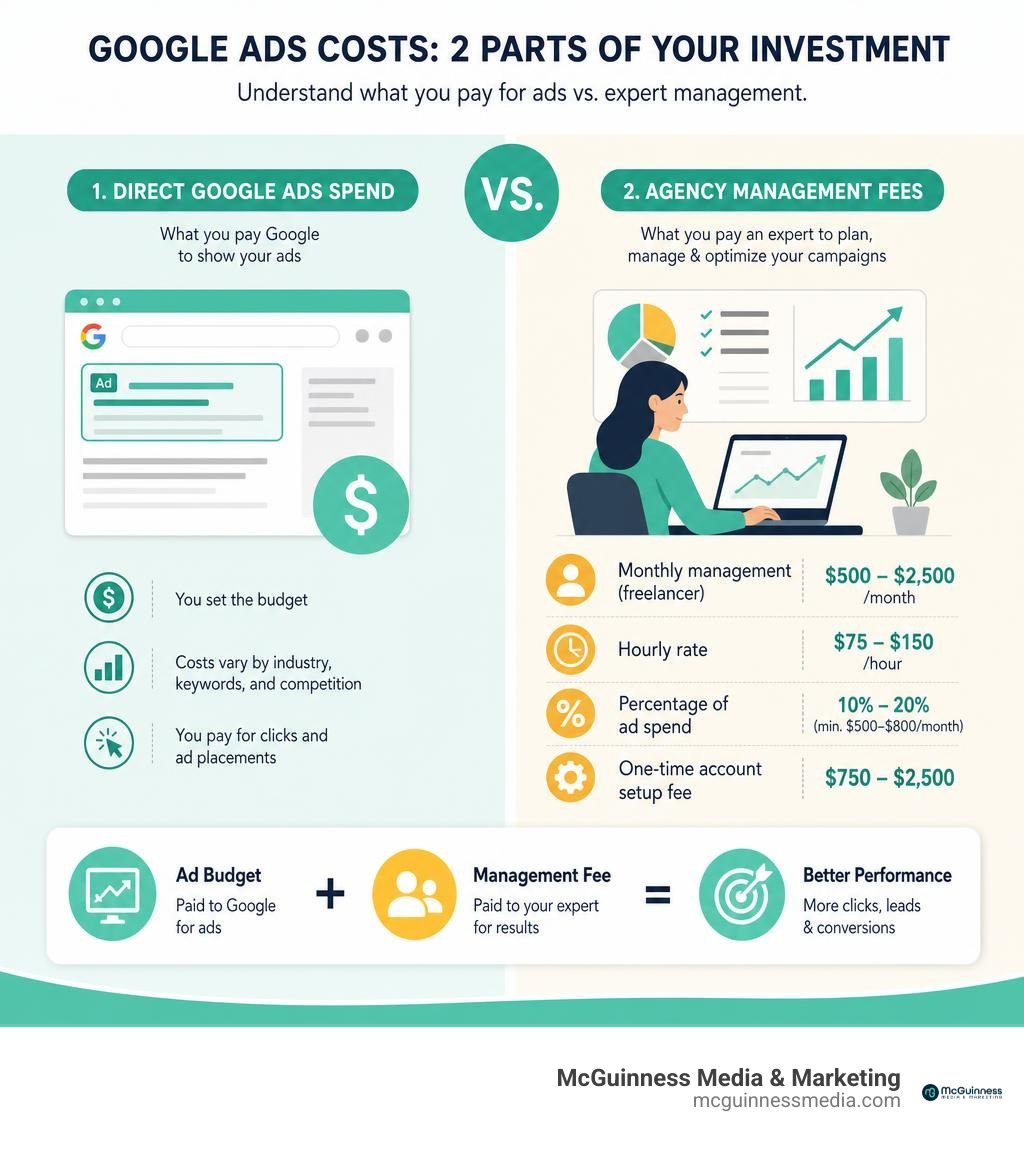
Google Ads management pricing typically falls into these ranges:
| Service Type | Typical Cost |
|---|---|
| Monthly management (freelancer) | $500 – $2,500/month |
| Hourly rate | $75 – $150/hour |
| Percentage of ad spend | 10% – 20% (minimum $500–$800/month) |
| One-time account setup fee | $750 – $2,500 |
Two separate costs are always involved: what you pay Google for your ads, and what you pay a specialist or agency to manage them. Confusing the two is one of the most common mistakes business owners make when budgeting for paid search.
The right management fee depends on your monthly ad spend, campaign complexity, and who you hire. A local business spending $2,000/month on ads might pay $600/month in management fees. An e-commerce brand spending $15,000/month might pay $2,000/month. Neither number is arbitrary — both reflect the real labor and expertise required to run campaigns that actually perform.
I’m Megan McGuinness, owner of McGuinness Media & Marketing, and with over 20 years of experience developing media strategies for regional, national, and global brands, I’ve helped clients across retail, finance, hospitality, and more navigate Google Ads management pricing to make confident, informed investment decisions. In the sections below, I’ll walk you through every cost factor — from pricing models to setup fees to what should and shouldn’t be included in your retainer.
Demystifying Google Ads Management Pricing Models
When you start evaluating agencies or freelancers to handle your pay-per-click (PPC) advertising, you will quickly realize that no two rate sheets look identical. The digital marketing industry utilizes several distinct fee structures to bill for campaign oversight. Understanding these models empowers you to choose an agreement that aligns with your financial goals and operational expectations.
To understand how management fees fit into broader advertising strategies, you can explore our Step-by-Step Guide to Media Buying Services.
Percentage of Spend vs. Flat Rate Google Ads Management Pricing
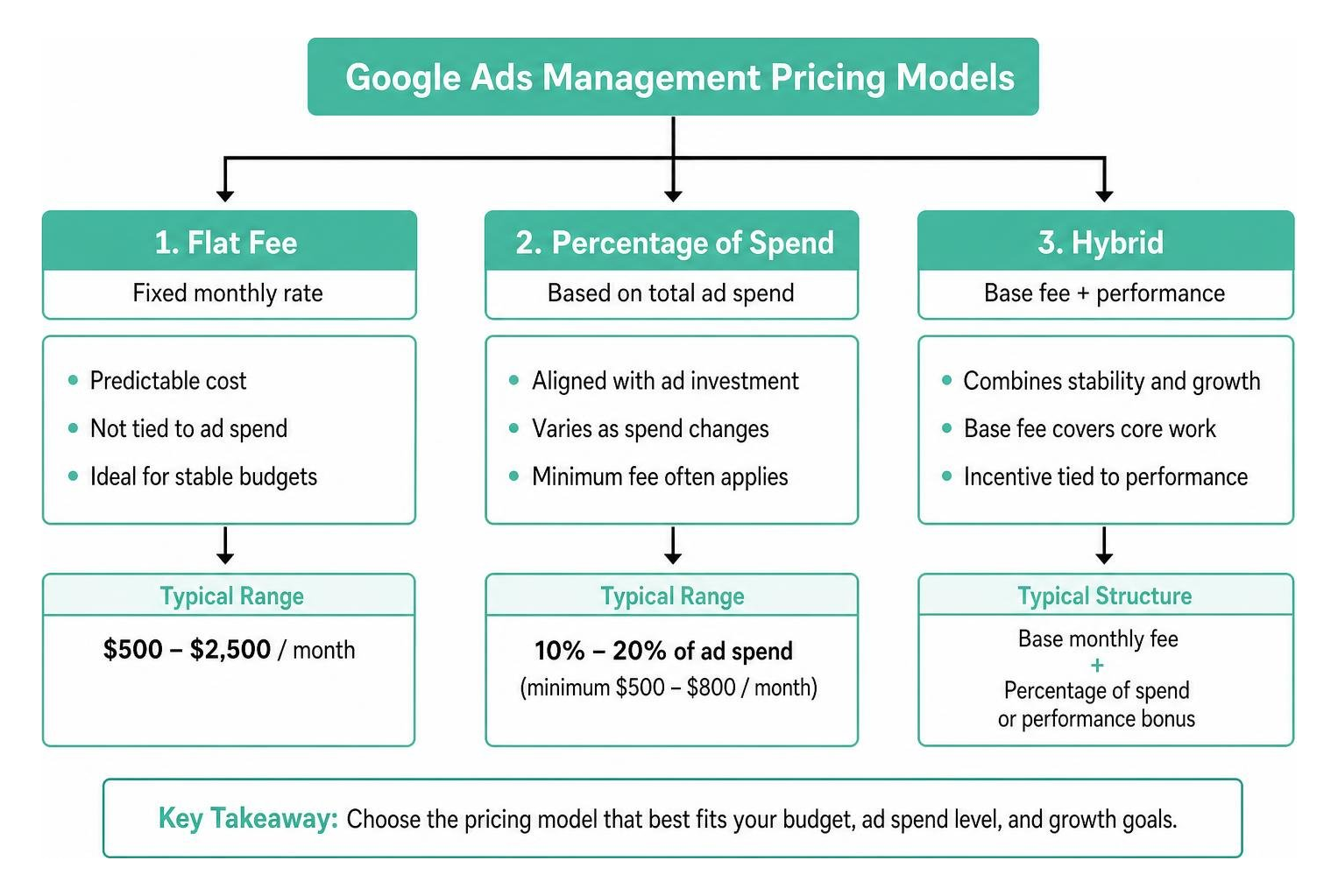
The percentage of ad spend model is traditionally the most common pricing structure used by agencies. Under this model, the management fee is calculated as a direct percentage — usually between 10% and 20% — of your total monthly ad budget paid to Google. For example, if your monthly ad budget is $20,000 and your agency charges a 15% management fee, your fee would be $3,000 for that month.
While this structure aligns agency compensation with campaign growth, it presents a challenge for smaller accounts. If a business spends $2,000 per month, a 10% fee yields only $200. Because properly optimizing a campaign requires a foundational time investment regardless of budget size, most specialists enforce a minimum monthly fee of $500 to $800. This fee floor ensures the specialist can dedicate adequate time to your account without working at a loss.
Conversely, a flat-rate pricing model sets a predictable monthly retainer regardless of minor spend fluctuations. A client pays a set fee — say $1,000 per month — to manage campaigns within an agreed spend tier (such as $2,000 to $5,000 in monthly ad spend). Flat fees offer budget stability for small businesses, preventing unexpected management costs when ad spending scales during peak seasonal periods.
Many modern agencies utilize a hybrid pricing structure: a flat monthly fee covering baseline ad spend, combined with a lower percentage charge (such as 10%) on any spend that exceeds an agreed threshold. This balances income stability for the manager with scalability for the business.
Hourly Rates and Performance-Based Pricing Models
Some businesses prefer paying strictly for time worked. Freelance Google Ads specialists typically charge hourly rates ranging from $75 to $150 per hour. Dedicated ongoing account management generally requires between 5 and 15 active labor hours per month, depending on campaign count, bid strategy complexity, and reporting requirements. Pay-per-hour structures work well for short-term account audits or consultative troubleshooting, but they can create billing unpredictability for standard monthly maintenance.
Performance-based pricing is another alternative where management fees are directly linked to specific business outcomes, such as cost-per-acquisition (CPA), qualified leads generated, or Return on Ad Spend (ROAS). While appealing on paper because it shares risk between client and agency, performance models require strict tracking attribution, long historical data baselines, and clear contractual definitions of what constitutes a “qualified lead.” As a result, pure performance models are less common for early-stage accounts.
How Much Does Google Ads Management Cost in 2026?
In 2026, google ads management pricing reflects standard industry benchmarks across various account sizes and campaign structures. The table below outlines typical monthly retainers and fee structures based on monthly ad spend levels:
| Business Profile | Monthly Ad Spend | Pricing Model | Typical Monthly Management Fee | Effective Management % |
|---|---|---|---|---|
| Local Service Provider | $2,000 | Flat Monthly Minimum | $600 | 30% |
| Mid-Sized Regional Business | $5,000 | Flat / Hybrid Model | $800 – $1,000 | 16% – 20% |
| Growing E-Commerce Brand | $15,000 | Tiered Spend % | $2,000 | 13.3% |
| Scaled Enterprise Account | $50,000+ | Sliding Scale % | $5,000 – $7,500 | 10% – 15% |
How Small Business Budgets Affect Google Ads Management Pricing
For small businesses running hyper-local campaigns with modest budgets around $2,000 per month, management fees often represent a higher percentage of total ad spend. A $600 monthly management fee on a $2,000 budget means 30% of total outbound marketing funds go toward strategy and execution, while 70% goes directly to Google.
While a 30% ratio might initially seem high, it reflects the fixed minimum hours required to perform negative keyword management, ad copy A/B testing, search term reviews, and bid optimization. Without this manual oversight, unoptimized automated campaigns can quickly waste thousands of dollars on irrelevant clicks. You can read more about balancing local campaign budgets in our guide on Lessons in Managing Local Ad Spend.
Account Setup Fees vs. Recurring Retainers
Setting up a brand-new Google Ads account — or completely restructuring a legacy account that suffers from historical misconfigurations — demands substantial initial labor. Designing campaign architecture, performing exhaustive keyword research, drafting compelling ad copy, configuring conversion actions, setting up negative keyword lists, and linking Google Analytics typically requires 10 to 20 hours of concentrated work.
For this reason, professional specialists charge a one-time setup fee ranging from $750 to $2,500 separate from recurring monthly retainers.
To illustrate how setup fees and ongoing retainers interact over time, consider a typical engagement for a growing B2B SaaS company:
- Initial Onboarding & Setup: $2,000 (one-time fee covering account architecture and advanced conversion tracking)
- First Month Management: $1,500 (intensive post-launch bid adjustments, landing page pairing, and search term grooming)
- Subsequent Ongoing Retainer: $1,200/month (ongoing optimization and performance maintenance)
Attempting to roll account build costs into a standard monthly fee often leads to rushed account structures or extended contract lock-ins. Charging or paying dedicated setup fees ensures the foundational account work is conducted thoroughly from day one. You can read more detailed rate card analysis at WhatShouldICharge Google Ads Pricing Guide.
Key Factors Influencing Management Fees and Specialist Capacity

Several core operational variables determine where a quote falls within standard pricing spectrums. Understanding these variables prevents surprises during contract discussions.
Specialist Capacity and Account Complexity
The technical depth of your account directly dictates the human labor needed each month. A local plumber running two Search campaigns targeting five surrounding ZIP codes requires far less maintenance than an e-commerce brand running broad Search, Google Shopping, Performance Max (PMax), and Remarketing campaigns with thousands of Product Stock Keeping Units (SKUs).
Specialist capacity is another crucial factor. A single dedicated PPC specialist can effectively manage only 6 to 12 active client accounts at one time before campaign quality begins to decline. Ongoing management requires between 5 and 15 active hours per month per client for data analysis, bid adjustments, creative updates, and strategic reporting. Beware of agencies that overload individual managers with 30 or 40 accounts; under those conditions, account maintenance typically becomes automated and reactive rather than strategic.
Ad Spend Costs Paid to Google vs. Management Fees
A fundamental principle of PPC accounting is maintaining a clear distinction between ** ad spend paid directly to Google** and management fees paid to your agency or specialist.
When setting daily budgets within the Google Ads platform, Google manages day-to-day traffic variations using an automated delivery system. On days with high search intent, Google may spend up to 2 times your average daily budget (known as overdelivery). However, Google caps your total monthly charges so you will never be billed more than your average daily budget multiplied by 30.4 (the average number of days in a month).
It is also important to understand the difference between served cost and billed cost:
- Served Cost: The total value of all clicks or impressions delivered by Google’s ad network.
- Billed Cost: The final amount you are actually charged after Google applies adjustments for invalid traffic or overdelivery credits.
Your management fee pays for professional strategy, keyword refining, and conversion tracking — it does not cover direct click charges from Google. For strategies on maximizing return on direct media spend, view our resource on Maximizing ROI Media Planning Tips for Small Businesses.
What Services Should Be Included in Your Retainer?

Before signing a management proposal, review the proposed scope of work to ensure critical deliverables are explicitly detailed.
Standard monthly PPC retainers should always include:
- Search term auditing and negative keyword expansions
- Ad copy creation, testing, and extensions updates
- Bidding strategy adjustment and device/geographic performance bid tweaks
- Conversion tracking monitoring and troubleshooting
- Budget pacing and channel allocation management
- Custom performance reporting and strategy check-in meetings
For insights into how comprehensive account management streamlines overall operations, review our article on how a Google Ads Manager Streamlines Your Business.
Landing Page Optimization and CRO Add-Ons
A common source of scope creep in Google Ads relationships involves landing page creation and Conversion Rate Optimization (CRO). Driving high-intent traffic to a web page represents only half of the advertising equation; if the landing page lacks clear calls to action, fast loading speeds, or mobile responsiveness, ad spend is wasted.
However, landing page design, A/B page testing, and custom copy creation require specialized web development labor distinct from media management. As a best practice, CRO services should be billed separately rather than bundled indiscriminately into standard ad retainers. Standalone CRO packages typically range from $500 to $1,500 per month for continuous multivariate testing, or $750 to $1,500 as a one-time audit and page design fee.
Conversion Tracking and Custom Performance Reporting
Accurate tracking forms the backbone of profitable advertising. Standard retainers must include complete setup and upkeep of conversion actions via Google Tag Manager and Google Analytics 4 (GA4). Whether tracking form fills, phone call length, dynamic e-commerce purchases, or appointment bookings, your manager must regularly verify that data flows accurately into Google Ads to feed Smart Bidding algorithms.
Reporting should transcend vanity metrics like raw clicks or impression shares. Monthly performance reports ought to detail cost-per-lead (CPL), cost-per-acquisition (CPA), Return on Ad Spend (ROAS), and actionable strategic recommendations for the upcoming billing cycle.
Frequently Asked Questions About Google Ads Management Fees
Should I pay a separate setup fee for a new Google Ads account?
Yes. Building a structured Google Ads account from scratch requires 10 to 20 hours of labor covering keyword research, campaign grouping, ad copywriting, conversion tracking integration, negative keyword list construction, and audience targeting setup. Expect to pay a one-time setup fee between $750 and $2,500.
How does Google Ads overdelivery affect my monthly budget?
Google Ads may spend up to double your daily budget on high-traffic days to capture strong conversion opportunities. However, you will never be billed more than your daily budget multiplied by 30.4 days over a full monthly billing cycle. Any impressions or clicks delivered beyond that threshold are automatically credited back to your account as invalid overdelivery charges.
How many accounts can a Google Ads specialist realistically manage at once?
A dedicated specialist can effectively manage between 6 and 12 client accounts simultaneously. Because active management requires 5 to 15 hours per month per account for search term grooming, creative testing, and strategic adjustments, exceeding 12 accounts per specialist often degrades campaign performance and increases client churn.
Conclusion: Choosing the Right Management Partner for Your Business
Navigating google ads management pricing comes down to recognizing value over raw cost. Choosing the cheapest available option often results in automated set-it-and-forget-it campaigns that waste ad dollars on irrelevant traffic. Conversely, paying a transparent retainer to an experienced team protects your ad spend investment and turns paid search into a predictable revenue generator.
At McGuinness Media & Marketing, based in Warwick, Rhode Island, we take pride in acting as an extension of your business. We craft custom strategic planning, transparent media buying execution, and performance-driven campaign structures designed to deliver clear, measurable growth.
Ready to make your ad spend work harder? Explore our full suite of Services, discover our approach to Digital Marketing, or reach out directly to learn how we can help you scale your business through our dedicated Advertise Company services.