An Essential Guide to AdWords Management
Why AdWords Management Can Make or Break Your Google Ad Spend
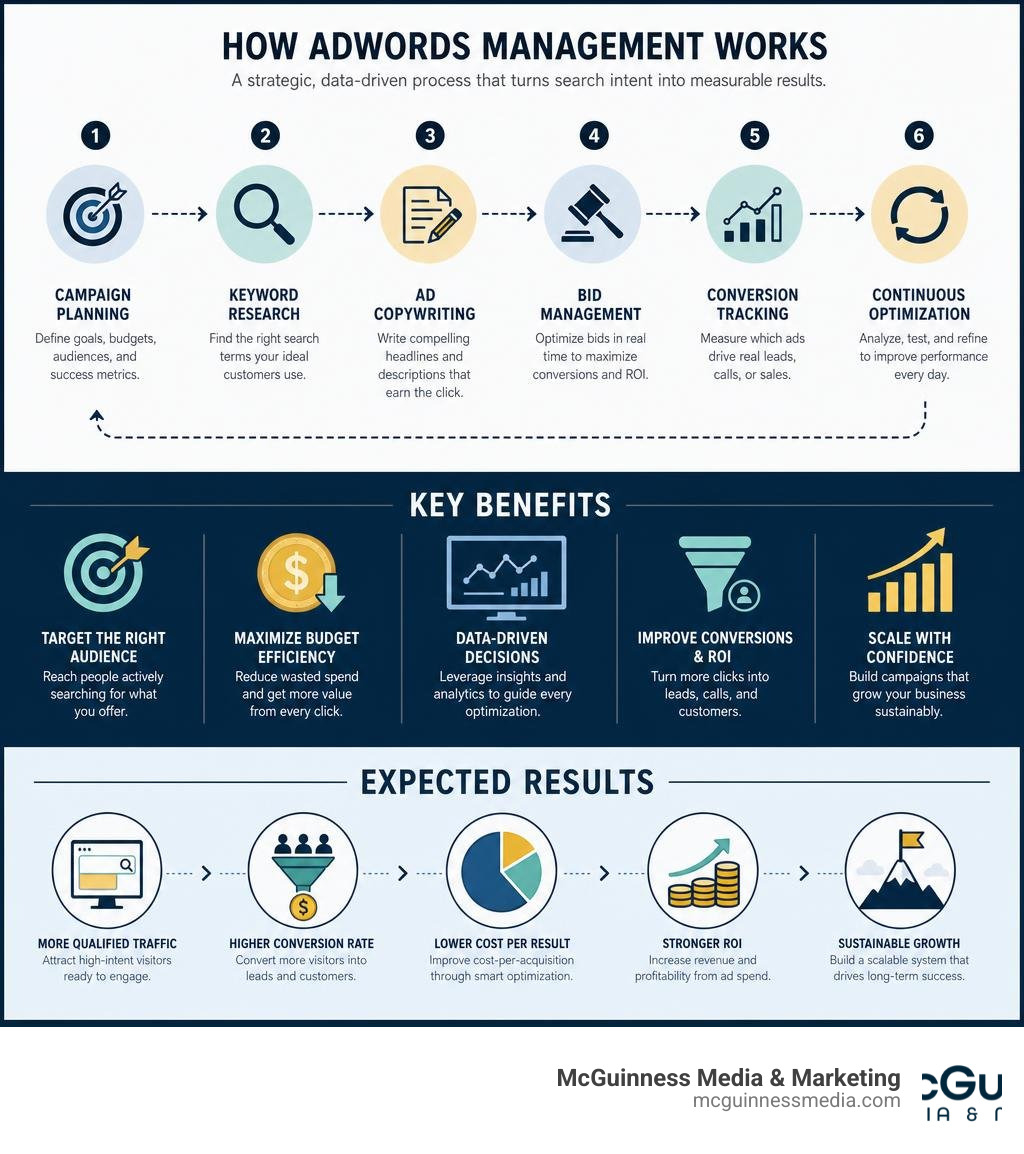
AdWords management is the ongoing process of planning, building, and optimizing paid ad campaigns on Google’s advertising platform to drive measurable business results.
Here’s a quick answer to what it covers:
- Campaign planning — setting goals, budgets, and targeting before a single dollar is spent
- Keyword research — finding the search terms your ideal customers actually use
- Ad copywriting — writing headlines and descriptions that earn the click
- Bid management — adjusting how much you pay per click to maximize ROI
- Conversion tracking — measuring which ads drive real leads, calls, or sales
- Continuous optimization — refining everything above on an ongoing basis
Google Ads is not a set-it-and-forget-it channel. Over 80% of search results now include paid ad placements, and those ads can occupy as much as 85% of the visible screen before a user even scrolls. If your campaigns aren’t actively managed, you’re handing that real estate — and your budget — to competitors.
The stakes are high. Businesses without expert management typically waste 25–40% of their ad budget on irrelevant clicks and poor targeting. On the flip side, well-managed campaigns using machine learning-driven bid strategies can improve cost-per-acquisition by 15–25% compared to manual approaches.
I’m Megan McGuinness, owner and CMO of McGuinness Media & Marketing, and with over 20 years of experience helping regional, national, and global brands grow through strategic digital marketing, I’ve seen how effective adwords management separates businesses that scale from those that simply burn budget. In the sections below, I’ll walk you through everything you need to know — from choosing the right tools and agency to the advanced strategies that actually move the needle.
What is AdWords Management and Why Does It Matter?
At its core, professional adwords management is the art and science of running pay-per-click (PPC) campaigns that turn search intent into profitable revenue. It is far more than just picking a few keywords and setting a daily budget. True management requires a continuous loop of campaign planning, keyword research, ad copywriting, conversion tracking, and budget pacing.
Many business owners try to handle their own ads, only to see their budgets vanish into thin air. This happens because Google Ads operates on a highly competitive, real-time auction system. Without strategic guardrails, you can easily pay for clicks from people who have zero intention of buying your product or service. For additional context on how Google determines which ads appear and in what order, see Google’s official explanation of the Google Ads auction.
To understand why this matters, look at how search engine results pages (SERPs) have evolved by July 2026. Over 80% of search results now contain Google Ads ad placements, and on mobile screens, those placements can cover as much as 85% of the space above the fold. Furthermore, 84% of mobile clicks go to the first-positioned ads. If you are relying solely on organic SEO, you are essentially invisible to a massive portion of your market.
By utilizing structured campaign management, you ensure that every dollar you spend is mathematically optimized to find high-intent buyers. For a deeper dive into how Google’s system works, read our guide on how to Unlock Growth: How Google Ads Manager Streamlines Your Business (note: link text matches the requested internal page Unlock Growth: How Google Ads Manager Streamlines Your Business).
The Core Benefits of Professional Google Ads Management
Why should you partner with experts rather than managing campaigns in-house? The answer lies in time, expertise, and efficiency.
First, let’s talk about time. The average advertiser saves 8 to 12 hours per week using dedicated adwords management software and professional oversight compared to manual campaign management. That is half a day of work you can reinvest back into running your business, training your team, or serving your clients.
Second, professional management directly impacts your bottom line. An experienced team knows how to read a campaign dashboard to improve your conversion rate, lower your cost per lead (CPL), and maximize your return on ad spend (ROAS).

Consider these industry realities:
- 96% of website visitors leave a site without converting. Professional managers don’t just write off those lost opportunities; they build sophisticated remarketing campaigns to bring them back.
- Returning site visitors convert at a rate 2X higher than new site visitors. By focusing on these warm audiences, we can dramatically lower your customer acquisition costs.
- Strategic alignment prevents waste. A standard audit of a self-managed Google Ads account typically reveals that 30% to 50% of the budget is being completely wasted on irrelevant search terms.
For companies looking to dominate their local markets, integrating paid search with professional SEO and web marketing is the fastest way to capture both immediate high-intent searchers and build long-term organic authority.
Key Features of High-Performing AdWords Management Software
As we navigate 2026, the technology behind PPC has shifted rapidly from manual rule-based adjustments to sophisticated artificial intelligence. High-performing adwords management software must leverage these modern capabilities to keep your campaigns competitive.
When evaluating tools or agencies, look for these five critical features:
- Automated Bidding: Gone are the days of manually adjusting bids keyword-by-keyword. Modern platforms use machine learning-driven bid management to analyze hundreds of contextual signals in real time, typically improving CPA by 15-25% compared to manual optimization.
- Performance Anomaly Detection: Your software should monitor your campaigns 24/7. If a tracking pixel breaks, a landing page goes down, or there is an unusual spike in cost-per-click, early anomaly detection flags the issue within hours, preventing 10-20% of wasted ad spend.
- Dynamic Budget Reallocation: Instead of locking your budget into rigid campaigns, smart software dynamically shifts funds to the highest-performing ad groups in real time. This dynamic reallocation typically increases overall ROAS by 20-30% without changing your total monthly spend.
- Automated Negative Keyword Discovery: The software should constantly scan search term reports to identify non-converting, irrelevant queries and automatically add them to your negative keyword lists.
- Quality Score Tracking: A high Quality Score is the holy grail of Google Ads because it directly lowers your costs. Your management platform must track and provide actionable recommendations to improve your ad relevance, landing page experience, and expected click-through rate (CTR).
Essential Tools for Modern AdWords Management
To win in the modern digital landscape, your marketing stack needs to be powered by machine learning. Tools that specialize in automated bid management, budget optimization, negative keyword discovery, and multi-platform reporting are no longer optional.
Currently, 73% of Google Ads agencies use at least one external management platform to streamline their workflows and uncover deeper insights. These third-party tools integrate directly with Google’s API, allowing us to build custom dashboards, run complex cross-campaign projections, and keep a relentless eye on your ROI.
How to Choose the Right AdWords Management Agency or Software
Choosing how to manage your Google Ads is a major strategic decision. Should you buy a subscription to a software platform and do it yourself, or should you partner with a specialized agency?
The right choice depends heavily on your budget, internal resources, and campaign scale. For businesses with a monthly spend under $5,000, starting with free native tools or basic software tiers may make sense. However, once your monthly ad spend crosses the $10,000 threshold, the time savings and performance gains of professional agency management typically justify the cost within 30 to 60 days.
Common mistakes when selecting an adwords management partner or tool include:
- Choosing on price alone: Cheap software or bargain-bin agencies often use outdated, broad-match strategies that end up costing you thousands in wasted ad spend.
- Overlooking integrations: Ensure your management solution seamlessly integrates with your CRM, Google Analytics 4 (GA4), and Google Tag Manager.
- Ignoring landing pages: Running great ads to a poor, unoptimized homepage is a recipe for failure. Your partner must understand the complete funnel, from the first click to the closed deal.
Selecting the Best AdWords Management Partner
To help you decide which path is right for your Rhode Island business, we’ve broken down the key differences between agency management and software-only solutions:
| Feature | Professional Agency Management | Software-Only Solutions |
|---|---|---|
| Strategic Oversight | Full strategic planning, competitor audits, and funnel optimization | You must define the strategy and interpret the data yourself |
| Time Commitment | Near zero; the agency handles the heavy lifting | 5 to 10 hours per week of manual tool management |
| Creative Development | Custom ad copy, asset creation, and landing page design | Limited templates; you must write your own copy |
| Technical Setup | GTM, GA4, call tracking, and CRM integration handled | You must configure your own tracking scripts |
| Ideal For | Businesses scaling revenue and requiring expert ROI-driven growth | Tech-savvy marketers with small budgets and spare time |
Whether you decide to work with local specialists or seek out a full-service digital marketing agency, choosing a partner that understands your local geographic market is essential.
Advanced Strategies: Quality Score, Remarketing, and Scaling
Once your foundational campaigns are running smoothly, it is time to deploy advanced tactics that maximize your efficiency and help you scale.
To see how local businesses navigate these strategies in the real world, check out our insights on Lessons in Managing Local Ad Spend.
Optimizing Quality Score to Reduce Cost-Per-Click
Many advertisers believe that the only way to get to the top of Google is to bid more money. Fortunately, that isn’t true. Google’s auction system relies heavily on Quality Score, a metric rated from 1 to 10 that measures the quality and relevance of your ads.
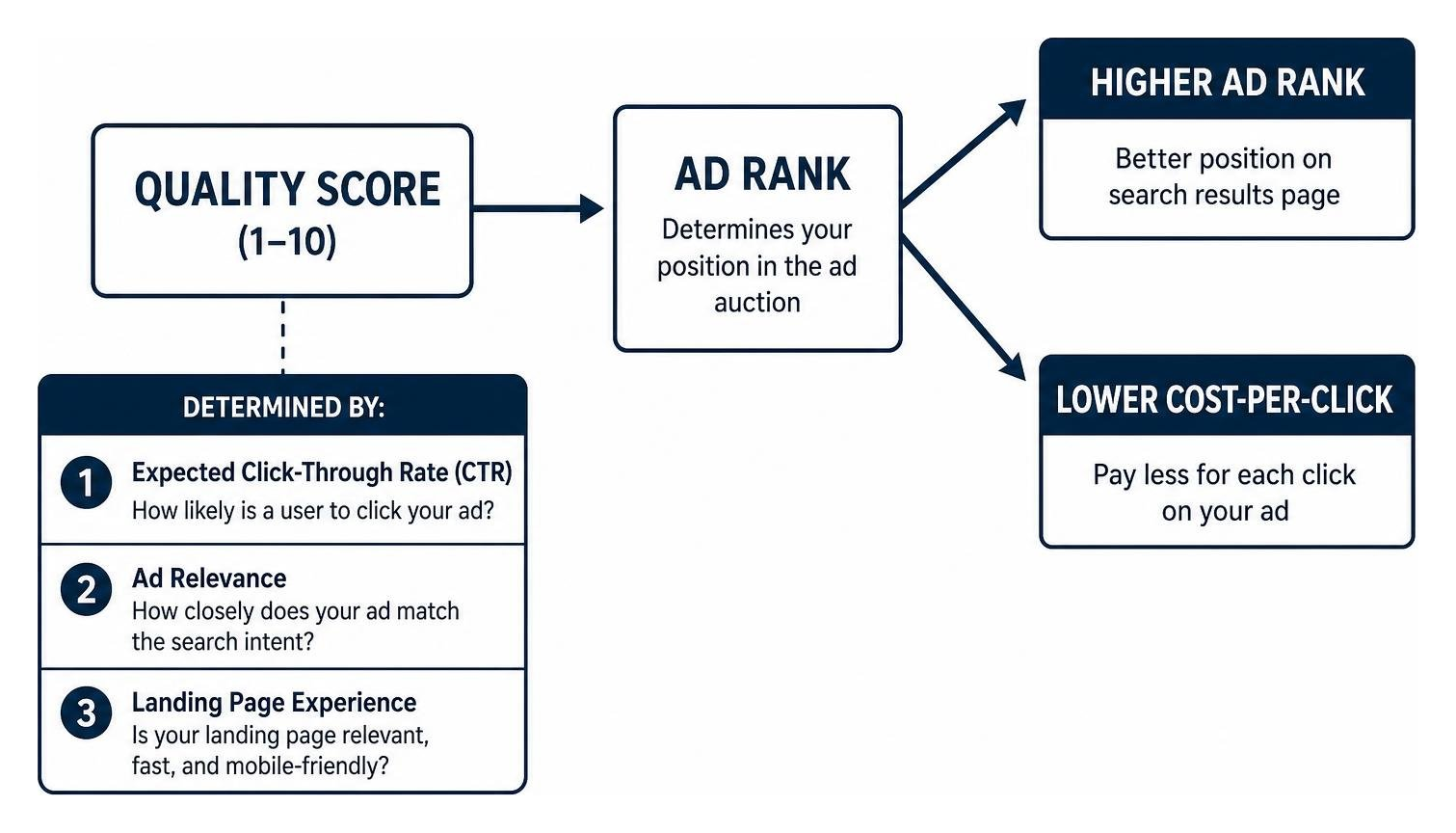
Your Quality Score is determined by three main factors:
- Expected Click-Through Rate (CTR): How likely is a user to click your ad when it is shown?
- Ad Relevance: How closely does your ad copy match the search intent of the user’s query?
- Landing Page Experience: Is your landing page mobile-friendly, fast-loading, and highly relevant to the ad the user clicked?
Why does this matter? Because a systematic Quality Score optimization strategy typically reduces your average cost-per-click (CPC) by 10-15% within 60 days. By writing highly targeted ad copy and directing traffic to dedicated, conversion-focused landing pages (which convert 2x to 5x better than standard homepages), you can leapfrog competitors who are bidding much more than you.
Leveraging Remarketing and Audience Targeting
As we noted earlier, 96% of website visitors leave without converting. If you don’t have a plan to bring them back, you are leaving money on the table.
Remarketing allows you to place a secure tracking tag on your site so you can serve tailored ads to past visitors as they browse the web, watch videos, or search on Google.
- Remarketing Lists for Search Ads (RLSA): This powerhouse feature allows us to customize search campaigns specifically for warm audiences. For example, if a user previously added an item to their cart but abandoned it, we can bid more aggressively or show them a special discount code when they search for your keywords again.
- YouTube and Video Influence: Video is an incredibly persuasive medium. Over 64% of shoppers say that YouTube influences their purchase decisions, and people who see Google video and TV ads have 2X better ad recall than those who see TV ads alone.
Integrating remarketing with your broader Media Planning strategy ensures a consistent, multi-touch brand experience that gently guides prospects down your sales funnel.
Scaling Campaigns Through Continuous A/B Testing
You cannot scale a campaign by setting it on autopilot. To grow your volume without skyrocketing your cost-per-lead, you must commit to continuous A/B split testing.
This means we regularly test:
- Ad Copy Variations: Writing at least 5 different headline and description combinations per ad group to see which psychological triggers drive the highest CTR.
- Smart Bidding Strategies: Testing Target CPA (Cost Per Acquisition) versus Target ROAS based on your campaign’s data maturity.
- Landing Page Elements: Testing different headlines, hero images, and call-to-action buttons to maximize your conversion rates.
For small businesses trying to make a big impact, check out our practical Maximizing ROI: Media Planning Tips for Small Businesses.
Understanding Google Ads Management Costs and Pricing Models
How much does professional adwords management cost? There is no one-size-fits-all answer, as pricing typically aligns with your campaign complexity and total ad spend.
Generally, agencies and software providers use three primary pricing models:
- Flat Monthly Fee: A clean, predictable model where you pay a set fee (e.g., $500 to $1,500/month) to manage your campaigns. This is highly popular for small-to-midsize businesses with stable ad budgets.
- Percentage of Ad Spend: The industry standard for larger accounts, typically charging 10% to 20% of your monthly Google ad budget. This model ensures that as your campaigns grow and require more intensive management, your agency’s resources scale with you.
- Setup Fees: A one-time fee to cover the initial competitive research, account structuring, tracking pixel installation, and landing page design.
To understand how these costs fit into your overall marketing budget, take a look at our Step-by-Step Guide to Media Buying Services.
Frequently Asked Questions About AdWords Management
How long does it take to see results from professional AdWords management?
While your ads can go live and start driving traffic within 24 hours of campaign launch, true optimization takes time. We advise businesses to commit to a 60-to-90-day window. The first 30 days are dedicated to gathering clean performance data, identifying winning keywords, and weeding out wasted spend. By days 60 to 90, we have enough statistical significance to implement smart bidding and scale your winners.
What is the difference between Google Ads and Performance Max campaigns?
Traditional Google Ads campaigns allow you to target specific channels individually, such as Search, Display, or YouTube. Performance Max (PMax) is an AI-driven, all-in-one campaign type that unifies Google’s entire inventory. PMax leverages machine learning to dynamically serve your ads across Search, YouTube, Display, Gmail, Discover, and Maps simultaneously based on your conversion goals.
Why is conversion tracking mandatory before launching campaigns?
Launching a PPC campaign without conversion tracking is like driving with your eyes closed. Before spending a single dollar on ads, we must set up robust conversion tracking using Google Analytics 4 (GA4) and Google Tag Manager (GTM). This allows us to attribute every phone call, form fill, or purchase back to the exact keyword and ad that generated it, ensuring we only scale what actually drives revenue.
For businesses looking for comprehensive digital support in Rhode Island, collaborating with an experienced local agency can help ensure your tracking infrastructure is flawlessly integrated across your entire web presence.
Conclusion
Mastering adwords management is one of the fastest, most reliable ways to scale your business, capture high-intent buyers, and outpace your competition. However, navigating the rapidly evolving landscape of AI-driven bidding, Quality Score optimization, and advanced audience remarketing requires dedicated expertise and constant vigilance.
At McGuinness Media & Marketing, we pride ourselves on being the premier creative and strategic marketing agency in Rhode Island. From our headquarters in Warwick, RI, we build highly targeted, transparent, and performance-driven Google Ads campaigns designed to grow your sales — not just your clicks.
Ready to stop wasting your ad spend and start scaling your revenue? Explore our comprehensive Digital Marketing services and Contact our team today for a custom campaign audit.