
A-Z Guide to Video & Photography
Why Video and Photography Matter for Your Brand in 2026
Video and photography are the two most powerful visual tools available to modern brands — and knowing how to use them together can be the difference between blending in and standing out.
Quick answer: What’s the difference between video and photography?
| Photography | Video | |
|---|---|---|
| Output | Still images | Moving footage with audio |
| Best for | Moments, products, portraits | Stories, events, tutorials, ads |
| Key skill | Composition, timing | Pacing, continuity, sound |
| Editing time | Minutes to hours | Hours to days |
| File size | Small | Large |
| Audience engagement | High for browsing | Higher for emotional impact |
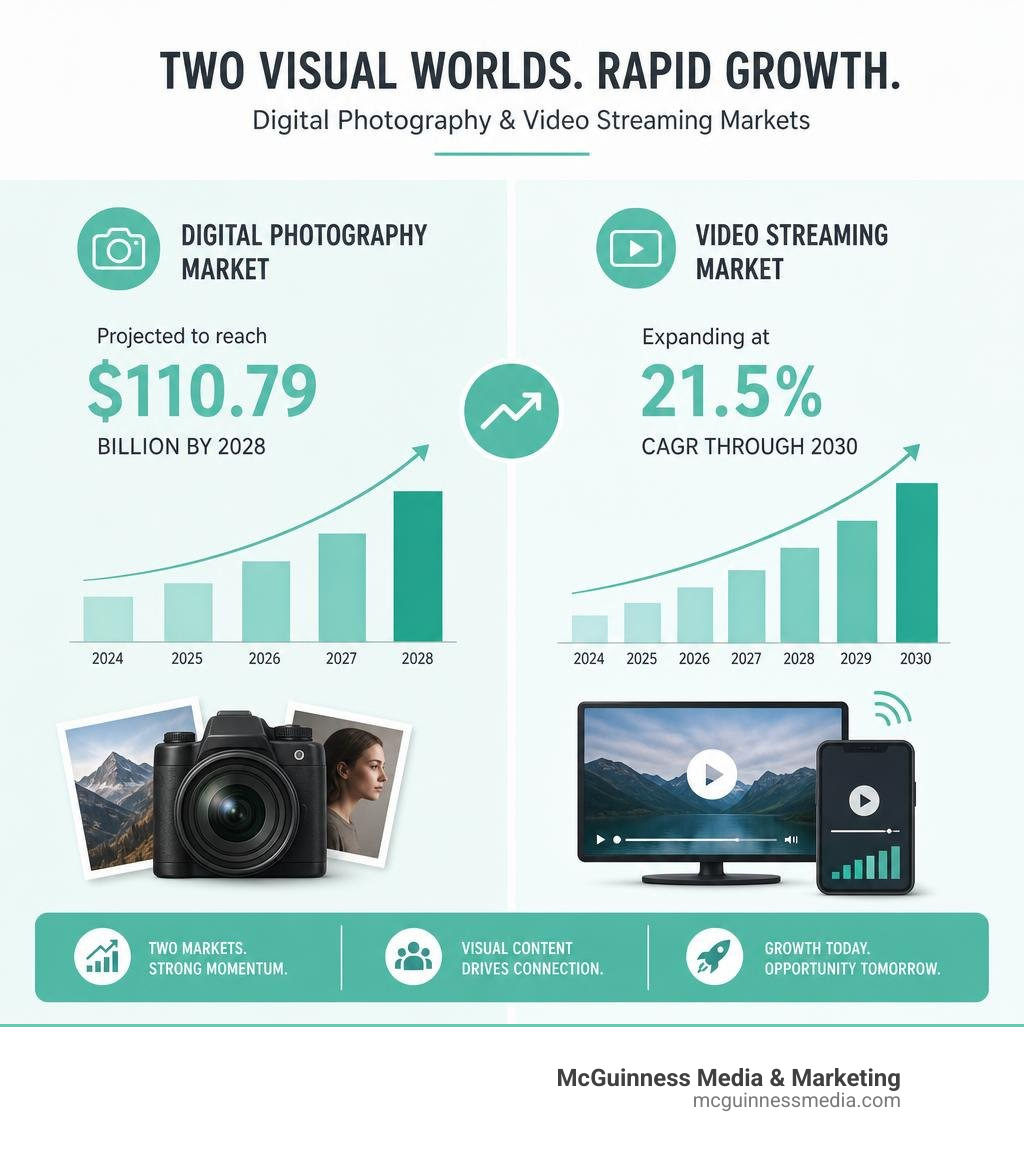
Both disciplines are growing fast. The global digital photography market is projected to reach $110.79 billion by 2028. Meanwhile, the video streaming market is expanding at a 21.5% CAGR through 2030. Brands that understand both — and use them strategically — have a clear competitive edge.
This guide covers everything: equipment, workflow, hybrid shooting, post-production, and career opportunities. Whether you’re a solo creator, a business owner, or a marketing professional, you’ll leave with a clear picture of how to make video and photography work harder for your goals.
I’m Megan McGuinness, owner of McGuinness Media & Marketing, and with over 20 years of experience building marketing strategies for regional and national brands, I’ve seen how the smart use of video and photography can transform how a business connects with its audience. In this guide, I’ll walk you through everything you need to know — from gear and workflow to post-production and business strategy.
The Technical Differences in video and photography
While both mediums rely on the fundamental physics of light, optics, and exposure, their technical execution could not be more different. Understanding these differences is crucial for anyone trying to master both.
| Technical Element | Still Photography | Videography |
|---|---|---|
| Primary Exposure Control | Shutter speed (variable to freeze/blur motion) | Frame rate & shutter angle (180-degree rule) |
| Focus Requirements | Single-point, instantaneous locking | Continuous, smooth tracking, and manual pulling |
| Aperture Usage | Often wide open for shallow depth of field | Frequently stepped down slightly to keep motion in focus |
| Data Rates | Low to moderate (individual RAW files) | Extremely high (continuous megabits/gigabits per second) |
| Audio Capture | Non-existent | Critical (often requiring external recording systems) |
In still photography, your primary goal is to capture a single, perfect slice of time. You have complete freedom over your shutter speed. If you are shooting a fast-moving subject, you can crank your shutter speed up to 1/4000s without a second thought.
In videography, however, you are bound by the 180-degree shutter rule. To maintain natural-looking motion blur that the human eye expects, your shutter speed must always be double your frame rate. If you are shooting cinematic footage at 24 frames per second (fps), your shutter speed must remain locked at 1/50s. If you jump up to 60 fps for smooth slow-motion, your shutter speed must be 1/120s. This limitation means videographers must rely heavily on Neutral Density (ND) filters to control exposure in bright conditions, whereas photographers can simply increase their shutter speed.
To learn more about how we apply these technical principles to real-world campaigns, check out our comprehensive creative Services.
Creative Approaches in Still Photography
Still photography is the art of subtraction. Because you are limited to a single frame, you must remove all distractions to focus the viewer’s eye on the “decisive moment.”
- Composition & Framing: Photographers use rules of thirds, leading lines, and negative space to guide the viewer through a static image.
- Lighting: Lighting in photography can be highly controlled and dramatic. A single flash of a strobe can freeze motion and paint a scene in a microsecond, allowing for creative lighting setups that would be impossible to maintain continuously for video.
- Depth of Field: Using wide apertures (like f/1.2 or f/1.4) allows photographers to isolate subjects completely from their backgrounds, creating a painterly aesthetic that immediately tells the viewer where to look.
Creative Approaches in Videography
Videography is the art of addition and continuity. Instead of a single moment, you are managing a sequence of moments that must flow logically from one to the next.
- Motion & Camera Movement: While a photographer stands still to avoid camera shake, a videographer embraces controlled movement. Pans, tilts, tracking shots, and crane movements are used to reveal information and build tension.
- Continuity & Pacing: A videographer must constantly think about how the current shot will cut together with the next. This requires careful attention to screen direction, lighting consistency, and narrative pacing.
- Storyboarding: Because video is a time-based medium, successful productions rarely happen by accident. Storyboarding and pre-visualizing the entire narrative arc are essential steps to ensure that the final edit tells a cohesive, engaging story.
The Rise of Mirrorless Systems and Hybrid Camera Technology
The line dividing video and photography has officially dissolved, thanks to the rapid evolution of mirrorless camera systems. Gone are the days when you needed to carry a heavy DSLR body for photos and a massive shoulder-mounted camcorder for video.

Today’s mirrorless cameras are true hybrid powerhouses. By removing the physical mirror mechanism of older DSLRs, manufacturers have been able to design compact bodies with ultra-fast sensor readouts, incredible electronic viewfinders (EVFs), and unmatched autofocus capabilities.
High-resolution video is no longer a luxury reserved for Hollywood sets. Standard consumer and prosumer cameras now routinely capture stunning 4K, 6K, and even 8K video. This massive resolution isn’t just about looking sharp on an 85-inch television; it gives creators the flexibility to crop, reframe, and stabilize their footage in post-production without losing precious detail.
One of the most exciting developments in modern hybrid shooting is Open Gate recording. Traditional cameras crop the sensor to a 16:9 widescreen ratio when recording video. Open Gate uses the entire physical area of the sensor (usually 3:2 or 4:3). This allows creators to deliver a widescreen 16:9 video for YouTube and a vertical 9:16 video for TikTok or Instagram Reels from the exact same clip, saving hours of reframing headaches in the editing room.
Flagship cameras like the Nikon Z 8 Camera | Compact Full Frame Hybrid Camera offer internal 12-bit RAW video recording alongside 45.7-megapixel still capture, making it a dream machine for professionals who refuse to compromise on either medium. Similarly, the Z6III Full-frame Mirrorless Camera with DCI-P3 EVF | Nikon introduces the world’s first partially stacked CMOS sensor in its class, offering lightning-fast readout speeds that virtually eliminate rolling shutter distortion—a massive win for high-speed action and panning video shots.
Essential Camera Features for video and photography Work
If you are looking to invest in a hybrid camera system that excels at both stills and motion, there are several non-negotiable features you must look for:
- Advanced Autofocus & Subject Tracking: Modern systems use AI-driven deep learning to identify and lock onto human eyes, animals, and vehicles. This is crucial for maintaining sharp focus when jumping between photo bursts and continuous video tracking.
- In-Body Image Stabilization (IBIS): A sensor that physically moves to counteract hand shake is a game-changer. It allows photographers to shoot at slower shutter speeds without a tripod and helps videographers capture smooth, organic handheld footage.
- Robust Recording Formats & Codecs: Look for cameras that offer 10-bit 4:2:2 internal recording and Log profiles (like C-Log or N-Log). These formats preserve maximum dynamic range, giving you the latitude you need to match the colors of your photos and videos in post-production.
For creators looking for a highly capable, video-first hybrid body, the Canon EOS R6 V Camera – Canon Europe (also available via Canon EOS R6 V Camera – Canon UK ) stands out. Boasting up to 7.5 stops of image stabilization, 7K oversampled RAW video, and 40fps continuous still shooting, it perfectly bridges the gap between high-end commercial production and solo content creation.
Secondary Cameras: Action Cams, Vlogging Cams, and Smartphones
While professional mirrorless bodies form the backbone of any serious production, secondary cameras play an increasingly important role in modern workflows.
- Action Cameras: Tiny, rugged, and waterproof, action cams can be mounted in places a primary camera could never go. They are perfect for capturing wide-angle safety shots, unique perspectives, or emergency backup footage during live events.
- Vlogging Cameras: Designed with solo creators in mind, these cameras prioritize lightweight bodies, flip-out screens, and simplified controls. A great example is the compact Canon EOS R50 V Camera – Canon Europe , which packs a 24.2MP APS-C sensor, 4K video, and a vertical tripod socket directly into a travel-friendly body.
- Smartphones: We’ve all heard the saying: “The best camera is the one you have with you.” Today’s smartphones account for over 90% of all photos taken globally. With advanced computational photography, multi-lens arrays, and high-quality 4K video, they are perfect for capturing quick behind-the-scenes (BTS) clips, social media stories, and spontaneous marketing moments.
However, these compact tools do have limitations. Their small sensors struggle in low light, they lack professional audio inputs, and they cannot replicate the organic depth of field and lens selection of a full-frame mirrorless system. They should complement your professional gear, not replace it.
Mastering the Hybrid Workflow in the Field
Capturing beautiful stills and cinematic video on the same shoot is a balancing act that requires meticulous planning. If you try to wing it, you will likely end up with mediocre photos and incomplete video coverage.

The key to hybrid success lies in preparation. Before you even pack your bags, you need to create a dual-purpose shot list. Group your day into distinct blocks: allocate specific windows exclusively for photography, and other blocks solely for video. Trying to switch your brain (and your camera settings) back and forth every 30 seconds is a recipe for creative exhaustion.
For high-end commercial and event projects, partnering with a dedicated production team is often the best path forward. Explore our professional Video & Photography Services to see how we handle these complex workflows seamlessly.
Balancing video and photography at Live Events
Live events, particularly weddings, are the ultimate test of a hybrid creator’s skills. The action moves fast, there are no second takes, and the lighting conditions are constantly changing.
If you are shooting solo, a dual-camera setup is essential. Keep one camera rigged primarily for video (mounted on a monopod or a lightweight gimbal, with an external microphone and an ND filter attached) and a second camera strapped to your harness dedicated entirely to quick still photography.
When covering events in local hubs like Warwick, RI, or across the wider Rhode Island area, vendors often work in tight coordination. Planning ahead and understanding the local venue layout is highly beneficial to ensure seamless execution.
For inspiration on how to manage these demanding environments, creators must focus on anticipation and preparation, ensuring every key moment is captured in both formats without interference.
The Crucial Role of Audio in Video Storytelling
It is a well-known industry secret: viewers will forgive average video quality, but they will immediately tune out if the audio is bad.
While still photography is entirely silent, audio is 50% of the video experience. To elevate your video storytelling, you must treat sound design with the same respect you show your visual composition.
- Lavalier Microphones: Essential for capturing clean, isolated dialogue during interviews, speeches, or wedding ceremonies.
- Shotgun Microphones: Mounted on top of your camera, these directional mics are great for picking up ambient sounds, environmental cues, and directional scratch audio.
- Ambient Sound & Foley: Don’t rely solely on background music. Capturing the rustle of leaves, the chatter of a crowd, or the roar of an engine adds a layer of sensory immersion that brings your visuals to life.
Post-Production and Choosing the Right Medium
Once the shoot is wrapped, the journey is only half over. The magic of video and photography truly comes together in the editing suite.
Photo editing and video editing require completely different software, workflows, and computer processing power. While photo editing in programs like Adobe Lightroom focuses on color correction, local adjustments, and retouching static pixels, video editing in Adobe Premiere Pro or DaVinci Resolve is a complex puzzle of time, movement, and sound.
Video editing requires syncing multiple audio tracks, applying color grading across hundreds of moving clips, managing massive file sizes, and rendering complex timelines. It is a highly demanding skill set that takes years of practice to master.
To ensure your edited visual content aligns with current audience behaviors and platform algorithms, take a look at our insights on 2025 Social Media Trends.
Stills vs. Video: When to Use Which
As a brand or creator, you don’t always need to deploy both mediums for every single message. Choosing the right format depends on your subject matter, your resources, and where your audience hangs out.
When to Choose Still Photography:
- High-Detail Products: If you are showcasing the intricate stitching of a leather bag or the texture of a gourmet dish, high-resolution stills allow the viewer to linger and inspect the details at their own pace.
- Bad Lighting Conditions: Stills are far more forgiving in low light. You can use long exposures, flash photography, or heavy noise reduction in post-production to save an image that would be unusable in video.
- Quick Browsing: Stills are perfect for website headers, print ads, and quick-scroll social media feeds.
When to Choose Video:
- Emotional Storytelling: If you want to make your audience laugh, cry, or feel inspired, the combination of moving faces, human voices, and a cinematic soundtrack is unmatched.
- Demonstrating Action: How-to tutorials, product assembly guides, and dynamic sports sequences require motion to make sense.
- High Audience Engagement: Social media algorithms heavily favor video content. If your goal is to boost reach and dwell time, video is your best bet. Learn more about optimizing your social presence with our specialized Social Media services.
Evolving Career Opportunities for Hybrid Creators
The rise of digital media has completely reshaped the creative job market. In the past, companies hired separate photographers and videographers. Today, businesses are looking for “preditors” (producer-director-editors) and hybrid content creators who can deliver a complete visual package.
Offering both high-end stills and polished video campaigns makes you incredibly valuable to modern marketing departments. It allows brands to maintain a consistent visual identity across their print materials, websites, and social media channels while keeping production costs efficient.
If you want to leverage professional visual assets to scale your business and drive organic traffic, explore our comprehensive Digital Marketing strategies.
Frequently Asked Questions
Can one person effectively shoot both video and photos at a wedding?
Yes, but it requires a very specific setup and realistic expectations. A solo hybrid shooter cannot capture a cinematic, multi-angle feature film and a massive 1,000-photo gallery simultaneously.
To make it work, solo creators rely on automation. They might set up stationary action cameras or wide-angle mirrorless bodies on tripods to capture “safety shots” of the ceremony and speeches, leaving them free to move around and capture close-up emotional photos. They also make strategic use of downtime—using the quiet moments of the day to capture short, artistic video clips that can be compiled into a highlight reel.
What is the best camera for hybrid photo and video work?
In 2026, mirrorless cameras reign supreme for hybrid work. The best choice depends on your budget and brand ecosystem:
- For Professionals: The Nikon Z 8 or Sony α1 offer unmatched resolution, blazing-fast speed, and internal RAW video recording.
- For Mid-Range Creators: The Canon EOS R6 V or Nikon Z6III provide the perfect balance of pro-grade video features (like 10-bit recording and excellent IBIS) and high-speed photography performance.
- For Beginners & Vloggers: The Canon EOS R50 V offers an incredibly accessible, lightweight entry point with built-in creator-friendly tools.
How does video editing differ from photo editing in terms of complexity?
While photo editing is primarily about adjusting a single static frame, video editing introduces the dimension of time.
In photo editing, once you color-correct your RAW image and remove any blemishes, you are finished. In video editing, you must cut together dozens of different clips to build a narrative arc, sync external audio tracks, apply color grading that remains consistent as subjects move through different lighting, add transitions, mix sound effects, choose background music, and render files that can often be hundreds of gigabytes in size. It requires significantly more computing power, specialized software knowledge, and time.
Conclusion
Mastering video and photography is no longer about choosing one over the other; it is about knowing how to weave them together to tell a single, unforgettable story.
At McGuinness Media & Marketing, we pride ourselves on being the #1 creative services leader in Rhode Island. Based in Warwick, RI, our team is dedicated to helping local and regional brands grow through strategic planning, expert media buying, and world-class visual content creation.
Ready to elevate your brand’s visual storytelling? Let’s create something amazing together. Connect with us today through our Services – Video and Photography page!